天目一号探测卫星

Search documents
12天9板,游资炒疯了
Ge Long Hui· 2025-12-02 11:38
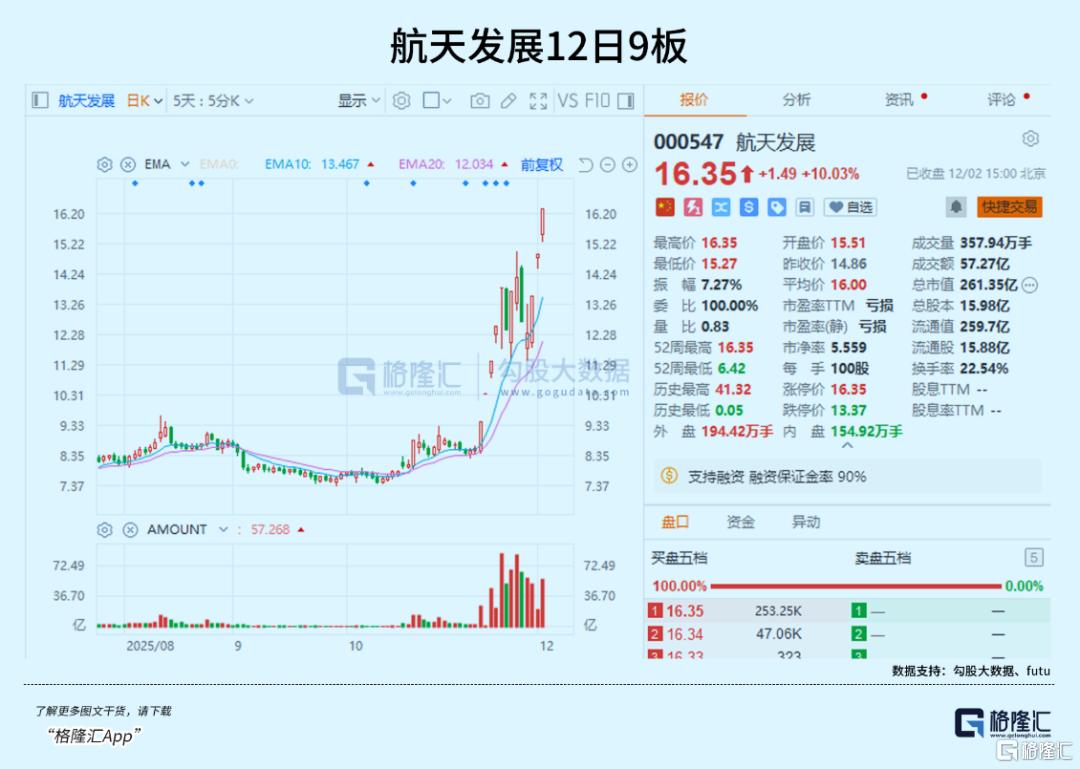
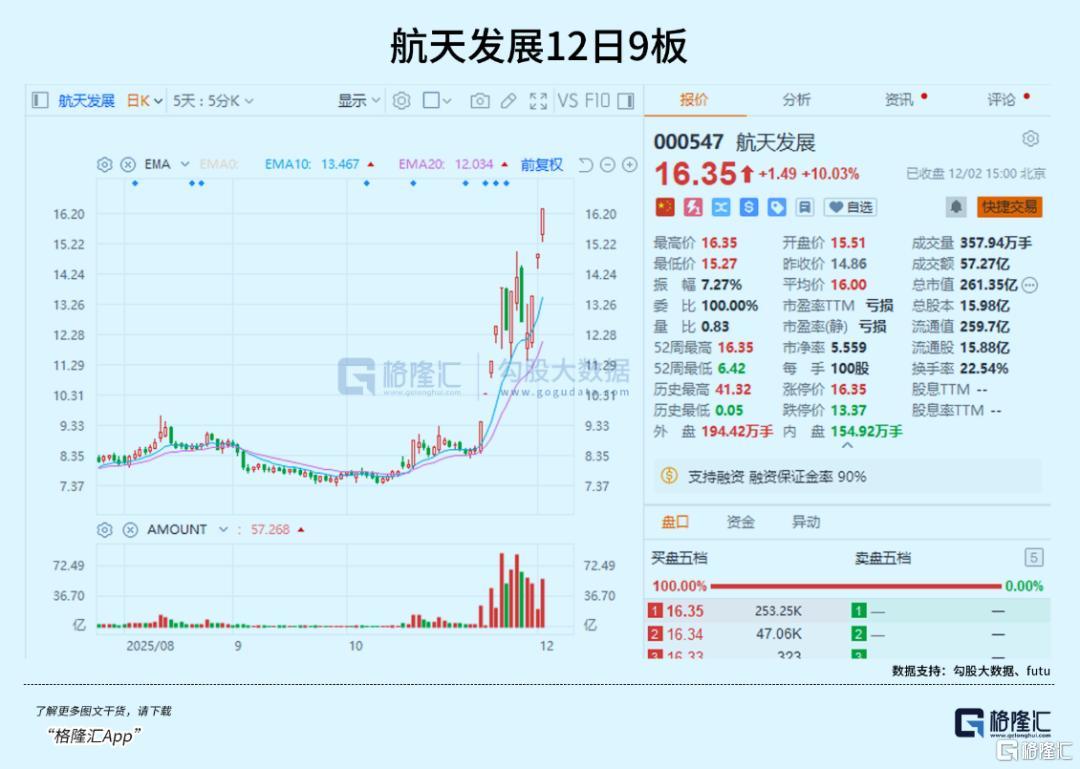
Core Viewpoint - The recent surge in the aerospace and military industry stocks is driven by significant retail investor interest, particularly in companies like Aerospace Development, which has seen multiple trading halts due to price increases amid a broader market decline [1][3][4]. Group 1: Stock Performance and Investor Activity - Aerospace Development has achieved 9 trading halts in the last 12 trading days, with a notable trading volume of 5.727 billion yuan on a single day [1]. - The stock has been heavily traded by well-known retail investors, with significant buying and selling activity recorded on various trading days [4][7]. - Other related stocks such as Aerospace Hanyu, Aerospace Power, and Thunder Defense have also attracted substantial retail investor attention, frequently appearing on trading leaderboards [3]. Group 2: Company Fundamentals - Aerospace Development's largest shareholder is China Aerospace System Engineering Co., Ltd., which indirectly holds approximately 21.02% of the company's shares, providing it with priority access to research and orders [8]. - The company reported a revenue of 1.697 billion yuan for the first three quarters, a year-on-year increase of 42.59%, with Q3 revenue alone reaching 1.008 billion yuan, reflecting a 209.17% increase [11]. - Despite revenue growth, the company has not yet turned a profit, with a net loss of 489 million yuan for the first three quarters, although the loss has narrowed by 43.14% year-on-year [11]. Group 3: Industry Trends and Government Policies - Recent government policies have significantly benefited the aerospace sector, including the National Space Administration's action plan for commercial aerospace development from 2025 to 2027 [16]. - The Ministry of Industry and Information Technology has initiated commercial trials for satellite IoT services, aiming to enhance the satellite communication market and support emerging industries [16]. - The establishment of a dedicated Commercial Aerospace Department by the National Space Administration indicates a shift towards a more structured approach to developing the commercial aerospace industry in China [16]. Group 4: Market Outlook and Challenges - The commercial aerospace industry in China is projected to grow from a market value of 1 trillion yuan in 2020 to 2.3 trillion yuan by 2024, with expectations of reaching 2.8 trillion yuan by 2025 [23]. - Despite the optimistic outlook, challenges remain, including high costs associated with satellite launches and a lack of market demand for satellite applications, which could hinder the industry's growth [20][22]. - The industry is currently experiencing a "threefold resonance" of policy, technology, and market demand, which is expected to create significant investment opportunities [22].

12天9板!游资炒疯了!
格隆汇APP· 2025-12-02 10:22
Core Viewpoint - The article highlights the recent surge in interest and investment in the aerospace sector, particularly in stocks related to commercial space and military aerospace, driven by significant policy support and market speculation [2][14][17]. Group 1: Market Performance - The aerospace and military sector has seen a strong performance, with multiple stocks hitting daily price limits and significant trading volumes, such as Aerospace Development achieving a trading volume of 5.727 billion [2][4]. - Aerospace Development has recorded 9 price limits in 12 trading days, indicating high investor interest and speculation [5][12]. - The stock has been heavily traded by well-known speculative investors, with significant buy and sell amounts recorded [6][9]. Group 2: Company Fundamentals - Aerospace Development reported a revenue of 1.697 billion for the first three quarters, a year-on-year increase of 42.59%, with Q3 revenue alone reaching 1.008 billion, a 209.17% increase [9]. - Despite revenue growth, the company has not yet turned a profit, with a net loss of 489 million for the first three quarters, although losses have narrowed compared to previous periods [9][10]. - The company's gross margin is significantly lower than the industry average, at only 5.09%, indicating potential operational challenges [9]. Group 3: Policy and Industry Outlook - Recent government policies have been favorable for the aerospace sector, including the National Space Administration's action plan for commercial aerospace development from 2025 to 2027 [14][15]. - The establishment of a dedicated regulatory body for commercial aerospace indicates a shift towards a more structured development of the industry [15][17]. - The commercial aerospace market in China is projected to grow significantly, with industry output expected to increase from 1 trillion in 2020 to 2.8 trillion by 2025 [26][27]. Group 4: Investment Opportunities and Risks - The article suggests that while the aerospace sector is currently a hot investment area due to favorable policies and market dynamics, there are underlying risks related to company performance and market conditions [12][28]. - The commercial space industry faces challenges such as high costs and a lack of downstream commercialization, which could impact the realization of profits for companies in the sector [22][24][25].

12天9板!游资炒疯了!
Ge Long Hui A P P· 2025-12-02 10:22
Core Viewpoint - The recent surge in the aerospace and military industry stocks is driven by significant retail investor interest, particularly in companies like Aerospace Development, which has seen multiple trading halts due to price increases amidst a broader market decline [1][15]. Group 1: Stock Performance and Investor Activity - Aerospace Development has achieved 9 trading halts in 12 trading days, with a strong presence of well-known retail investors, making it a focal point in the recent market activity [1][4]. - The stock has seen substantial trading volumes, with a total of 57.27 billion yuan on a single trading day, indicating high investor interest [1]. - Other stocks in the aerospace sector, such as Aerospace Hanyu and Aerospace Power, have also attracted significant retail investor attention, frequently appearing on the trading leaderboard [3]. Group 2: Company Financials and Shareholder Structure - Aerospace Development reported a revenue of 16.97 billion yuan for the first three quarters, a year-on-year increase of 42.59%, with Q3 revenue alone reaching 10.08 billion yuan, reflecting a 209.17% increase [11]. - The company has a major shareholder, China Aerospace System Engineering Co., which holds approximately 21.02% of the shares, providing it with priority access to research and development support and order resources [8][10]. - Despite revenue growth, the company reported a net loss of 4.89 billion yuan for the first three quarters, with a gross margin of only 5.09%, significantly below the industry average of 25% [11][12]. Group 3: Industry Trends and Government Policies - Recent government policies, including the establishment of a dedicated Commercial Aerospace Department, are expected to significantly benefit the aerospace sector, indicating a shift towards a more structured regulatory environment [15][16]. - The National Space Administration's action plan aims to integrate commercial aerospace into the national development framework, enhancing overall industry efficiency [15]. - The commercial aerospace market in China is projected to grow from 1 trillion yuan in 2020 to 2.8 trillion yuan by 2025, highlighting the sector's potential for substantial growth [22]. Group 4: Challenges and Market Dynamics - The aerospace industry faces challenges such as high costs and an imbalanced supply chain, with a concentration of resources in satellite and rocket manufacturing, while downstream applications remain underdeveloped [19][20]. - The current cost of launching commercial satellites is reported to be between 60,000 to 80,000 yuan per kilogram, which constrains profitability for many innovative business models [21]. - Despite these challenges, the combination of policy support, technological advancements, and market demand is expected to create significant investment opportunities in the aerospace sector [22].