奥林帕斯奖

Search documents
全球悬赏!华为重磅出手!两大主攻方向 破解AI数据困局
Zheng Quan Shi Bao Wang· 2025-12-27 06:29
Core Insights - Huawei has launched the 2025 Olympus Mons Awards with a total prize pool of 3 million yuan, aimed at addressing fundamental challenges in data storage and processing amid the AI wave [1][6] - The awards focus on two main directions to systematically build future data infrastructure, from hardware to software [2] Group 1: Focus Areas - Direction One: Innovative medium technologies for the AI era, addressing the transformation of data access patterns and the need for high-performance, cost-effective storage systems [3] - Direction Two: Developing a data foundation for Agentic AI, transitioning storage systems from passive data warehouses to proactive data platforms [4] Group 2: Technical Challenges - The first direction emphasizes overcoming three technical challenges: SSD-based storage-computing integration, high-density storage channel modulation coding, and hierarchical large memory network protocols [3] - The second direction focuses on two key goals: knowledge extraction and multimodal data representation, as well as semantic information refinement for efficient reasoning in large models [4] Group 3: Incentives and Impact - The Olympus Mons Awards will recognize two winners and five pioneers, providing not only monetary rewards but also opportunities for deep technical collaboration with Huawei [6] - Since its inception in 2019, the awards have attracted over 320 top scholars from 12 countries, highlighting their significant impact on the data storage industry [8]


全球悬赏!华为,重磅出手!
券商中国· 2025-12-27 04:39
Core Viewpoint - Huawei has launched the 2025 Olympus Mons Awards with a total prize of 3 million yuan, aiming to gather global intelligence to tackle fundamental challenges in data storage and processing amid the AI wave [1][9]. Group 1: AI Data Transformation - The rapid evolution of AI technology, particularly agent applications, is causing a profound transformation in data, leading to explosive growth in scale and changes in nature, retention methods, and management paradigms [2]. - Traditional data storage systems are increasingly burdened by high computational costs, complex protocol stacks, difficulties in knowledge base construction, and rising storage costs [2][3]. Group 2: Focus Areas of the Awards - The 2025 Olympus Mons Awards focus on two forward-looking directions to systematically build future data infrastructure from hardware to software architecture [4]. - Direction One: Innovative medium technologies for the AI era, addressing the need for new paradigms like "storage-based computation" and exploring high-density information recording and hierarchical large memory technologies [5]. - Specific technical challenges include SSD-based storage-computation integration, storage channel modulation coding for ultra-high recording density, and hierarchical large memory network protocols [6]. - Direction Two: The data foundation for agentic AI, transitioning storage systems from passive data warehouses to proactive, intelligent data platforms, focusing on knowledge extraction and semantic information refinement [7]. Group 3: Incentives for Innovation - To encourage global researchers to engage in these cutting-edge challenges, Huawei has established an attractive reward mechanism, including 2 Olympus Awards and 5 Pioneer Awards, with a total prize pool of 3 million yuan [8]. - Awarded individuals or teams will not only share the prize but also establish deep technical communication channels with Huawei and receive further research resource support [8]. - The evaluation will consider the value of prior research achievements and the proposed follow-up research plans in terms of technological foresight, innovation, and potential commercial value [8]. Group 4: Impact of the Awards - Since its inception, the Olympus Mons Awards have had a significant global impact, attracting over 320 top scholars from 12 countries and awarding 6 Olympus Awards and 18 Pioneer Awards [9]. - Huawei's initiative underscores the importance of solidifying the foundation of data storage and processing in the increasingly competitive AI technology landscape, recognizing innovation value and calling for the co-construction of the next-generation data infrastructure ecosystem [9].

华为,悬红300万元征集!
Zheng Quan Shi Bao· 2025-12-26 13:53
Core Insights - Huawei has officially launched the global call for the 2025 Olympus Mons Awards, marking the sixth year of this global event [1] - The awards aim to address challenges in data processing in the AI era, including high computational costs, complex protocol stacks, knowledge base construction difficulties, and increased storage costs [1] Prize Details - The total prize pool for this year's Olympus Mons Awards remains at 3 million yuan, with two main awards of 1 million yuan each and five Pioneer Awards of 200,000 yuan each [1] - Since its establishment in 2019, the Olympus Mons Awards have attracted over 320 scholars from 12 countries, awarding 6 main awards and 18 Pioneer Awards [1] Previous Winners - The 2024 Olympus Mons Award was awarded to Professor Wu Yongwei's team from Tsinghua University for their innovative "data exchange for computation" technology [2] - Pioneer Awards in 2024 were given to teams from Fudan University, Huazhong University of Science and Technology, Peking University, City University of Hong Kong, and Technical University of Berlin [2] - The 2023 Olympus Mons Award was awarded to teams from ETH Zurich and Shanghai Jiao Tong University, with Pioneer Awards going to teams from National University of Singapore, KAIST, Peking University, and the Institute of Computing Technology, Chinese Academy of Sciences [2]
华为,悬红300万元征集!
证券时报· 2025-12-26 13:17
Core Viewpoint - Huawei has officially launched the global solicitation for the 2025 Olympus Mons Awards, focusing on addressing challenges in data processing in the AI era, including high computational costs, complex protocol stacks, and increased storage costs [2][8]. Group 1: Olympus Mons Awards Overview - The Olympus Mons Awards, established by Huawei in 2019, aims to drive foundational theoretical research in the global data storage field and accelerate the industrialization of research results [8]. - The total prize pool for this year's awards remains at 3 million yuan, with two Olympus Mons Awards of 1 million yuan each and five Pioneer Awards of 200,000 yuan each [5]. Group 2: Challenges for 2025 - The awards will focus on innovative medium technologies for the AI era, addressing issues such as the increasing cost of processing cold and warm data and the need for new paradigms in storage and computation [3]. - Specific challenges include: - Fusion of storage and computation based on SSDs and efficient indexing technology [3]. - Storage channel modulation coding technology for ultra-high recording density [3]. - Hierarchical large memory network protocols and IO path optimization technology [3]. Group 3: Past Achievements - Since its inception, the awards have attracted over 320 scholars from 12 countries, resulting in 6 Olympus Mons Awards and 18 Pioneer Awards being awarded [8]. - Notable past winners include: - The team led by Professor Wu Yongwei from Tsinghua University, awarded the 2024 Olympus Mons Award for their innovative "storage-based computation" technology [8]. - Teams from Fudan University, Huazhong University of Science and Technology, Peking University, and others received the 2024 Pioneer Awards [8][9].

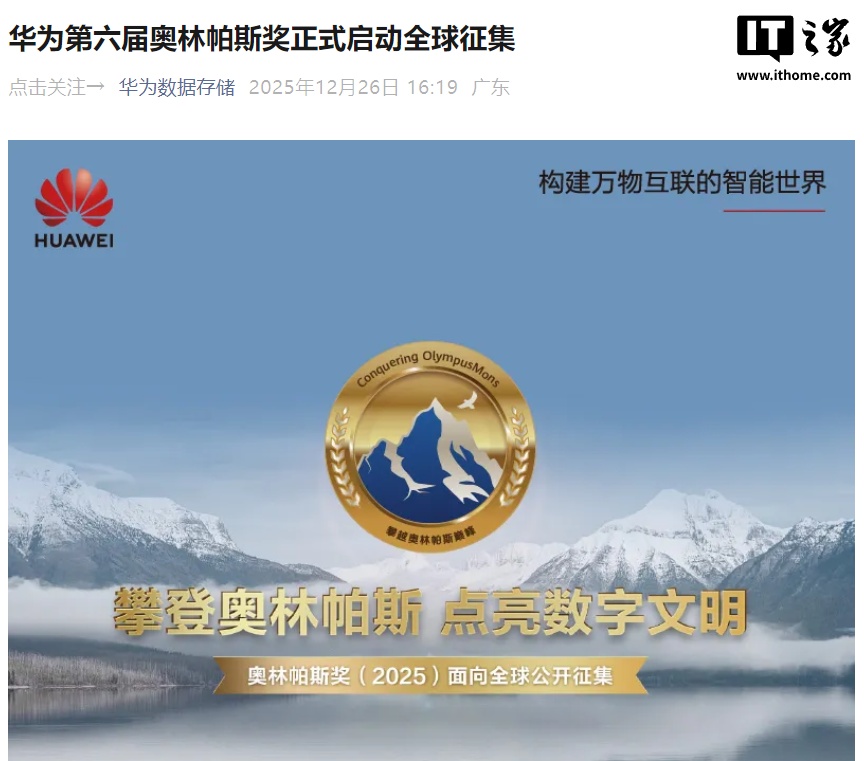
华为悬赏单项最高 100 万元攻克存储技术难题,第六届奥林帕斯奖启动全球征集
Xin Lang Cai Jing· 2025-12-26 12:21
Group 1 - The OlympusMons Awards, established by Huawei in 2019, aim to encourage global researchers in the field of data storage to advance fundamental theoretical research and overcome key technical challenges, facilitating the industrialization of research outcomes and promoting collaboration between academia and industry [3][44] - Since its inception, the awards have attracted over 320 scholars from 12 countries, resulting in the awarding of 6 OlympusMons Awards and 18 Pioneer Awards [3][44] - In 2025, the program will offer 2 OlympusMons Awards, each with a prize of 1 million yuan, and 5 Pioneer Awards, each with a prize of 200,000 yuan, providing winners with opportunities for technical exchange and research support from Huawei [3][44] Group 2 - The 2025 OlympusMons challenges focus on innovative medium technologies for the AI era, addressing the increasing costs of processing cold, warm, and hot data, and promoting high-performance, large-capacity, and cost-effective storage systems [5][46] - The first challenge involves SSD-based computing and efficient indexing technology, emphasizing the need for high-density information recording and hierarchical large memory innovations [5][46] Group 3 - The bandwidth specifications for various storage technologies are as follows: HBM (1-4 TB/s), DRAM (100 GB/s), large capacity (7-32 GB/s), and SSD (costing $0.06 to $15 per GB) [6][47] - The challenges include near-storage computing power limitations due to high arithmetic intensity of operators, which creates performance bottlenecks in storage-computing integration architectures [8][49] - The expansion of SSD capacity leads to increased memory demands for FTL mapping tables, raising power consumption, costs, and reliability issues, which are core technical bottlenecks for SSD scalability [8][49] Group 4 - The second challenge focuses on storage channel modulation coding technology for ultra-high recording density, addressing the need to enhance storage channel capacity density as data scales reach the YB level [11][52] - The goal is to achieve a recording density gain of G≥3 and develop high-reliability detection and decoding technologies with an error rate deterioration of less than 10% [18][59] Group 5 - The third challenge targets hierarchical large memory network protocols and IO path optimization technologies, essential for meeting the demands of Agentic AI, which requires high bandwidth, low latency, and high IOPS [20][60] - The development of a hierarchical large memory system is proposed to overcome limitations and provide a robust storage foundation for Agentic AI applications [20][62] Group 6 - The fourth challenge involves knowledge extraction, multi-modal data representation, and knowledge retrieval technologies, addressing issues such as semantic loss during data transformation and the complexity of multi-modal knowledge alignment [28][72] - The aim is to enhance knowledge extraction completeness and improve semantic understanding consistency, achieving high accuracy in knowledge representation and retrieval [33][73] Group 7 - The fifth challenge focuses on semantic information condensation technology for efficient inference in large models, aiming for an end-to-end storage-computing collaborative information condensation system [34][78] - The objective is to achieve a compression ratio of ≥20 times while maintaining inference accuracy loss of less than 1% and improving throughput by over 5 times [38][79]
华为全球悬赏300万元解决这一难题
新华网财经· 2025-12-26 12:13
Core Viewpoint - Huawei's sixth Olympus Award has been launched with a prize pool of 3 million RMB, focusing on addressing storage challenges in the AI era [1][3]. Group 1: Award Overview - The Olympus Award was established by Huawei in 2019 to guide foundational research in global data storage, overcome key technological challenges, and accelerate the commercialization of research outcomes [3]. - Since its inception, the award has attracted over 320 scholars from 12 countries, resulting in 6 Olympus Awards and 18 Olympus Pioneer Awards being awarded [3]. Group 2: Future Plans - In 2025, two Olympus Awards will be set up, each with a prize of 1 million RMB, along with five Olympus Pioneer Awards, each worth 200,000 RMB [3]. - Awardees will establish technical communication channels with Huawei and receive research support [3]. Group 3: Focus Areas - The current Olympus Award will focus on issues such as high computational costs for data processing, complex protocol stacks, challenges in knowledge base construction, conflicts between inference efficiency and accuracy, and rising storage costs in the context of AI technology development [3].

华为悬赏300万!
国芯网· 2025-12-26 11:12
Core Viewpoint - Huawei has launched the sixth Olympus Award with a total prize of 3 million RMB, focusing on solving storage challenges in the AI era [2]. Group 1: Award Details - The Olympus Award was established in 2019 to drive research in global data storage, attracting over 320 scholars from 12 countries [2]. - In 2025, the award will include 2 Olympus Awards (100,000 RMB each) and 5 Olympus Pioneer Awards (20,000 RMB each) [2]. - Winners will establish technical communication channels with Huawei and receive research support [2]. Group 2: Focus Areas - The award will address issues such as high computational costs, complex protocol stacks, knowledge base construction difficulties, conflicts between inference efficiency and accuracy, and rising storage costs in the AI era [4]. - The first direction focuses on innovative medium technologies for the AI era, including: - Problem 1: SSD-based compute-storage integration and efficient indexing technology [5]. - Problem 2: Storage channel modulation coding technology for ultra-high recording density [7]. - Problem 3: Hierarchical large memory network protocols and IO path optimization technology [9]. - The second direction emphasizes the data foundation for Agentic AI, including: - Problem 4: Knowledge extraction, multimodal data representation, and knowledge retrieval technology [11]. - Problem 5: Semantic information condensation technology for efficient inference of large models [12].