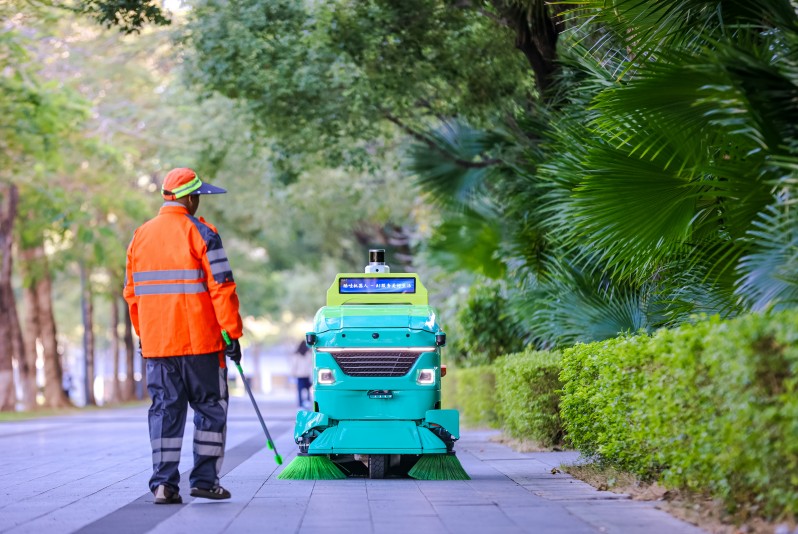
小型机器人R0

Search documents
下一个千亿级风口:Physical AI在街头重新定义城市服务
3 6 Ke· 2025-12-05 03:19
Core Insights - The focus of the article is on the practical application of robots in urban sanitation, highlighting the advancements made by KooWa Robotics in this field, particularly with their new robot model R0, which is designed to handle complex tasks in urban environments [2][4][19]. Group 1: Industry Context - The sanitation industry in China is characterized by labor intensity, recruitment difficulties, high safety risks, and strict operational standards, making it a prime candidate for automation [2][5]. - KooWa Robotics aims to address these industry pain points by focusing on "dirty work" in urban services, thereby enhancing productivity through robotic solutions [2][7]. Group 2: Technological Advancements - KooWa has developed a five-level evolution system for their sanitation robots, with the current capabilities reaching the fourth level, allowing for autonomous operation in various urban environments [10][11]. - The company utilizes a unified Physical AI Model that integrates navigation and operational capabilities, enabling robots to understand and interact with their environment effectively [12][18]. Group 3: Economic Viability - A KooWa AI sanitation robot can perform the work equivalent to 5-10 human workers daily, demonstrating significant economic efficiency [19][20]. - The cost of KooWa's robots has decreased by over 70% due to in-house manufacturing and design, allowing for scalable and economically viable solutions in the sanitation sector [19][20]. Group 4: Market Potential - The sanitation automation market is projected to grow significantly, driven by urbanization, aging populations, and rising labor costs, creating a stable demand for robotic solutions [25][26]. - KooWa's advancements position it to lead in establishing a standardized and scalable sanitation system, potentially influencing global standards in the robotics industry [26][27].