
川北薅草锣鼓

Search documents
川北田间的千年“BGM”,太上头!
Xin Lang Cai Jing· 2026-01-12 18:00
Core Viewpoint - The article highlights the cultural significance and historical roots of the "Chuanbei Hao Cao Luo Gu," a traditional folk art form in the Chuanbei region, recognized as a national intangible cultural heritage, which serves as both a labor accompaniment and a reflection of local agricultural practices and community spirit [6][10]. Group 1: Historical Background - The origins of Chuanbei Hao Cao Luo Gu are not definitively known, but it is believed to have started during the Qin Dynasty and flourished in the late Yuan to early Ming Dynasties, as indicated by folk manuscripts from the late Qing to the Republic of China [6][10]. - The art form is closely tied to the agricultural practices in the Chuanbei mountainous region, particularly during the summer when farmers gather to harvest crops, making it an essential part of collective labor [7][10]. Group 2: Artistic Elements - Chuanbei Hao Cao Luo Gu integrates percussion, storytelling, and folk literature, with instruments like gongs, drums, and cymbals forming the core ensemble, where the drum acts as the conductor of rhythm [8][10]. - The performance structure is intricately linked to the labor process, consisting of seven parts that guide the rhythm of work, including calling workers, offering prayers, and celebrating the completion of tasks [9][10]. Group 3: Cultural Significance - This folk art not only serves as a labor accompaniment but also embodies the agricultural wisdom and cultural memory of the Chuanbei region, reflecting the integration of local ethnic elements in its melodies and lyrics [10][11]. - Recognized as a living fossil of ancient Chinese agricultural civilization, Chuanbei Hao Cao Luo Gu was included in the first batch of national intangible cultural heritage lists in 2006, emphasizing its importance in the study of Chinese folk music history [10][11]. Group 4: Preservation Efforts - Despite the decline in its prevalence due to agricultural mechanization, efforts to preserve and promote Chuanbei Hao Cao Luo Gu continue through educational initiatives in schools and community performances that engage younger generations [11].

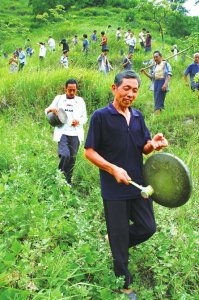
庄稼人的劳动号子(说说我家乡的非遗)
Ren Min Ri Bao· 2025-07-07 22:28
Group 1 - The article highlights the cultural significance of the Chuanbei grass-harvesting gong drum, which has been preserved as a national intangible cultural heritage since 2006, reflecting the agricultural labor and traditions of local farmers [1] - The rhythmic connection between the gong drum sounds and the labor of farmers is emphasized, showcasing how the beats align with the physical effort of farming, creating a deep-rooted cultural expression [1] - The transition from traditional farming tools to modern machinery is noted, yet the essence of the traditional rhythms remains ingrained in the community, symbolizing the enduring connection to their agricultural heritage [2] Group 2 - The narrative illustrates the generational shift in labor, with the son operating machinery while still feeling a connection to the traditional sounds of farming, indicating a blend of old and new practices [2] - The article conveys that as long as the land is cultivated and farmers continue to work, the traditional gong drum songs will persist as an integral part of their identity and daily life [2]