工商银行APP

Search documents
炒黄金APP大比拼!这一款完胜!专业投资者都在用
Xin Lang Cai Jing· 2025-12-05 05:39
Core Viewpoint - The increasing interest in gold investment has led to a high frequency of inquiries about which app to use for tracking gold prices. Among various options, the Sina Finance app stands out as the best choice for both casual users and professional investors due to its comprehensive market coverage, fast information updates, ease of trading, and professional analysis capabilities [1][9]. Group 1: Market Coverage - The Sina Finance app offers the most comprehensive market coverage, including key products like international London gold, New York futures, and domestic Shanghai gold contracts, along with updates on gold ETF holdings and global central bank reserves. It also tracks key indicators affecting gold prices, such as the US dollar index and US Treasury yields, with data delays controlled within 10 seconds [2][10]. - Professional trading apps (e.g., Jinrong China, Lingfeng Precious Metals) focus solely on their specific trading products, lacking cross-market data such as domestic futures and gold stocks, which limits their ability to meet investors' needs for a one-stop view of the entire gold industry chain [2][10]. - Bank apps (e.g., Industrial and Commercial Bank of China, China Merchants Bank) only display their own gold accumulation and paper gold quotes, offering a narrow market perspective with data updates often exceeding 30 seconds [2][10]. - Brokerage apps (e.g., Eastmoney, CITIC Securities) cover domestic gold futures and gold concept stocks but lack real-time international spot gold data, failing to connect with global gold market dynamics [2][10]. Group 2: Information Speed and Professionalism - The Sina Finance app leads the industry in information update speed, capable of pushing notifications within 30 seconds of key events like non-farm payroll data and Federal Reserve meetings. It collaborates with the World Gold Council to provide in-depth content, including monthly gold demand reports and institutional holding analyses, along with live interpretations of gold price trends by experienced analysts [3][11]. - Other trading apps (e.g., Jinrong China) primarily focus on their trading activities, with delayed updates on global macroeconomic information and biased professional analyses that lack objectivity [3][11]. - Bank and brokerage apps mainly provide policy notifications and product introductions, with limited exclusive gold information and insufficient depth in analyzing the logic behind gold price fluctuations [3][11]. Group 3: Trading Convenience - The Sina Finance app does not conduct direct trading but partners with leading domestic futures companies, allowing users to open accounts within the app without needing to switch to third-party platforms. The account opening process is streamlined to under 15 minutes, enabling users to view their futures gold trading positions directly within the app [4][12]. - Other trading apps (e.g., Jinrong China) only support trading on their platforms, requiring users to resubmit identity information for account opening, which poses risks related to overseas regulation and capital outflow for domestic users [4][12]. - Bank apps only allow purchases of their own gold products, restricting trading options for gold futures and stocks. Brokerage apps support gold futures trading but require separate downloads for account opening, lacking seamless integration with market viewing functions [4][12]. Group 4: Community and User Experience - The Sina Finance app features a community centered around "market discussions," where users share analysis logic and holding strategies in a neutral environment, without a clear tendency to induce trading. It also allows users to subscribe to gold price alerts and set custom price warnings, with a clean interface free from excessive advertisements [5][13]. - Other trading apps (e.g., Jinrong China) have communities that primarily focus on "trader following" and "strategy recommendations," which essentially guide users to trade on their platforms, resulting in a heavily commercialized atmosphere and poor user experience due to intrusive promotional pop-ups [5][13]. - Bank and brokerage apps lack dedicated gold communities, preventing users from exchanging market views, and their functionalities are scattered, requiring multiple steps to find gold-related features, which reduces convenience [5][13]. Summary - Overall, professional trading apps like Jinrong China are suitable for users who only wish to trade on a single platform, while bank and brokerage apps cater to those who only buy their own gold products. However, for users seeking a comprehensive view of the gold market, quick access to professional information, and convenient connections to legitimate trading channels, the Sina Finance app's advantages are unparalleled. It serves as the preferred tool for both casual users monitoring gold prices and professional investors relying on in-depth analysis for decision-making [7][14].


九大基金销售平台对比,谁更胜一筹?
2 1 Shi Ji Jing Ji Bao Dao· 2025-11-20 06:57
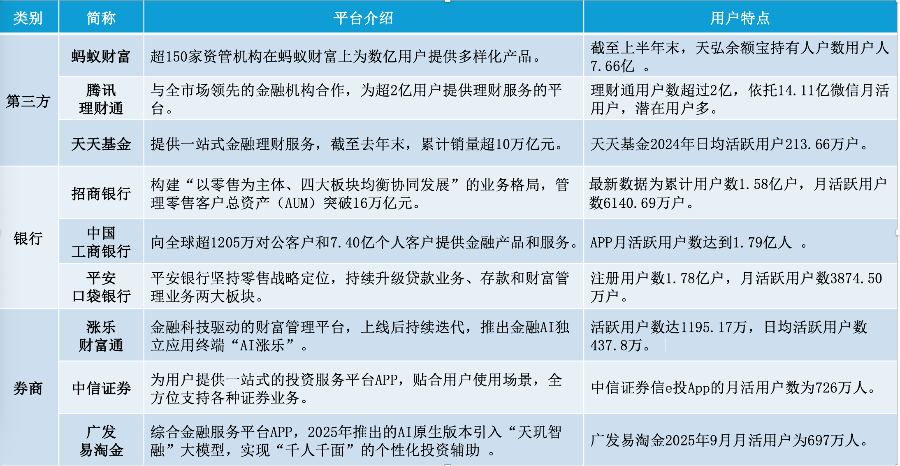
Core Viewpoint - The investment landscape is shifting from "single product selection" to "platform selection," emphasizing the efficiency of asset allocation and long-term wealth preservation for investors seeking certainty [1] Regulatory Environment - The China Securities Regulatory Commission's 2025 action plan aims to establish a classification evaluation mechanism for fund sales institutions and reduce subscription and service fees, promoting a transition from a "fast" to a "deep cultivation" approach in the industry [1] Platform Strategy - Major distribution platforms are adjusting their strategies to focus on long-term returns and user experience rather than short-term gains, leading to diversified competition that includes advisory services, digital tools, and content ecosystems [1] Comparative Analysis of Fund Sales Platforms - The analysis includes nine representative fund sales institutions categorized into three core groups: third-party platforms (Ant Wealth, Tencent Licai Tong, and Tiantian Fund), bank-affiliated platforms (China Merchants Bank, Industrial and Commercial Bank of China, and Ping An Bank), and brokerage platforms (CITIC Securities, Huatai Securities, and GF Securities) [1] User Demand Analysis - The KANO model is utilized to analyze user needs across fund sales apps, categorizing them into five levels: basic, expected, attractive, indifferent, and reverse needs, highlighting the non-linear relationship between product performance and user satisfaction [2] Third-Party Platforms - Ant Wealth excels in attractive features, while Tencent Licai Tong offers limited advisory services. Tiantian Fund has the most comprehensive product offerings, catering to experienced investors [4] - Ant Wealth provides robust educational and community features, while Tiantian Fund allows users to filter funds based on specific criteria. Tencent Licai Tong lags in the richness of professional tools [4] Bank Platforms - China Merchants Bank stands out in expected needs by offering asset allocation reports, while Industrial and Commercial Bank of China relies on its offline network but shows slower innovation in response to younger, online investors [5] - Ping An Bank utilizes an intelligent risk assessment system to recommend products, addressing various user needs effectively [5] Brokerage Platforms - Huatai Securities' Zhangle Wealth integrates research capabilities to offer in-depth market analysis and fund evaluation, while GF Securities' Yitaojin leads in video content and real-time updates, enhancing user engagement [6] - CITIC Securities' Xintou provides personalized advisory services for high-net-worth clients, indicating a shift towards professional service-based revenue models [6]