
平安惠享纯债

Search documents
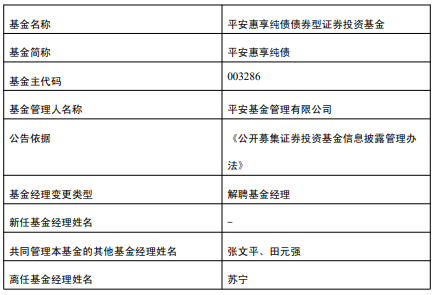
苏宁离任平安惠享纯债
Zhong Guo Jing Ji Wang· 2025-11-21 07:47
Group 1 - Ping An Fund announced the departure of fund manager Su Ning from Ping An Huixiang Pure Bond Fund [1][2] - Su Ning has a background as a fixed income trader and researcher, having previously worked at E Fund Management Co., Ltd. before joining Ping An Fund in June 2019 [1] - The Ping An Huixiang Pure Bond Fund was established on October 27, 2016, with various share classes showing year-to-date returns of 2.51%, 2.19%, and 2.57%, and cumulative net values of 1.3225, 1.1544, and 1.1771 respectively [1] Group 2 - The fund is managed by Ping An Fund Management Co., Ltd., and the announcement was made in accordance with the "Publicly Raised Securities Investment Fund Information Disclosure Management Measures" [2] - The fund manager change is classified as the dismissal of the fund manager, with Zhang Wenping and Tian Yuanqiang listed as co-managers [2]

6000亿规模养不起一个APP!平安基金关停直销APP背后的固收之困
Sou Hu Cai Jing· 2025-08-12 10:13
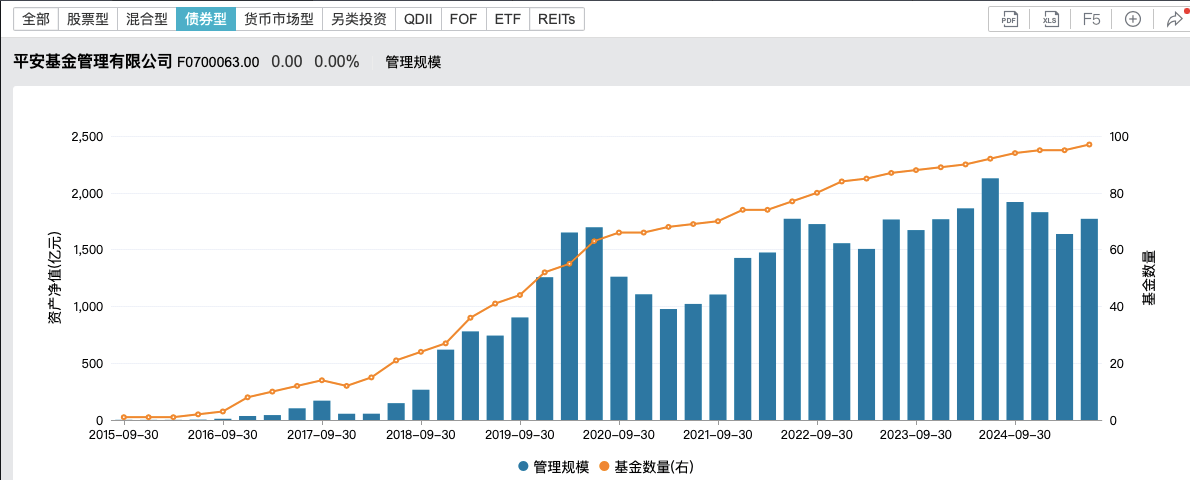
Core Viewpoint - Ping An Fund announced the suspension of its APP operations starting August 31, 2025, migrating all functionalities to its official website and WeChat service account, reflecting a broader trend among public fund companies to cut costs and improve efficiency [1][3][6]. Group 1: Company Strategy and Performance - Ping An Fund, managing assets of approximately 650 billion yuan, has struggled with customer stickiness and a lack of diverse product offerings, leading to the decision to shut down its direct sales APP [2][8]. - The company has been following a "fixed income first, equity second" strategy since 2015, which has resulted in a heavy reliance on fixed income products, causing challenges in expanding its equity product line [10][24]. - As of June 2025, Ping An Fund's total scale was about 656 billion yuan, with fixed income products accounting for a significant portion of its assets [13][14]. Group 2: Market Trends and Comparisons - The trend of public funds shutting down their APPs has been growing since 2019, with nearly 20 companies following suit, indicating a shift in the industry towards cost-cutting measures [4][5]. - Ping An Fund's closure of its APP is seen as a rational choice amid rising cost pressures and a shrinking market for direct sales channels [7][24]. - The company has not capitalized on the growth of the domestic ETF market, with its ETF product scale lagging behind leading fund companies [17]. Group 3: Financial Insights - The decline in total scale is attributed to a significant drop in bond fund sizes, which fell from 212.7 billion yuan to 163.7 billion yuan over a year, highlighting the challenges faced by the company [15]. - The management fees for equity funds are generally higher than those for fixed income funds, which impacts the overall profitability of Ping An Fund, as its equity product offerings remain limited [20][21]. - The shift in investor composition for the Ping An Hui Xiang Pure Bond fund indicates a growing reliance on institutional investors, raising concerns about the sustainability of its retail investor base [22][23].
平安惠享纯债两次 “定向优惠”:平安基金的“机构依赖症”凸显
Sou Hu Cai Jing· 2025-08-07 10:20
Core Viewpoint - The recent fee adjustment by Ping An Fund, which offers preferential redemption rates, highlights the company's deep reliance on institutional clients, raising concerns about fairness and potential risks in its business model [1][4][11]. Group 1: Fee Adjustment and Its Implications - Ping An Fund announced a preferential redemption fee for its Ping An Huixiang Pure Bond Fund, effective from August 1 to 31, targeting only specific institutional clients through direct sales channels, which are less utilized by retail investors [4][10]. - The fund's A-class shares have a staggering 99.67% held by institutions, with a significant redemption of 263 million shares by institutions during the reporting period [4][9]. - The original redemption fee was 0.05%, but with the discount, it drops to 0.0125%, saving a specific institution approximately 231,000 yuan, which raises fairness concerns for retail investors [8][10]. Group 2: Institutional Dependence - Ping An Fund's reliance on institutional clients is evident, with 31 of its 210 funds having 100% institutional holdings, and 67 funds with over 90% institutional holdings [11][14]. - The high proportion of institutional investments can lead to significant volatility in fund sizes if these clients withdraw their investments, posing a risk of fund liquidation [14]. - The company’s strategy of depending on institutional clients for scale may undermine its ability to attract retail investors, creating a cycle of institutional dominance and retail disengagement [14]. Group 3: Market Position and Future Outlook - Despite the potential regulatory gray areas surrounding the fee adjustments, Ping An Fund has not explicitly violated any regulations, but the adjustments may encourage concentrated redemptions by institutions, impacting net asset values [10][11]. - The company faces a critical decision on whether to continue its reliance on institutional clients or to enhance its appeal to retail investors, which will be crucial for its long-term competitiveness in the market [14].
