平安2号卫星

Search documents
3家股份银行的卫星先后上天 除了楼盘风险监测,还有什么神通?
Mei Ri Jing Ji Xin Wen· 2026-01-25 12:44
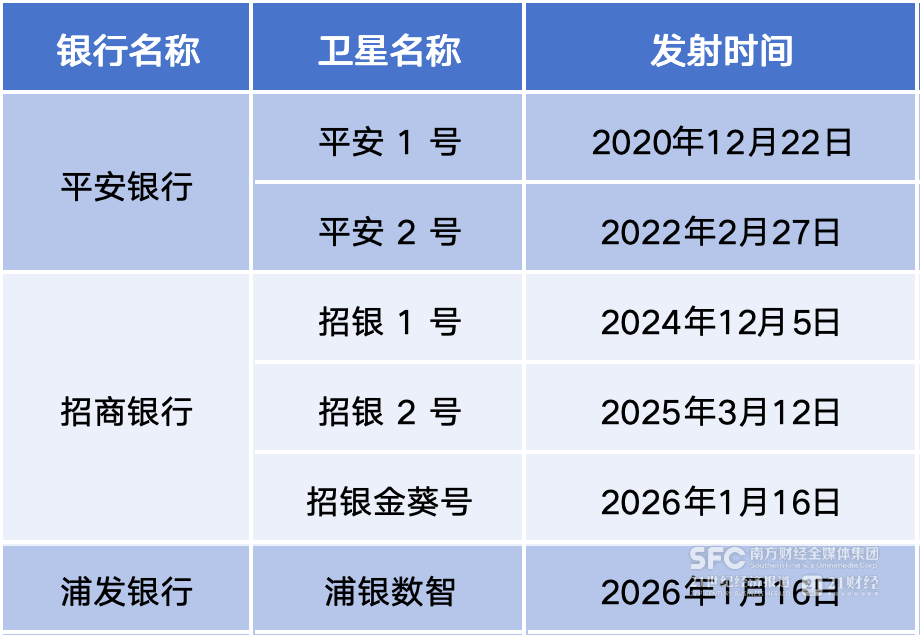
Core Viewpoint - The successful launch of "Zhaoyin Jinkui" and "Puyin Shuzhi" satellites marks a significant advancement in the banking sector's integration of satellite technology, enhancing financial services and risk management capabilities [1][2]. Group 1: Satellite Launches and Applications - The "Zhaoyin Jinkui" satellite and "Puyin Shuzhi" satellite are part of China's first global low-orbit satellite IoT constellation, "Tianqi Constellation," developed by Beijing Guodian Gaoke Technology Co., Ltd [1]. - Prior to this, China Merchants Bank launched "Zhaoyin 1" and "Zhaoyin 2" satellites in 2024 and 2025, respectively, while Ping An Bank launched "Ping An 1" and "Ping An 2" in 2020 and 2022 [1][2]. - The satellites are utilized in various fields such as supply chain finance, real estate risk monitoring, and cross-border asset and trade supervision, creating a digital risk control system and emergency communication network [1][2]. Group 2: Specific Applications and Innovations - Ping An Bank's "Ping An 1" satellite enables data transmission from remote areas, enhancing the bank's ability to monitor operational data from factories and farms [2]. - The "Ping An 2" satellite improves communication stability and helps the bank access real-time supply chain data, thereby enhancing its financial service capabilities [2][3]. - China Merchants Bank employs satellite technology for high-precision monitoring of real estate construction progress, achieving over 95% accuracy in risk management for mortgage projects [4]. Group 3: Emergency Communication and Risk Management - The banks emphasize the importance of satellite communication for emergency scenarios, allowing data transmission even in areas without ground signal coverage [6]. - China Merchants Bank has initiated tests for low-orbit satellite communication technology in its financial disaster recovery systems, enhancing business continuity in extreme situations [6]. - Ping An Bank and Shanghai Pudong Development Bank plan to leverage the "Tianqi Constellation" for innovative applications in financial asset lifecycle management and rapid recovery of essential financial services during disasters [6]. Group 4: Industry Trends and Future Directions - The banking sector's investment in satellite technology aligns with the rapid development of China's commercial space industry, with banks exploring various applications to enhance service delivery and reduce costs [7]. - China Merchants Bank's subsidiary has initiated the first domestic SPV satellite leasing business, addressing the financing needs of commercial space enterprises [7]. - Other banks, such as Industrial and Commercial Bank of China and Xingye Bank, are also integrating satellite remote sensing technology into their operations to improve risk management and monitoring capabilities [8].



尾焰划破夜空 金融机构为何爱上“发卫星”
2 1 Shi Ji Jing Ji Bao Dao· 2026-01-21 08:05
Core Viewpoint - The recent successful launch of satellites by major banks in China, including China Merchants Bank and Shanghai Pudong Development Bank, signifies a strategic shift towards utilizing satellite technology for enhancing financial services and risk management in the banking sector [1][2][3]. Group 1: Satellite Launches and Their Purpose - China Merchants Bank and Shanghai Pudong Development Bank have joined Ping An Bank in launching satellites, indicating a trend among banks to leverage space technology for business needs [2][4]. - The satellites are part of the "Tianqi Constellation," which aims to provide global coverage and enhance communication capabilities, thereby improving data transmission and supporting more devices [4][5]. - The "Zhaoyin Jinkui" satellite launched by China Merchants Bank is designed to enhance the density of the satellite constellation and reduce revisit intervals, which will significantly improve global communication capabilities [4][5]. Group 2: Business and Risk Management Enhancements - Banks are utilizing remote sensing satellite technology for precise monitoring of collateral and project progress, which enhances post-loan management efficiency and reduces credit risk [3][7]. - The integration of satellite technology into financial risk control systems allows banks to monitor real-time data from various sectors, addressing information asymmetry in lending [7][8]. - For instance, China Merchants Bank has implemented a high-precision construction monitoring system for mortgage projects, achieving over 95% accuracy in monitoring construction progress [8]. Group 3: Applications in Supply Chain and Disaster Recovery - Satellite technology is crucial for expanding supply chain finance by providing timely and effective data transmission, especially in remote areas where traditional communication may fail [9][10]. - In extreme scenarios, such as natural disasters, satellite communication ensures business continuity for banks by maintaining service availability when ground networks are disrupted [11][12]. - The banks' involvement in satellite launches also aligns with national strategies, enabling them to support the commercial space industry while enhancing their service offerings [12][13]. Group 4: Broader Industry Implications - The trend of banks launching satellites is not limited to a few institutions; it is gradually permeating various banking operations, enhancing risk management capabilities across sectors like agriculture and logistics [13][14]. - The adoption of satellite remote sensing technology is becoming a standard practice in the banking industry, reflecting a shift towards innovative financial services that integrate advanced technologies [14].