
平板卫星

Search documents
商业航天大年来了 广东、山东等多个地方争相布局
2 1 Shi Ji Jing Ji Bao Dao· 2026-02-09 23:21
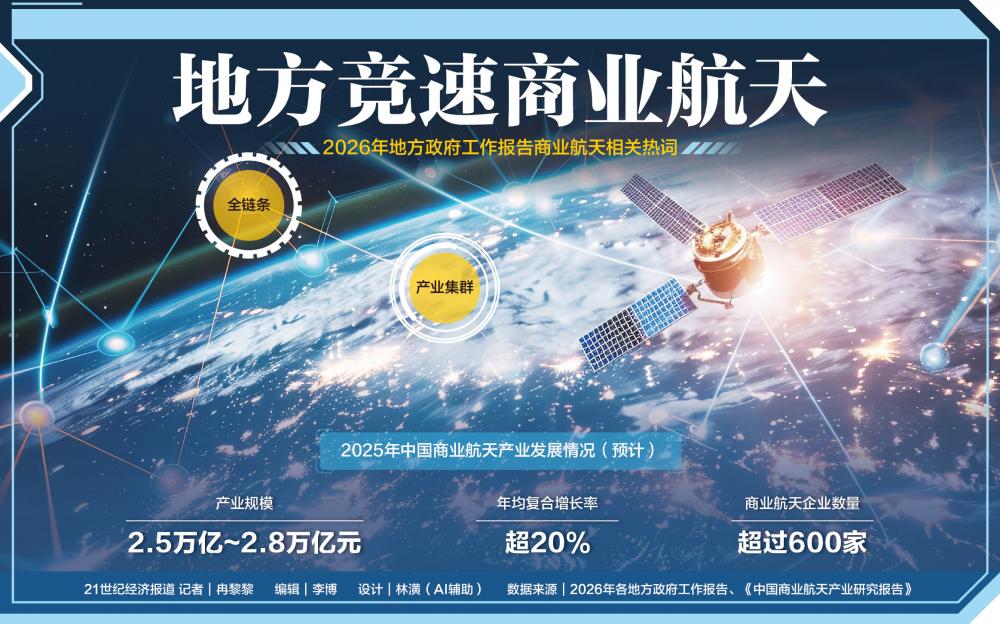
Core Insights - The Chinese government is accelerating the development of a strong aerospace industry, with a focus on commercial aerospace as a key emerging pillar industry by 2026 [2][3] - Over 20 provinces have initiated discussions on commercial aerospace in their local government work reports, with many explicitly mentioning aerospace-related industries [2][3] - Key themes in local government plans include "full chain" and "industrial clusters," addressing the current shortcomings in collaboration and technology within the commercial aerospace sector [2][4] Full Chain Development - Guangdong aims to achieve breakthroughs in key technologies across various fields, including commercial aerospace, by 2026, targeting a scale of 300 billion yuan for its commercial aerospace and related industries [4] - Beijing has established over 210 commercial aerospace-related companies and plans to enhance its infrastructure, including a commercial aerospace measurement and control center [4] - The full chain approach is seen as essential for improving overall industry efficiency and reducing reliance on external supply chains [6] Industrial Cluster Development - Zhejiang is focusing on developing emerging pillar industries, including aerospace, with a goal for strategic emerging industries to account for approximately 35% of industrial output by 2026 [8] - Shandong is promoting four key emerging industries, including aerospace, and aims to integrate the Yantai Oriental Aerospace Port into the national commercial aerospace framework [9] - Local governments are encouraged to leverage their unique resources and capabilities to foster collaboration and avoid redundant developments in the aerospace sector [10] Industry Challenges and Innovations - The commercial aerospace industry in China is projected to reach a scale of 2.5 to 2.8 trillion yuan by 2025, with an annual growth rate exceeding 20% and over 600 companies involved [3] - Key challenges include high entry barriers, insufficient industry collaboration, funding gaps, and limited application scenarios [5] - Companies like Galaxy Aerospace and Hongqing Technology are focusing on technological innovation and the development of satellite communication technologies to address industry pain points [11][12]

地方竞速商业航天
21世纪经济报道· 2026-02-04 04:56
Core Viewpoint - The article emphasizes the significant attention and expectations surrounding the development of China's commercial aerospace industry by 2026, driven by government initiatives and local policies aimed at fostering a comprehensive industrial ecosystem [1][4]. Group 1: Full Chain Layout - The concept of "full chain" is highlighted as a key strategy in various provinces, aiming to enhance the development of critical technologies in commercial aerospace and related fields [5][6]. - Guangdong aims for a comprehensive push in key technologies related to low-altitude and commercial aerospace by 2026, targeting an industry scale of 300 billion yuan [5]. - Beijing has established over 210 commercial aerospace-related enterprises and plans to significantly increase its rocket launch capacity by 2025, aiming for 90% of national commercial rocket launches [5][6]. Group 2: Industry Cluster Development - The term "industry cluster" is another focal point, with provinces like Zhejiang and Shandong emphasizing the development of emerging industries, including aerospace, to enhance regional economic growth [10][11]. - Shandong's Eastern Aerospace Port is noted as China's only commercial maritime launch base, with plans to support the entire aerospace industry chain and facilitate the launch of 137 satellites [10]. - Local governments are encouraged to leverage their unique resources and industrial bases to foster collaboration and avoid redundant construction, thereby creating a distinctive and complementary commercial aerospace development landscape [11]. Group 3: Corporate Initiatives - Companies are recognized as crucial players in advancing the aerospace industry, with specific firms like Tianbing Technology and Tianzhang Satellite receiving support to enhance their capabilities [12]. - Innovations in technology are being prioritized, with companies like Galaxy Aerospace focusing on developing satellite technology that connects directly to mobile phones, aiming for mass production of key devices [12][13]. - Hongqing Technology is also concentrating on integrating satellite platforms and rockets, enhancing efficiency in system delivery and communication networks [13].
商业航天大年来了 广东、山东、浙江等10多个地方争相布局
2 1 Shi Ji Jing Ji Bao Dao· 2026-02-03 23:49
Core Insights - The "14th Five-Year Plan" emphasizes the acceleration of building a strong aerospace nation and the development of strategic emerging industries, including aerospace [1][14] - By 2026, the goal is to establish aerospace as a new pillar industry, with significant attention on commercial aerospace development [1][14] - Over 20 provinces have initiated local meetings, with about half directly or indirectly addressing commercial aerospace in their government work reports [1][16] Full Chain Layout - The Chinese commercial aerospace industry is projected to reach a scale of 2.5 to 2.8 trillion yuan by 2025, with an annual compound growth rate exceeding 20% and over 600 companies in the sector [3][16] - Key terms in local government plans include "full chain" and "industrial clusters," with Guangdong aiming for breakthroughs in core technologies related to low-altitude and commercial aerospace by 2026 [4][17] - Beijing has established over 210 commercial aerospace-related enterprises, with plans for significant increases in launch activities by 2025 [4][17] Industrial Clusters Development - Zhejiang aims to support the development of emerging industrial clusters, including aerospace, with a target for strategic emerging industries to account for 35% of industrial output [9][21] - Shandong is focusing on building a commercial aerospace industry cluster around the Dongfang Aerospace Port, which has launched 137 satellites [10][22] - Local governments are encouraged to leverage their unique resources and capabilities to develop aerospace technologies and industries in a coordinated manner [11][23] Challenges and Recommendations - The industry faces challenges such as high entry barriers, insufficient collaboration, funding gaps, and limited application scenarios [6][19] - Recommendations include enhancing the policy framework, improving infrastructure, and fostering innovation in business models to support the industry's growth [20] - The need for a comprehensive ecosystem that integrates the entire aerospace value chain is emphasized to enhance competitiveness and reduce dependency on external supply chains [20] Company Initiatives - Companies like Tianbing Technology and Tianzhang Satellite are being supported to grow and enhance their capabilities in the commercial aerospace sector [12][24] - Innovations in satellite technology, such as mobile direct satellite communication, are being pursued by companies like Galaxy Aerospace [12][24] - Hongqing Technology is focusing on integrating satellite platforms and rockets to improve efficiency and delivery capabilities [13][25]
商业航天大年来了!广东、山东、浙江等已出手
2 1 Shi Ji Jing Ji Bao Dao· 2026-02-03 12:21
Core Insights - The Chinese government is accelerating the development of a strong aerospace industry, with a focus on commercial space by 2026, as highlighted in the "14th Five-Year Plan" and various local government reports [1][2] - Over 20 provinces have initiated discussions on commercial aerospace, with approximately half directly addressing related industries in their government work reports [2][3] - Key themes in local government plans include "full-chain" and "industry clusters," aiming to address existing challenges in the commercial aerospace sector [1][3] Full-Chain Development - Guangdong aims to achieve breakthroughs in key technologies across various fields, including commercial aerospace, by 2026, targeting a scale of 300 billion yuan for its aerospace and related industries [3] - Beijing has established over 210 commercial aerospace companies and plans to enhance its infrastructure, including a commercial space launch center, to support significant increases in launch activities by 2025 [3][4] - The need for a comprehensive policy framework and improved collaboration within the industry is emphasized to overcome existing challenges such as high costs and reliance on foreign technology [4][6] Industry Cluster Development - Zhejiang is focusing on developing emerging industries, including aerospace, with a goal for strategic emerging industries to account for 35% of industrial output by 2026 [8] - Shandong is promoting its commercial aerospace capabilities, particularly through the Dongfang Spaceport, which has launched 137 satellites, and aims to create a comprehensive aerospace industry chain [9] - Local governments are encouraged to leverage their unique resources and capabilities to foster innovation and avoid redundant developments in the aerospace sector [10] Company Initiatives - Companies like Tianbing Technology and Tianzhang Satellite are being supported by local governments to enhance their capabilities in the commercial aerospace sector [11] - Galaxy Aerospace is focusing on technological innovation, particularly in satellite technology that allows direct mobile connectivity, and aims to accelerate production and development [11][12] - Hongqing Technology is prioritizing innovation in satellite platforms and aims to integrate various systems to improve efficiency in satellite and rocket operations [12]
银河航天创始人董事长兼CEO徐鸣:太空科创时代的发展迎来历史机遇期
Cai Jing Wang· 2025-07-24 23:05
Industry Insights - The construction of space infrastructure is emerging as a new engine for global economic growth, with the global space economy expected to reach $1 trillion by 2040 and its broader economic and social value projected at approximately $7.9 trillion, resulting in a cumulative impact of over $80 trillion from 2025 to 2040 [1] - The number of satellites in orbit has surpassed 13,000, primarily consisting of low Earth orbit communication satellites, characterized by constellation, scale, low cost, and low orbit [1] - The integration of technology, industry, and finance is crucial for the success of technological revolutions, with a multi-layered financial innovation system providing strong momentum for the transformation of industries such as smart manufacturing and commercial aerospace [1] Company Developments - The company has consistently focused on technological innovation and rapid iteration, achieving several pioneering innovations, including the first domestic flexible solar wing flat satellite and the first batch of low Earth orbit broadband communication satellites [2] - The company has developed the world's first large-scale rollable fully flexible solar wing, which reduces the volume and weight of solar wings while increasing energy density to meet high-power energy demands for satellites [2] - The fully flexible solar wing can be deployed in orbit, expanding to over 10 meters in length and nearly 2 meters in width, while being compact enough to fit within the diameter of a thermos when rolled up [2] Financial Support and Innovation - The financial support system for innovation in China is continuously improving, with enhanced efficiency and service levels, facilitating the integration of technology and industry [3] - The company emphasizes the importance of long-term commitment to technological innovation, believing that continuous breakthroughs and the synergy between industry and finance will lead to broader development opportunities in the space technology era [3] - The company is recognized as a leading satellite internet solution provider and satellite manufacturer in China, being the first unicorn in the commercial aerospace sector, having successfully launched 25 advanced satellites [3]