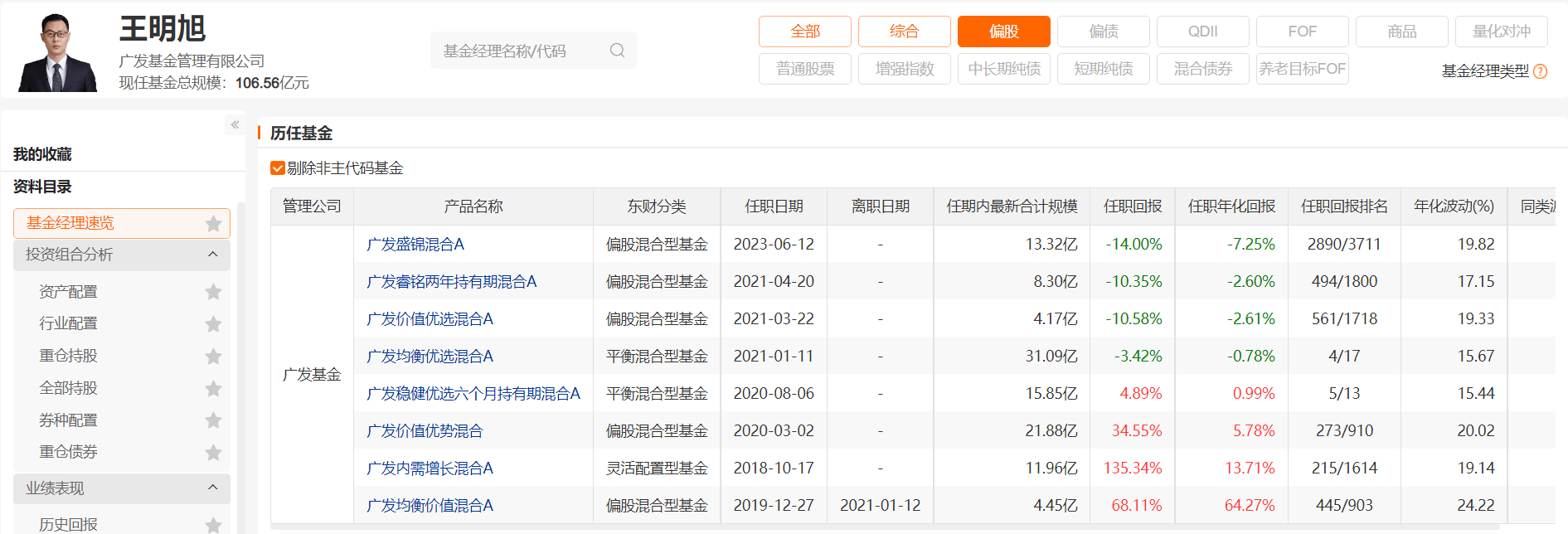
广发盛锦混合

Search documents
广发基金4产品高位发行难解套 广发兴诚混合累计亏5成
Zhong Guo Jing Ji Wang· 2026-02-10 08:06
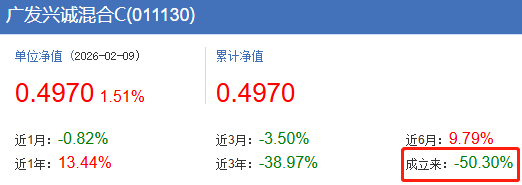
Core Insights - The article discusses the performance of actively managed equity funds established in 2021, revealing that over 50% of these funds have not returned to their initial investment levels, with significant losses reported [1] Fund Performance - A total of 667 actively managed equity funds established in 2021 were analyzed, with approximately 362 funds showing negative returns since inception, representing over 54% of the sample [1] - Among these, 86 funds have experienced declines of over 30%, and 34 funds have seen declines exceeding 40% [1] - Specifically, four funds from GF Fund Management established in 2021 have reported cumulative losses greater than 40% [1] Specific Fund Details - The worst-performing fund, GF Xingcheng Mixed C/A, has a cumulative return of -50.30% since its inception on January 6, 2021 [2][6] - GF Xingcheng Mixed A has a cumulative return of -49.28% as of February 9, 2026 [2][6] - Other funds from GF Fund Management, such as GF Chengxiang Mixed C/A and GF Growth Select Mixed C/A, have also reported significant losses of -49.09% and -40.56%, respectively [6] Fund Management - The current managers of GF Xingcheng Mixed are Zheng Chengran and Liu Bin, both of whom have over five years of management experience [3][4] - Historical performance under previous managers has also been negative, with returns of -3.96% and -38.45% during their respective tenures [3] - The top holdings of GF Xingcheng Mixed include companies like Sungrow Power Supply, WuXi AppTec, and Dongfang Cable [4] Other Fund Managers - The managers of GF Shengjin Mixed, which has a cumulative decline close to 40%, are Duan Tao and Wang Mingxu, both with substantial experience in fund management [4][5] - The top holdings of GF Shengjin Mixed include companies such as Luoyang Molybdenum, Jitu Express, and Zhongwei Company [5]

在管产品收益排名倒数、利润普亏,广发基金王明旭做错了什么
Sou Hu Cai Jing· 2026-01-22 13:55
Core Insights - The latest quarterly report from GF Fund reveals significant performance issues for funds managed by Wang Mingxu, with a total loss of approximately 1.73 billion yuan in Q4 2025 [1][4][5] - Despite the overall strong performance of GF Fund, with total assets under management reaching 1.59 trillion yuan, Wang Mingxu's funds have consistently ranked at the bottom in terms of returns [3][4] - The report indicates a shift in asset allocation strategies, with Wang Mingxu's funds undergoing a "shuffle" in Q4, including clearing out, reducing, and increasing positions [1][7] Fund Performance - Wang Mingxu's eight managed funds all reported losses in Q4 2025, with the most significant loss from the GF Shengjin Mixed Fund, amounting to 69.09 million yuan [4][5] - The worst-performing fund, GF Domestic Demand Growth Flexible Allocation Mixed A/C, recorded a return of -16.31% and -16.69%, underperforming the average return of similar funds by over 20 percentage points [5][6] - Overall, 96% of active equity funds in the market achieved positive returns in 2025, while 230 funds reported losses, with many of Wang Mingxu's products frequently appearing on the bottom of the performance rankings [3][4] Asset Allocation Issues - Analysts attribute the poor performance to Wang Mingxu's concentrated asset allocation and delayed adjustments, leading to a "one drag all" risk among his funds [6][7] - In Q4 2025, Wang Mingxu adjusted his asset allocation by reducing positions in high-end liquor stocks and increasing exposure to sectors like optical communications and storage devices [7] - The report highlights that despite adjustments, the funds still exhibited high similarity in their asset allocations, indicating a lack of diversification [7] Future Outlook - Wang Mingxu expressed optimism for the A-share market in 2026, anticipating a potential upward trend driven by new capital inflows and improved market conditions [8]
百亿基金经理的滑铁卢:广发基金经理王明旭旗下产品集体垫底引发的投资策略反思
Sou Hu Cai Jing· 2025-10-27 02:51
Core Viewpoint - The public fund market in 2025 presents a stark contrast, with the A-share market recovering while prominent fund manager Wang Mingxu faces significant setbacks, leading to a decline in the performance of his managed funds [3][11]. Performance Overview - Wang Mingxu's seven independently managed equity funds have all reported negative returns year-to-date as of October 23, 2025, with four of them ranking among the bottom ten in performance within their category [4][5]. - The funds managed by Wang Mingxu have underperformed significantly compared to the benchmark index, with the flagship fund, Guangfa Value Advantage Mixed, showing a decline of 17.40%, contrasting sharply with the 17.06% increase in the CSI 300 index [5][6]. Investment Strategy - An analysis of Wang Mingxu's investment strategy reveals a high degree of similarity across his funds, with concentrated holdings in specific stocks such as Jiangsu Bank and Sifang Jingchuang, which have not performed well in the current market [8][10]. - The strategy of heavily investing in traditional value stocks has not aligned with the market's preference for growth stocks, particularly in sectors like pharmaceuticals and technology, leading to poor performance [10]. Comparative Performance - In contrast to Wang Mingxu's struggling funds, the Guangfa Shengjin Mixed Fund, co-managed with Duan Tao, achieved a positive return of 18.29%, highlighting the importance of diversified investment strategies [10]. - The successful performance of Guangfa Shengjin Mixed underscores the necessity for flexibility and balance in investment portfolios, especially in a rapidly changing market environment [10]. Investor Sentiment - Wang Mingxu's management scale has decreased from a peak of 306.52 billion yuan in mid-2021 to 108.91 billion yuan, reflecting a growing trust crisis among investors [11]. - The dissatisfaction among investors is evident, with many expressing frustration over losses, indicating a potential shift in investor confidence and expectations for future performance [11][12].
广发瑞轩三个月定开混合清盘 成立近4年亏损45%
Zhong Guo Jing Ji Wang· 2025-08-08 07:06
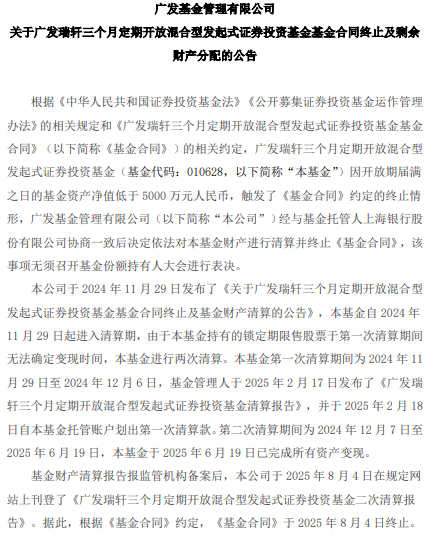
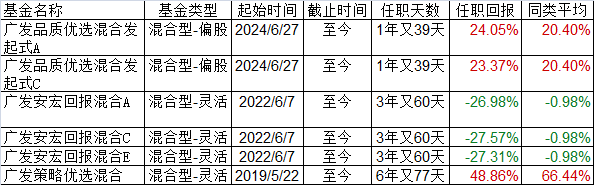
Core Viewpoint - The announcement from GF Fund indicates the termination of the GF Rui Xuan Three-Month Regular Open Mixed Fund due to its net asset value falling below 50 million RMB, leading to a mandatory liquidation process [1][3]. Fund Performance Summary - The GF Rui Xuan Three-Month Regular Open Mixed Fund was established on February 3, 2021, and as of November 28, 2024, it reported a cumulative net asset value of 0.5434 RMB per unit, with a cumulative return of -45.66% [3]. - Year-to-date performance shows a decline of -9.66%, with a one-month decline of -4.04% and a three-month decline of -6.49% [4]. - Over the past year, the fund has experienced a return of 9.29%, but over two years, it has declined by -14.03% [4]. Managerial Changes and Performance - The fund was managed by two managers, Miao Yu and Duan Tao, followed by Luo Yang, with both management periods resulting in losses. The fund's size decreased from 1.01 billion RMB at inception to approximately 1.08 million RMB at the time of liquidation [7]. - Duan Tao currently manages five funds, with only two outperforming their peers. His other funds, including the GF Sheng Jin Mixed Fund, have shown significant losses, with a decline of 42% and 43% [8]. - Luo Yang manages three funds, with the GF An Hong Return Mixed Fund showing a loss of 27% over three years, significantly underperforming the peer average of -0.98% [8].
广发瑞轩三个月定开混合清盘 成立近4年亏损45%
Zhong Guo Jing Ji Wang· 2025-08-05 08:08
Group 1 - The core point of the news is that the Guangfa Rui Xuan three-month regular open mixed fund has been terminated due to its net asset value falling below 50 million RMB, triggering the termination clause in the fund contract [1] - The fund was established on February 3, 2021, and as of the last disclosed net value date on November 28, 2024, it had a cumulative net value of 0.5434 RMB and a cumulative return of -45.66% [1] - The fund's scale decreased from 1.01 billion RMB at inception to approximately 1.08 million RMB at the time of the second liquidation [2] Group 2 - Fund managers Miao Yu and Duan Tao managed the fund, but both management periods ended in losses, contributing to the fund's poor performance [2] - Duan Tao currently manages five funds, with only two outperforming their peers, while the others, including Guangfa Shengjin Mixed Fund, have significant losses [2] - Another manager, Luo Yang, oversees three funds, with one fund showing a return loss of 27% over three years, significantly underperforming its peer average [2][3]
广发基金浮动费率试点,业绩与激励能否真正绑定?
Sou Hu Cai Jing· 2025-06-18 07:56
Core Viewpoint - The launch of the floating fee rate fund, Guangfa Value Steady Mixed Fund (024448), is seen as a significant step in aligning fund manager incentives with investor returns, but the effectiveness of this new fee structure remains to be tested in the market [2][12]. Fund Structure and Management - Guangfa Value Steady Mixed Fund adopts a dual fee structure of "base management fee + performance fee," where the management fee is set at 1.5% if annualized excess returns exceed 6%, and reduced to 0.6% if excess returns are negative and below -3% [2][12]. - Wang Mingxu, the proposed fund manager, has a mixed track record, with some funds significantly underperforming their benchmarks [3][11]. Performance Analysis - Wang Mingxu currently manages over 10 billion yuan across seven products, with notable performance discrepancies; for instance, Guangfa Balanced Preferred Mixed Fund (010379) has returned -3.4% since his appointment, lagging its benchmark by 6.3 percentage points [3][11]. - Over the past three years, more than 60% of Guangfa's actively managed equity products have underperformed their benchmarks by over 10 percentage points, raising concerns about the alignment of management compensation with investor returns [11][12]. Employee Compensation and Shareholding - Guangfa Fund's employee shareholding platform has distributed nearly 600 million yuan in dividends over the past five years, with significant amounts going to top executives, highlighting a disparity between management income and investor returns [5][8]. - The shareholding structure includes several high-ranking executives, indicating a strong financial incentive tied to the fund's performance, yet the actual returns for investors have been disappointing [6][12]. Regulatory Context - The floating fee rate initiative is part of a broader regulatory push to reform the public fund industry, aiming to better align fund company revenues with investor returns and establish a performance-based incentive system [2][12]. - The regulatory framework emphasizes the need for fund managers to be held accountable for long-term performance, with penalties for those consistently underperforming [12].