
广发价值稳进混合

Search documents
牛市巨亏超11亿!广发基金百亿基金经理王明旭,被喷惨了
Xin Lang Cai Jing· 2026-01-08 10:34
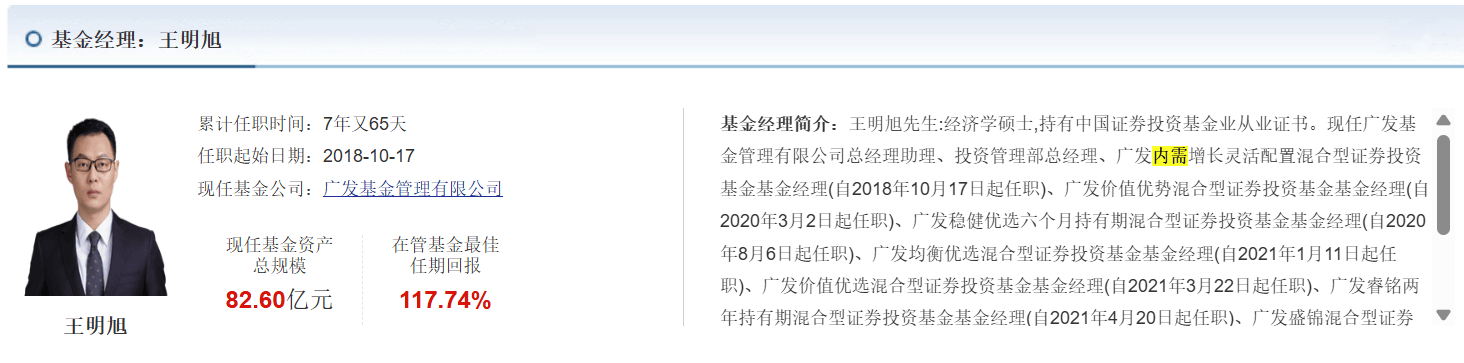
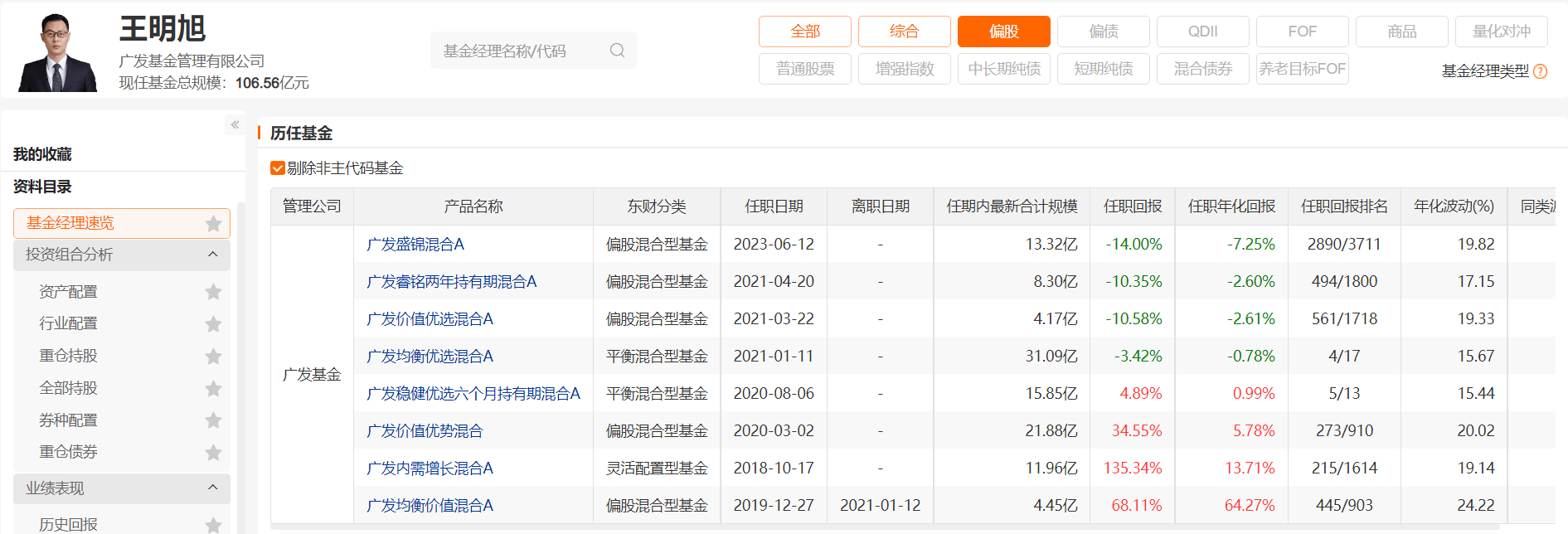
Core Viewpoint - The performance of Wang Mingxu, a fund manager at GF Fund, has significantly declined in 2025, leading to him being labeled as the "most unfortunate fund manager" of the year due to substantial losses across multiple funds he manages [1][4][26]. Group 1: Fund Performance Overview - In 2025, out of 4711 actively managed equity funds, 4494 reported positive returns, while 217 had negative returns, indicating a stark contrast in fund performance [1][28]. - The top 10 performing funds achieved returns exceeding 130%, with the highest being 233%, while the bottom 10 funds saw declines of over 10%, with the largest drop nearing 20% [1][28]. - Notably, four of the bottom 10 funds were managed by Wang Mingxu, highlighting a significant underperformance [2][29]. Group 2: Specific Fund Losses - Wang Mingxu managed seven funds that collectively lost 1.135 billion yuan in the past year, with all of them ranking at the bottom of their respective categories [4][31][36]. - The specific losses for these funds included: - GF Domestic Demand Growth Mixed A: -16.31% - GF Value Advantage Mixed: -15.47% - GF Value Preferred A: -14.55% - GF Rui Ming Two-Year Holding A: -13.34% - GF Steady Preferred Six-Month Holding A: -12.60% - GF Balanced Preferred A: -12.50% [4][36]. Group 3: Management and Strategy Issues - Wang Mingxu's investment strategy has been criticized for not aligning with market trends, particularly during a structural bull market favoring growth stocks, while his funds were heavily invested in underperforming sectors like real estate and liquor [24][22]. - His funds exhibited a pattern of high overlap in holdings and similar trading strategies, which contributed to their collective underperformance [24][22]. - Despite the poor performance of his funds, GF Fund continued to collect substantial management fees, totaling 55.94 million yuan for the first half of 2025 from the funds he managed [26][27].


浮动费率基金首考现“最惨答卷” 广发基金总助旗下产品亏损垫底
Sou Hu Cai Jing· 2025-12-23 06:32
Core Viewpoint - The first batch of 26 floating rate funds, intended as a benchmark for high-quality industry development, has shown mixed results, with some funds, like GF Value Steady Mixed Fund, significantly underperforming, raising questions about the fund manager's capabilities and the company's operational model [1][9]. Group 1: Fund Performance - Most funds in the initial batch achieved positive returns, but GF Value Steady Mixed Fund reported losses of 7.11% and 7.35% for its A and C shares, ranking at the bottom among the 26 products [1][3]. - The fund's top ten holdings were heavily concentrated in traditional sectors like liquor and software services, which underperformed in the current market characterized by a focus on technology and high-end manufacturing [3][5]. - The fund manager, Wang Mingxu, has shown a lack of flexibility in investment strategy, failing to adapt to macroeconomic changes and not implementing effective stop-loss measures, leading to significant underperformance against benchmarks [5][6]. Group 2: Manager's Capability and Strategy - Wang Mingxu's recent performance has been poor across multiple products, indicating a decline in management capability, with many funds under his management showing negative returns [6][8]. - His investment logic appears outdated, as he has struggled to identify market trends and has made repeated misjudgments regarding sector allocations, particularly in the context of a rapidly changing market [8][9]. - The company's approach to fund management has been criticized for being overly focused on scale rather than aligning fund managers' capabilities with the products they oversee, leading to poor performance outcomes [8][9]. Group 3: Company Reputation and Future Implications - The underperformance of GF Value Steady Mixed Fund has severely damaged GF Fund's brand reputation, raising doubts about its professional capabilities and potentially affecting investor trust across its product line [9][10]. - The negative performance may hinder future product issuances, as investor confidence in floating rate funds could be adversely impacted, leading to a potential chain reaction of redemptions across other funds managed by Wang Mingxu [9][10]. - The company is urged to take substantial corrective actions to restore trust and improve performance, rather than passively accepting losses [9][10].
广发基金浮动费率试点,业绩与激励能否真正绑定?
Sou Hu Cai Jing· 2025-06-18 07:56
Core Viewpoint - The launch of the floating fee rate fund, Guangfa Value Steady Mixed Fund (024448), is seen as a significant step in aligning fund manager incentives with investor returns, but the effectiveness of this new fee structure remains to be tested in the market [2][12]. Fund Structure and Management - Guangfa Value Steady Mixed Fund adopts a dual fee structure of "base management fee + performance fee," where the management fee is set at 1.5% if annualized excess returns exceed 6%, and reduced to 0.6% if excess returns are negative and below -3% [2][12]. - Wang Mingxu, the proposed fund manager, has a mixed track record, with some funds significantly underperforming their benchmarks [3][11]. Performance Analysis - Wang Mingxu currently manages over 10 billion yuan across seven products, with notable performance discrepancies; for instance, Guangfa Balanced Preferred Mixed Fund (010379) has returned -3.4% since his appointment, lagging its benchmark by 6.3 percentage points [3][11]. - Over the past three years, more than 60% of Guangfa's actively managed equity products have underperformed their benchmarks by over 10 percentage points, raising concerns about the alignment of management compensation with investor returns [11][12]. Employee Compensation and Shareholding - Guangfa Fund's employee shareholding platform has distributed nearly 600 million yuan in dividends over the past five years, with significant amounts going to top executives, highlighting a disparity between management income and investor returns [5][8]. - The shareholding structure includes several high-ranking executives, indicating a strong financial incentive tied to the fund's performance, yet the actual returns for investors have been disappointing [6][12]. Regulatory Context - The floating fee rate initiative is part of a broader regulatory push to reform the public fund industry, aiming to better align fund company revenues with investor returns and establish a performance-based incentive system [2][12]. - The regulatory framework emphasizes the need for fund managers to be held accountable for long-term performance, with penalties for those consistently underperforming [12].
发行两周 亮点十足 新型浮动费率基金火热销售进行时
Zhong Guo Zheng Quan Bao· 2025-06-08 20:52
Core Insights - The new floating rate funds have seen significant sales success within just two weeks of issuance, with multiple banks reporting sales exceeding 1 billion yuan, and some surpassing 10 billion yuan [1][2] - The Oriental Red Core Value Mixed Fund has already exceeded its fundraising cap of 2 billion yuan, with a subscription confirmation rate of approximately 94.03% [2][3] - A trend of self-purchase by fund companies has emerged, with Manulife Fund investing 10 million yuan in its own floating rate fund, reflecting a commitment to shared interests and risk with investors [1][5] Fund Sales Performance - As of June 6, several banks, including SPDB, Bank of China, and others, reported that their sales of new floating rate funds exceeded 1 billion yuan, with SPDB and Bank of China surpassing 10 billion yuan [2] - The first batch of 16 floating rate funds launched on May 27 has seen strong initial subscription, with many funds achieving over 1 billion yuan in subscriptions by June 6 [2][3] Fund Company Actions - Multiple fund companies have announced self-purchases of their floating rate funds, with amounts ranging from 10 million to 20 million yuan, indicating confidence in the market [5][6] - The self-purchase actions by companies like Oriental Red Asset Management and Tianhong Fund demonstrate a commitment to aligning interests with investors [5][6] Fund Characteristics - The new floating rate funds have varied performance benchmarks, with some using the CSI 500 Index as a benchmark, while others target the CSI 300 Index or the CSI 800 Index [4] - The introduction of floating rate funds is seen as a response to the policy aimed at linking management fees to fund performance, marking a new approach in the industry [6]
自购绑定 全员发海报 业绩基准“分水岭” 16只同日冲锋 新型浮动费率基金闪击
Zhong Guo Zheng Quan Bao· 2025-05-27 20:31
Group 1 - The first batch of new floating rate funds was launched on May 27, with 16 products available for subscription, marking a significant transformation in the public fund industry [1][2] - The rapid issuance of these funds occurred just two trading days after receiving approval from the regulatory authority, indicating a swift response from the industry [1][2] - Initial sales were strong, with reports of some products achieving subscription scales exceeding several hundred million yuan on the first day [2] Group 2 - The fund companies have deployed their top-performing fund managers for these new products, emphasizing a balanced and stable investment style [3] - The performance benchmarks for these floating rate funds vary, with many choosing broad market indices like CSI 300 and CSI 500, reflecting the fund managers' market style predictions [4][5] - The management fees for these funds will be dynamically calculated based on the actual returns to investors, introducing a new level of operational and system capability requirements for fund companies [6][7] Group 3 - The floating management fee mechanism links the fee rate to the excess return relative to the performance benchmark, aiming to enhance investor satisfaction and promote long-term investment behavior [7] - The current market environment is viewed as a "golden window" for equity investments, with favorable external conditions and relatively low valuations in both A-share and Hong Kong markets [7]