建设用地使用权量化登记

Search documents
济南不动产登记改革,何以频频“出圈”?
Feng Huang Wang Cai Jing· 2025-12-18 23:56
Core Insights - Jinan has pioneered the quantitative registration reform of construction land use rights, allowing companies to secure large loans using undeveloped land shares, showcasing innovative practices in real estate registration reform [1][4][9] Group 1: Quantitative Registration Reform - The quantitative registration model addresses long-standing issues in real estate registration, such as the inability to effectively activate land assets and the complexities of traditional registration methods [3][4] - This model has been successfully applied in three key projects, involving 898 acres of land and facilitating nearly 3 billion yuan in financing, thereby enhancing asset liquidity and resource allocation efficiency [4] Group 2: Innovations in Property Transactions - The "mortgage transfer" initiative simplifies the process of transferring ownership of second-hand houses, significantly reducing the time required for transactions from potentially over a month to just 1-3 working days [5][6] - The introduction of the "sealed transfer" model allows properties under court seizure to be financed, providing a solution for debtors while ensuring the safety of financial institutions [6][7] Group 3: Broader Implications and Future Prospects - Jinan's reforms reflect a deep understanding of the needs of citizens and businesses, aiming to balance interests among financial institutions, enterprises, and the public [8][9] - The ongoing quantitative registration reform is expected to provide new ideas for managing diverse assets, particularly in urban renewal and land consolidation, thereby enhancing the vitality of land factors in high-quality urban development [8][9]
滨州主城区全面推行建设用地使用权量化登记
Qi Lu Wan Bao Wang· 2025-10-23 04:18
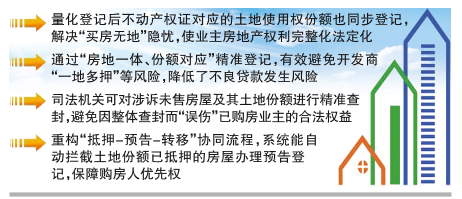
Core Viewpoint - The implementation of a new quantitative registration model for land use rights in Binzhou City aims to fundamentally address long-standing issues in real estate registration, ensuring the legal rights of homebuyers are protected and enhancing the clarity of property rights [1][3]. Group 1: Quantitative Registration Model - The quantitative registration of land use rights is a refined management approach that calculates the land use rights of each property based on its proportion of the total building area, allowing for clear identification of land use rights for each unit [1][3]. - This model ensures that when homeowners purchase a property, the corresponding land use rights are registered simultaneously, eliminating the previous concern of "buying a house without land" [3][4]. Group 2: Risk Mitigation and Legal Clarity - The new registration method effectively prevents risks such as developers using the same land as collateral multiple times and provides financial institutions with clear information on collateral ownership, thereby reducing the risk of bad loans [3][4]. - Judicial authorities can use the quantitative data for precise enforcement actions, avoiding the blanket seizure of properties and protecting the legal rights of existing homeowners [3][4]. Group 3: Case Study and Implementation - A case involving a logistics park project illustrates the effectiveness of the quantitative registration policy, where precise segmentation of land use rights allowed for the lifting of an overall court seizure, enabling the project to resume operations and benefit all stakeholders [4]. - To ensure successful implementation, the city has focused on data sharing, process collaboration, and system integration, creating a mechanism for generating quantitative plans and automating information sharing across departments [4][5]. Group 4: Future Plans - The Binzhou Natural Resources and Planning Bureau plans to enhance training and system functionality, with intentions to expand the quantitative registration system citywide and explore its application in industrial land and other non-residential areas [5].