开悟具身智能世界模型产品平台

Search documents
开悟世界模型3.0,大晓机器人构建具身智能开放新生态
Zhong Guo Jing Ji Wang· 2025-12-22 09:54
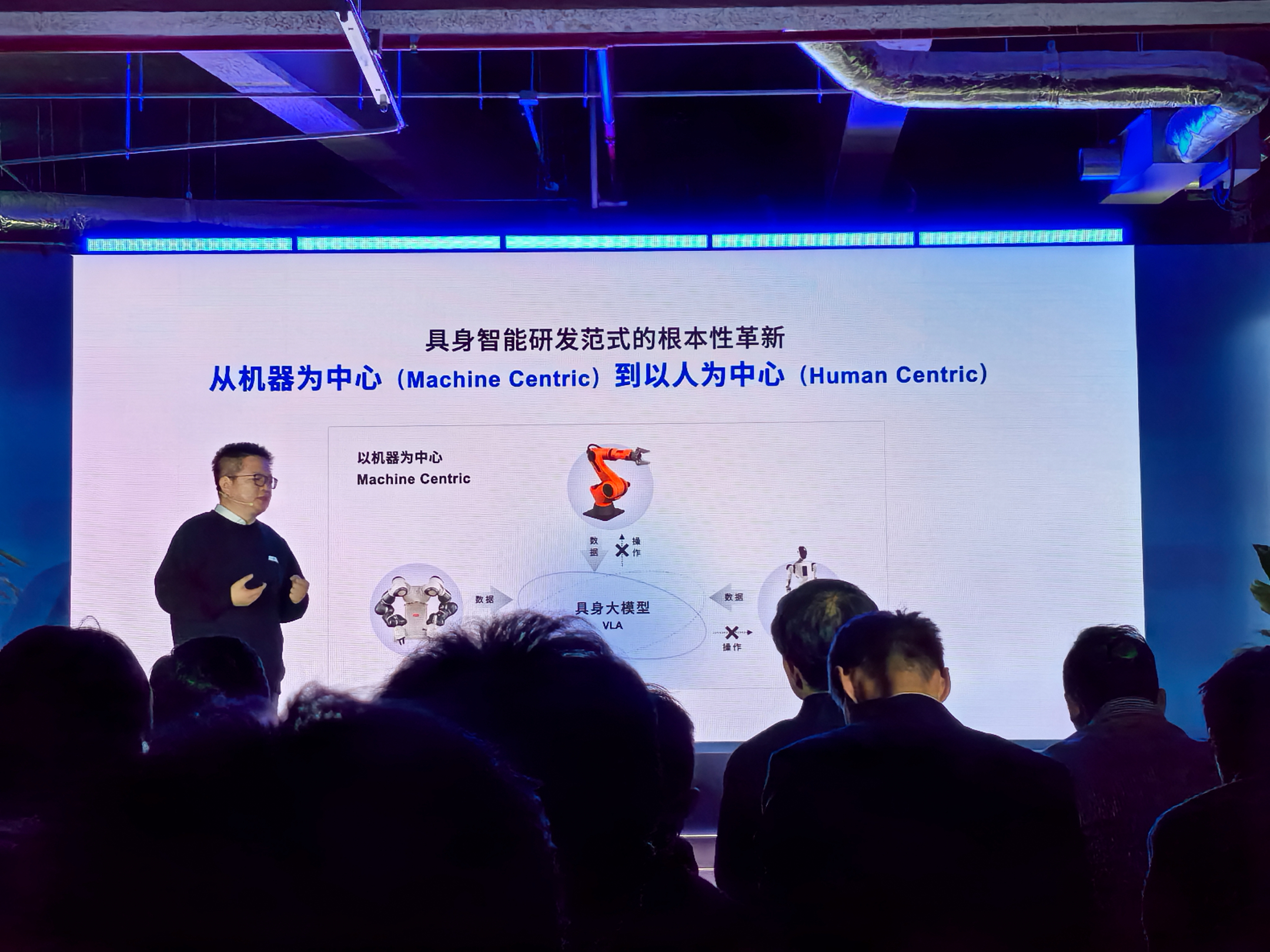
Core Insights - The company DaXiao Robotics has launched the industry's first ACE embodied research paradigm and the open-source commercial application of the Kairos 3.0 world model, aiming to drive the large-scale commercial implementation of embodied intelligence and foster industry growth in China [1][10]. Group 1: Technological Innovations - DaXiao Robotics has introduced the "Human-centric" ACE embodied research paradigm, which fundamentally transforms industry development by focusing on human interaction with the physical world [5]. - The ACE paradigm utilizes environmental data collection to achieve millions of hours of data accumulation, enhancing the value of real data to over 100 million hours [5][9]. - The environmental data collection technology integrates multi-dimensional data from various modalities, providing precise data support for embodied model training [5][9]. Group 2: Data Processing and Model Capabilities - The data processing approach includes temporal consistency alignment and dynamic trajectory prediction modeling, enabling the transformation of collected "human-object-environment" information into dynamic scene data for model training [9]. - The ACE paradigm delivers four core data values: comprehensive data dimensions, long-range task coverage, high interaction precision, and scalable data collection efficiency [9]. - The Kairos 3.0 world model is the first to offer "multi-modal understanding-generation-prediction," allowing machines to understand physical laws and human behaviors deeply [10][12]. Group 3: Product Launch and Ecosystem Development - DaXiao Robotics has launched the Kairos embodied intelligent world model product platform, which integrates multi-modal generation capabilities and supports a wide range of application scenarios [13]. - The platform is open-sourced to the industry, allowing all enterprises to utilize the Kairos model toolchain, promoting the rapid emergence of lightweight and customized embodied intelligent products [13]. - The company has introduced the embodied super brain module A1, which accelerates the commercialization of robots and fosters an innovative ecosystem in embodied intelligence [13][14]. Group 4: Autonomous Navigation and Application Scenarios - The A1 module enables robots to operate in complex, dynamic environments without the need for pre-collected high-precision maps, achieving robust and safe path generation [14][17]. - The module can interpret natural language commands and execute tasks in various scenarios, including security, energy, transportation, and cultural tourism, demonstrating practical value in industrial applications [17].


机器人从比硬件转向比大脑,商汤发布开悟世界模型3.0
Nan Fang Du Shi Bao· 2025-12-21 14:59
Core Insights - The commercialization path of embodied intelligence faces core bottlenecks such as data shortages and insufficient generalization capabilities, as highlighted by the recent launch of SenseTime's ACE embodied research paradigm and the Kairos 3.0 open-source model, marking a shift from hardware competition to brain upgrades in the field of embodied intelligence [1][4] Group 1: Technological Advancements - SenseTime's ACE paradigm and Kairos 3.0 model aim to address the industry's long-standing issues of data scarcity and generalization capabilities, representing a fundamental shift in the research path of embodied intelligence [6][10] - The Kairos 3.0 model allows for AI-generated training materials, such as videos of robotic tasks, which are more convenient than real-life filming and can simulate dangerous scenarios to avoid real-world risks [3][4] Group 2: Data Collection Innovations - The new "environmental data collection" approach proposed by SenseTime focuses on a human-centered data collection system, integrating multi-modal data from various perspectives to create a 3D asset library based on physical principles [6][9] - This method has already been implemented in real-time retail warehouse scenarios, covering thousands of SKUs and completing the entire sorting and packaging process, demonstrating its effectiveness in capturing human behavior and object interaction [9] Group 3: Open Source Strategy - The open-source nature of the Kairos 3.0 model aims to alleviate the industry's challenges related to model compatibility and communication costs, allowing chip manufacturers to optimize algorithms based on the model [10][12] - The open-source strategy is expected to enhance the coverage of various application scenarios, as it invites global developers to participate in data collection and model optimization, addressing the limitations of individual companies [10][12] Group 4: Market Potential and Challenges - According to the International Federation of Robotics (IFR), service robot sales for professional scenarios are projected to reach nearly 200,000 units in 2024, with a 9% year-on-year growth, driven by labor shortages and aging populations [12] - Despite the growing interest in humanoid robots, only a few companies have progressed to large-scale pilot or pre-commercial deployment, with Morgan Stanley estimating that the humanoid robot market could reach $5 trillion by 2050, but growth will be relatively slow until the mid-2030s [12]
开悟世界模型3.0开源、超级大脑模组A1落地!具身智能商业化提速
Guo Ji Jin Rong Bao· 2025-12-18 14:41
Core Insights - The article discusses the launch of Kairos 3.0 and the embodiment super brain module A1 by Daxiao Robotics, introducing a human-centric ACE embodiment research paradigm to accelerate the commercialization of robotics [2][8] Group 1: ACE Embodiment Research Paradigm - Daxiao Robotics proposes the ACE embodiment research paradigm to address the significant data gap in the era of embodied intelligence, moving away from the traditional machine-centric approach [8] - The ACE paradigm focuses on human interaction with the physical world, utilizing environmental data collection as a core engine to create a comprehensive technical system [8] - Environmental data collection technology can achieve data collection of tens of millions of hours annually, amplifying the value of real data to the equivalent of hundreds of millions of hours [8] Group 2: Kairos 3.0 Features - Kairos 3.0 can generate long-duration dynamic interactive scene videos, allowing precise control of elements within the scene [9] - The model features capabilities such as one-click generation across different entities, multi-entity generalization, and prediction of numerous evolution paths, creating a high-fidelity, generalizable virtual training environment for embodied intelligence [9] Group 3: Product Platform and Accessibility - The Kairos 3.0 model is integrated into a product platform that includes multi-modal generation capabilities, covering 115 categories of embodied scenarios with 328 tags [9] - The model has been open-sourced to the industry, with APIs available to facilitate the rapid development of lightweight and customized embodied intelligence products [9] Group 4: Super Brain Module A1 - The embodiment super brain module A1 leverages a leading pure visual end-to-end VLA model, enabling robots to adapt to complex and dynamic environments without pre-collected high-precision maps [10] - The module allows robots to autonomously generate robust, safe, and reasonable paths in dynamic settings, achieving true autonomous action [10] - A1 also features cloud interaction capabilities, enabling real-time interpretation of natural language commands and image semantics, allowing robots to execute tasks like obstacle avoidance and following commands accurately [10]