开悟世界模型3.0

Search documents
蚂蚁集团领投,大晓机器人完成天使轮融资
Nan Fang Du Shi Bao· 2026-02-11 04:54
Group 1 - The financing heat in the embodied intelligence sector continues, with Daxiao Robotics recently completing its angel round of financing [2] - The round was led by Ant Group, with participation from Qiming Venture Partners, Jinjing Capital, Hony Capital, Lenovo Ventures, and others, including existing shareholder SenseTime [2] - The raised funds will primarily be used to advance the company's ACE embodied full-stack R&D paradigm, accelerate environmental data collection, and promote the large-scale implementation of the embodied super brain module [2] Group 2 - Daxiao Robotics operates independently in the embodied intelligence field following the restructuring of SenseTime's "1+X" framework, with Wang Xiaogang as chairman [2] - The team includes two of the top five Chinese computer scientists globally, focusing on environmental intelligence and world modeling [2] - Daxiao Robotics aims to address the industry's "data scarcity" issue with its ACE embodied R&D paradigm, which constructs a full-link technology system [2] Group 3 - Wang Xiaogang emphasized that Daxiao will adopt a "soft and hard integration" model similar to Apple's, using world models to define hardware and deliver practical solutions [3] - The company views embodied intelligence as a rapidly growing sector with unlimited potential, committing to continuous technological innovation and deep understanding of scenarios [3] - Daxiao Robotics plans to accelerate product commercialization and ecosystem development, collaborating with strategic partners to create a fully controllable embodied intelligence ecosystem [3]


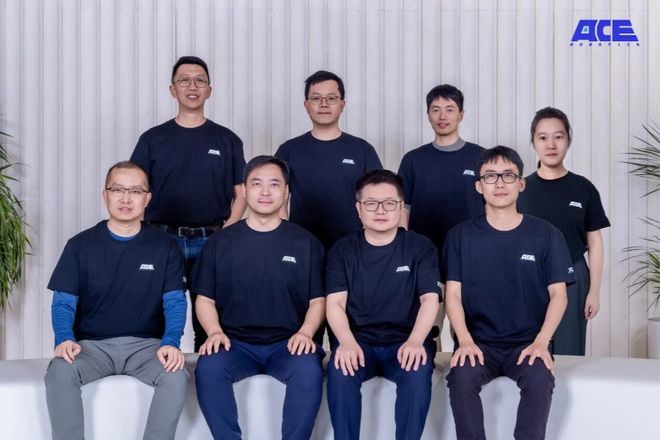
大晓机器人完成天使轮融资:蚂蚁集团领投,商汤联合创始人王晓刚任董事长
Sou Hu Cai Jing· 2026-02-10 10:41
Group 1 - Daxiao Robotics has recently completed its angel round financing, led by Ant Group, with participation from Qiming Venture Partners, Jinjing Capital, Hongyi Investment, Lenovo Capital, and others [1] - The funds raised will be used to advance Daxiao Robotics' "human-centered" ACE embodied full-stack R&D paradigm, accelerate environmental data collection, and develop the Kairos 3.0 world model [1] - The company aims to promote the large-scale implementation of its embodied super brain module and actively expand into commercial scenarios such as energy, transportation, and cultural tourism [1] Group 2 - Daxiao Robotics was established in July 2025 as a new business under SenseTime, with co-founder Wang Xiaogang serving as chairman [3] - The company focuses on autonomous decision-making capabilities in robotics and has introduced the world's first ACE technology paradigm and the Kairos 3.0 world model, enabling autonomous navigation through pure vision [3] - Daxiao Robotics has formed strategic partnerships with multiple enterprises to facilitate the implementation of its technology in industrial scenarios [3]
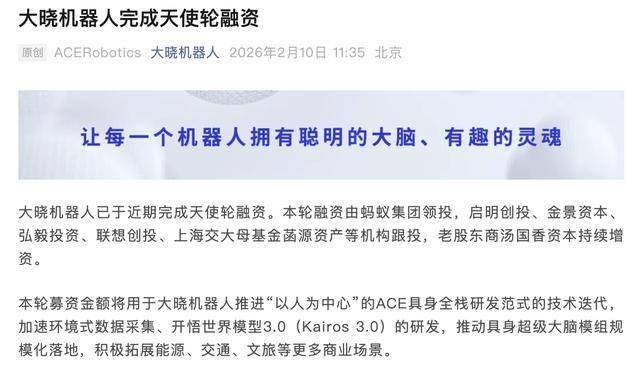
对话大晓机器人董事长王晓刚,解码具身智能落地“三部曲”
Sou Hu Cai Jing· 2026-01-14 00:14
Core Insights - The article discusses the advancements and challenges in the field of embodied intelligence and humanoid robots, highlighting the need for scalable production and systematic operations to support industry growth [2][3]. Group 1: Company Developments - SenseTime's co-founder Wang Xiaogang emphasizes the importance of comprehensive capabilities for establishing a foothold in the humanoid robot sector, indicating that the company is not without its shortcomings [2]. - The launch of the ACE embodied research paradigm and the open-source commercial application of the "Awakening World Model 3.0" are significant milestones for the company, addressing core pain points in embodied intelligence [2][3]. - The company has built a full-link technology system that effectively addresses issues such as data scarcity and generalization difficulties in the industry [2]. Group 2: Industry Standards and Challenges - Wang Xiaogang, who is also involved in the standardization committee for humanoid robots, identifies three main challenges in establishing a standard system: lack of data sharing standards, unclear safety responsibilities, and the need for improved quality standards [3]. - The industry is still in its early stages, requiring collaborative efforts across the sector to develop effective standards [3]. Group 3: Technological Innovations - The ACE paradigm introduces a human-centric approach to data collection, significantly enhancing data quality and reducing costs compared to traditional methods [12][14]. - The new paradigm allows for the collection of millions of hours of data annually, which is crucial for the development of effective embodied intelligence systems [12][14]. - The "Awakening World Model 3.0" integrates multi-modal understanding and predictive capabilities, marking a significant evolution in the field [19][22]. Group 4: Strategic Collaborations - The company has formed strategic partnerships with leading firms in various sectors, including hardware and cloud services, to create a comprehensive ecosystem for embodied intelligence [27][29]. - Collaborations with companies like Galaxy General aim to leverage each other's strengths in technology and production to overcome key technical challenges [29][31]. Group 5: Market Focus and Future Outlook - The company plans to focus on commercial and industrial applications in the next 3-5 years, with an emphasis on high-standard environments like front warehouses and retail storage [32]. - The potential for large-scale deployment in commercial services is highlighted, while industrial applications face challenges due to data sensitivity and low willingness to share [32]. - The company aims to develop a unified platform to support the development of both software and hardware in the industry, similar to NVIDIA's CUDA ecosystem [23].

抢滩万亿具身智能蓝海 泛汽车企业“卡位”人形机器人赛道
Zhong Guo Jing Ying Bao· 2026-01-09 19:58
Core Viewpoint - The automotive industry is increasingly entering the humanoid robot sector, viewing it as a "third growth curve" alongside traditional automotive business lines, with significant investments and product developments underway [3][4][5]. Group 1: Investment and Development - Chery Group announced it is accelerating the incubation of its humanoid robot, Moja, with a recent investment of 35 million yuan from Wuhu Bertli Automotive Safety Systems [3]. - The humanoid robot market is projected to reach a size of $5 trillion by 2050, with an estimated deployment of 1 billion units, indicating a vast market opportunity for automotive companies [7]. - Dongfeng Group is also developing humanoid robots for tasks such as customer reception and material handling in factories, showcasing the diverse applications of these robots [5]. Group 2: Technological Synergy - Automotive companies possess inherent advantages in technology and manufacturing processes, which can be leveraged in the development of humanoid robots [7][10]. - The overlap in supply chains between smart vehicles and humanoid robots is as high as 60%, providing a natural pathway for cost reduction [10]. - Chery's approach to humanoid robots is seen as a natural extension of its existing automotive technology and manufacturing capabilities [8]. Group 3: Market Entry and Competition - New players, including companies like SenseTime and Black Sesame Intelligence, are entering the humanoid robot market, indicating a competitive landscape [4][6]. - SenseTime's recent product launches and partnerships in the humanoid robot space highlight the industry's focus on collaboration and ecosystem development [4]. - The entry of automotive companies into the humanoid robot sector is seen as a strategic move to capture future technological opportunities and enhance their market positions [7][11]. Group 4: Challenges and Future Outlook - The humanoid robot industry is still in its early stages, facing challenges such as the lack of industry standards and safety regulations [9]. - Key technological breakthroughs are needed in areas like AI chips, battery technology, and sensor systems to enable large-scale deployment of humanoid robots [10]. - The development of commercial models, such as robot leasing platforms, is emerging as a potential avenue for revenue generation in the humanoid robot sector [11].
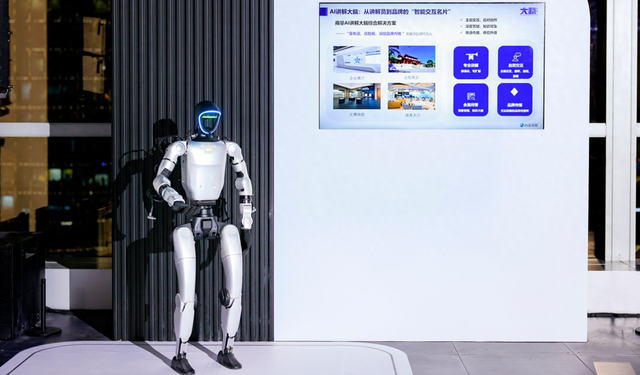
赵何娟对话王晓刚:什么将是机器人的ChatGPT时刻|2025 T-EDGE全球对话
Tai Mei Ti A P P· 2026-01-05 18:12
Core Insights - The humanoid robotics sector is experiencing rapid growth, with global investment reaching approximately $7 billion in the first nine months of 2025, driven particularly by the Chinese market, marking a 250% increase year-over-year [1] - Despite the investment surge, most humanoid robots remain limited to basic functionalities like dancing and boxing, indicating that technological advancements are still in their infancy [1] - A global dialogue event, the 2025 T-EDGE Global Conversations, is set to take place, focusing on innovative ideas in the AI era, featuring discussions on new research paradigms in embodied intelligence [1] Investment Trends - The humanoid robotics investment reached about $7 billion in the first nine months of 2025, a 250% increase compared to the same period last year [1] - The growth is largely attributed to the Chinese market, highlighting its significant role in the global robotics landscape [1] Technological Developments - Current humanoid robots are primarily engaged in simple tasks, indicating that the technology is still developing and has not yet reached its full potential [1] - The ACE research paradigm introduced by Daxiao Robotics focuses on human-physical world interactions, utilizing environmental data collection to build a comprehensive world model [3][4] - The ACE paradigm aims to create a unified understanding of the world by integrating physical laws, human behavior, and real machine actions, enabling robots to understand and generate complex interactions [3] Research Paradigms - The shift from machine-centric to human-centric research paradigms is emphasized, suggesting that understanding human interactions with the physical world is crucial for advancing embodied intelligence [20] - The new paradigm aims to collect data through human activities using wearable devices and sensors, which can provide insights into physical interactions and behaviors [20][21] - The need for theoretical breakthroughs in understanding physical laws and human-machine interactions is highlighted as essential for the development of effective embodied intelligence [18][19] Future Opportunities - The integration of AI with sensor technology is seen as a significant opportunity, with the potential for a new market in intelligent sensors that can enhance robotic capabilities [32] - The development of a robust ecosystem for AI and sensor integration is crucial for advancing the field, with a focus on creating adaptable models that can work with various hardware [35] - The potential for a large-scale wearable market is anticipated, driven by advancements in AI and sensor technology [30] Industry Insights - The conversation around embodied intelligence reflects a broader trend in AI development, moving towards more complex interactions with the physical world [4][28] - The importance of interdisciplinary talent development is emphasized, as the future of robotics will require expertise in both AI and physical sciences [41] - The company aims to leverage its understanding of human behavior and physical interactions to design robots that can effectively operate in real-world environments [28][47]

VLA模型走不通,机器人的下一步该怎么走?
Tai Mei Ti A P P· 2025-12-22 12:58
Core Insights - The VLA (Visual-Language-Action) model faces challenges in training due to the scarcity and complexity of physical world data, which is essential for enhancing its capabilities [2] - The shift from a machine-centered to a human-centered AI research paradigm is necessary for training embodied intelligence models [2] Group 1: ACE Paradigm - The ACE (Action-Centric Embodiment) paradigm focuses on human interaction with the physical world as the starting point for research, utilizing environmental data collection as a core engine [3] - The ACE framework integrates first-person and third-person video, haptic information, motion trajectories, and voice data to create a physics-based 3D asset library [3] Group 2: Open Source Model - The "Awakening World Model 3.0" has been released as an open-source and commercially applicable model, aiming to unify understanding across different domains by integrating physical laws, human behavior, and real machine actions [5] - The platform supports 11 major categories and 54 subcategories, covering 115 types of embodied scenarios, allowing developers to quickly generate visual task simulations with simple commands [5] Group 3: Industry Collaboration - The company collaborates with various robotics firms to integrate the ACE paradigm and world model with hardware solutions tailored for different scenarios [6] - Partnerships with domestic chip manufacturers enhance the computational capabilities of the Awakening World Model 3.0 [6] Group 4: Market Applications - In the short term, the focus will be on deploying quadruped robots with autonomous navigation capabilities in security and inspection sectors [6] - The medium-term strategy includes addressing labor-intensive logistics scenarios, while long-term goals involve exploring applications in home environments, contingent on resolving safety and liability issues [6] Group 5: Industry Trends - The ACE paradigm aligns with trends observed in companies like Tesla and Figure AI, indicating a significant opportunity in the sector over the next one to two years [7]

破解具身智能数据困境 大晓机器人发布“以人为中心”ACE具身研发范式
Huan Qiu Wang· 2025-12-22 08:13
Core Insights - The embodied intelligence industry is facing a dual challenge of data gaps and deviations in research paths, with a significant disparity between the data requirements for intelligent driving and the current data volume in the embodied intelligence field [1] - The traditional research paradigm is deemed ineffective, as it either complicates human interaction or machine learning, leading to high data costs and inefficiencies [1] - To address these challenges, the company has launched the ACE embodied research paradigm and the open-source Awakening World Model 3.0, along with the embodied super brain module A1 [1][3] Group 1 - The ACE paradigm is centered around human-centric data collection, enabling the gathering of millions of hours of data without disrupting human activities, thus significantly increasing efficiency and reducing costs [3] - The Awakening World Model 3.0 integrates multi-modal understanding, generation, and prediction, allowing machines to comprehend physical laws and human behaviors, enhancing their cognitive capabilities [3][4] - The model is open-sourced to promote ecosystem development, allowing various enterprises to utilize its tools and contribute to a shared data pool [4] Group 2 - The embodied super brain module A1 addresses existing hardware limitations by providing 360-degree environmental coverage and enabling autonomous navigation in complex environments without pre-collected high-precision maps [5] - The A1 module is designed to be compatible with various quadruped robots and integrates with multiple industry applications, targeting sectors such as security, energy, and transportation [5] - The company plans to scale the deployment of A1-equipped robots in security inspections and urban governance in the short term, with a long-term vision of expanding into flexible industrial production lines and eventually into household applications [5]

申万宏源证券晨会报告-20251222
Shenwan Hongyuan Securities· 2025-12-22 00:41
Group 1: Market Overview - The Shanghai Composite Index closed at 3890 points, with a daily increase of 0.36% and a monthly change of 0.03% [1] - The Shenzhen Composite Index closed at 2465 points, with a daily increase of 0.98% and a monthly change of -0.34% [1] - Large-cap indices showed a slight increase of 0.3% yesterday, while mid-cap and small-cap indices increased by 0.91% and 0.8% respectively [1] Group 2: Industry Performance - The decoration and renovation industry saw a daily increase of 3.33%, but a decline of 7.79% over the past month, while it increased by 30.51% over the past six months [1] - The energy metals sector increased by 3.26% yesterday, with an impressive 85.77% increase over the past six months [1] - The general retail sector increased by 3.22% yesterday, with an 8.93% increase over the past month and an 18.79% increase over the past six months [1] Group 3: Notable Declines - The components sector experienced a decline of 0.74% yesterday, with a 3.46% increase over the past month and a significant 69.42% increase over the past six months [1] - The other electronics sector declined by 0.68% yesterday, with a 42.32% increase over the past six months [1] - State-owned large banks saw a decline of 0.67% yesterday, with a 7.66% increase over the past six months [1]


机器人从比硬件转向比大脑,商汤发布开悟世界模型3.0
Nan Fang Du Shi Bao· 2025-12-21 14:59
Core Insights - The commercialization path of embodied intelligence faces core bottlenecks such as data shortages and insufficient generalization capabilities, as highlighted by the recent launch of SenseTime's ACE embodied research paradigm and the Kairos 3.0 open-source model, marking a shift from hardware competition to brain upgrades in the field of embodied intelligence [1][4] Group 1: Technological Advancements - SenseTime's ACE paradigm and Kairos 3.0 model aim to address the industry's long-standing issues of data scarcity and generalization capabilities, representing a fundamental shift in the research path of embodied intelligence [6][10] - The Kairos 3.0 model allows for AI-generated training materials, such as videos of robotic tasks, which are more convenient than real-life filming and can simulate dangerous scenarios to avoid real-world risks [3][4] Group 2: Data Collection Innovations - The new "environmental data collection" approach proposed by SenseTime focuses on a human-centered data collection system, integrating multi-modal data from various perspectives to create a 3D asset library based on physical principles [6][9] - This method has already been implemented in real-time retail warehouse scenarios, covering thousands of SKUs and completing the entire sorting and packaging process, demonstrating its effectiveness in capturing human behavior and object interaction [9] Group 3: Open Source Strategy - The open-source nature of the Kairos 3.0 model aims to alleviate the industry's challenges related to model compatibility and communication costs, allowing chip manufacturers to optimize algorithms based on the model [10][12] - The open-source strategy is expected to enhance the coverage of various application scenarios, as it invites global developers to participate in data collection and model optimization, addressing the limitations of individual companies [10][12] Group 4: Market Potential and Challenges - According to the International Federation of Robotics (IFR), service robot sales for professional scenarios are projected to reach nearly 200,000 units in 2024, with a 9% year-on-year growth, driven by labor shortages and aging populations [12] - Despite the growing interest in humanoid robots, only a few companies have progressed to large-scale pilot or pre-commercial deployment, with Morgan Stanley estimating that the humanoid robot market could reach $5 trillion by 2050, but growth will be relatively slow until the mid-2030s [12]

王晓刚和他的“世界模型”:一人管十狗,先让四足机器人上街干活|智能涌现专访
3 6 Ke· 2025-12-21 04:38
Core Insights - The article discusses the advancements in robotics technology, particularly focusing on the launch of the "A1 embodied super brain module" and the "KAIWU" world model 3.0 by the company, which enhances the capabilities of robotic dogs to perform various tasks autonomously [2][4][6]. Group 1: Technological Advancements - The A1 module allows robotic dogs to gain "spatial intelligence" and "autonomous decision-making" capabilities, transforming them from simple machines into intelligent entities capable of complex tasks [2][4]. - The KAIWU world model 3.0 establishes the physical laws of the world within AI models, enabling robots to learn tasks more efficiently and adapt to new environments [3][4][18]. - The world model addresses the limitations of previous VLA models, which struggled with understanding physical laws and required vast amounts of data for training [3][17]. Group 2: Commercialization Strategy - The company plans to initially deploy robotic dogs for urban management tasks, such as traffic monitoring and law enforcement, in collaboration with local authorities [1][8]. - The commercialization roadmap includes expanding from four-legged robots to wheeled dual-arm robots for logistics, and eventually to bipedal humanoid robots for more complex household tasks [8][40]. - The company aims to leverage its existing resources and partnerships to accelerate market entry and reduce costs in various applications, including security and inspection [9][38]. Group 3: Data Collection and Model Validation - The world model's effectiveness relies on a closed-loop validation process, where real-world scenarios are used to test and refine the model's capabilities [7][20]. - Data collection focuses on human interactions with the physical world, allowing for scalable data acquisition that can be applied across different robotic platforms [27][29]. - The company emphasizes the importance of integrating the world model with real-world applications to build trust and demonstrate its utility [7][25].