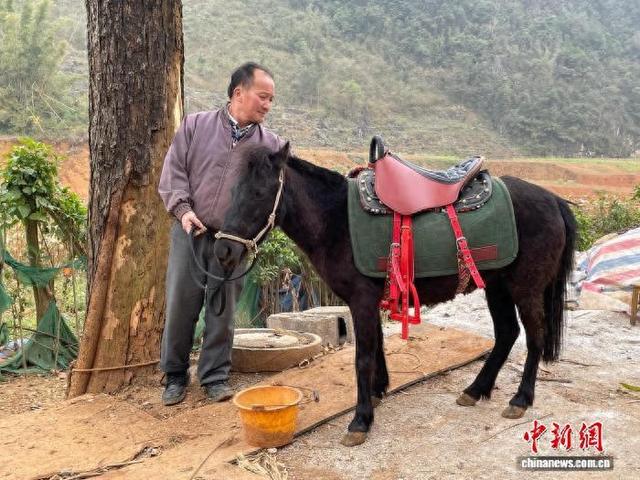
德保矮马

Search documents
骐骥驰骋 骉腾万里
Xin Lang Cai Jing· 2026-02-16 07:46
Group 1 - The article highlights the ongoing exhibition "Jijin Wanli - Special Exhibition of Bronze Civilization in Southwest China" at the Guangxi Zhuang Autonomous Region Museum, featuring a bronze horse from the Han Dynasty [1] - The bronze horse from the Han tomb in Hepu, Guangxi, is noted for its impressive stature and design, attracting significant attention [1][2] - The exhibition also includes other artifacts such as a bronze horse from the Guigang Fengliuling Han tomb and a ceramic knight figurine from the Southern Dynasties, reflecting the cultural significance of horses in ancient burial practices [2][3] Group 2 - The article discusses the historical context of horse culture in Guangxi, emphasizing the integration of Central Plains horse culture with local customs [4] - The De Bao dwarf horse, a descendant of the Han Dynasty's Guo Xia horse, is highlighted as a unique local breed, known for its small size and historical significance [6][8] - The De Bao dwarf horse played a crucial role in historical events, including military campaigns, showcasing its importance in local heritage [7] Group 3 - The article describes the cultural significance of horses in the Miao ethnic community, particularly during the annual celebrations in Rongshui, where horse-related activities are central to the festivities [9][11] - The Miao horse fighting tradition, which has been practiced for over 500 years, is recognized as an intangible cultural heritage of Guangxi, illustrating the deep-rooted connection between horses and local customs [11]
背靠独特基因库,在“冷门”马学里寻突破
Xin Lang Cai Jing· 2026-02-14 16:39
Core Insights - The article highlights the significant advancements in equine genetic research led by Jiang Lin and her team at the Beijing Institute of Animal Science, showcasing the unique genetic resources of Chinese horse breeds and their potential for international collaboration in the field of genetics [1][2][3]. Group 1: Research Background and Development - Jiang Lin transitioned from a postdoctoral researcher to a leading figure in equine genetics research, focusing on a previously underexplored area in China [1]. - The research team capitalized on China's unique horse genetic resources, which represent about 10% of the global horse population, to contribute to international studies [1][2]. - Historical groundwork laid by previous scientists in the 1970s and 1980s provided a solid foundation for current research efforts, emphasizing the importance of preserving genetic diversity [2]. Group 2: International Collaboration and Breakthroughs - A pivotal moment occurred in 2017 when Jiang Lin connected with Ludovic Orlando, a leading scholar in ancient DNA research, leading to fruitful collaboration [3]. - The team identified a key genetic mutation (TBX3) responsible for height variations in Chinese horses, which was published in a prominent journal, marking a significant contribution to the field [6][7]. Group 3: Challenges and Achievements - The research faced challenges such as funding limitations and the need for extensive data collection, but the team remained focused on the unique aspects of Chinese horse genetics [2][6]. - The successful publication of their findings in a top-tier journal demonstrates the value of persistence and exploration in a niche research area [7]. - The team's efforts not only advanced scientific knowledge but also aimed to support the conservation and utilization of local horse breeds in China [7].
中国矮马“果下马”:它们的精彩“马上到来”
Xin Lang Cai Jing· 2026-02-14 16:39
Core Viewpoint - The discovery and conservation of the Dabo Pony, a rare breed known as "the panda among horses," highlight the importance of preserving genetic diversity and cultural heritage in China's equine industry [1][5][11]. Group 1: Historical Significance - The Dabo Pony, also referred to as "Guoxia Ma," has historical roots dating back to the Han Dynasty, where it served as a vital transport animal [2][3]. - The breed was thought to be extinct until its rediscovery in the 1980s by Chinese agricultural scientists, marking a significant breakthrough in equine research [2][5]. Group 2: Conservation Efforts - Conservation efforts led by experts like Wang Tiequan have established a foundation for the protection and study of the Dabo Pony, which is recognized as a national genetic resource [3][4]. - The establishment of a national breeding farm in Dabo County has resulted in a population increase, with 382 ponies recorded by 2025, up from previous years [6][7]. Group 3: Economic and Cultural Integration - The integration of the Dabo Pony into tourism and cultural initiatives, such as the creation of the "Pony Kingdom" tourist attraction, aims to enhance its economic viability and cultural significance [7][10]. - The development of a youth equestrian program and the introduction of the "Mengmeng Horse" breed are part of a broader strategy to promote equestrian sports and reduce reliance on imported ponies [8][10]. Group 4: Future Prospects - The collaboration between conservationists and entrepreneurs suggests a promising future for the Dabo Pony, potentially positioning it as a key player in China's pony breeding industry [10][11]. - The ongoing efforts to combine the Dabo Pony with the emerging "Mengmeng Horse" breed could create a comprehensive pony market in China, enhancing both domestic and international equestrian opportunities [10][11].
(新春见闻)从代步工具到流量IP “马中熊猫”迎高光时刻
Xin Lang Cai Jing· 2026-02-14 08:17
Core Viewpoint - The De Bao pony, known as the "Panda of Horses," has transitioned from a traditional transportation tool to a popular cultural icon, attracting significant attention and tourism opportunities in Guangxi, China [1][5]. Group 1: De Bao Pony Characteristics and History - The De Bao pony is one of the world's two dwarf horse breeds, characterized by its small stature (76 to 106 cm in height and 65 to 140 kg in weight) and gentle temperament, making it popular among children [1][3]. - Historically, the De Bao pony served as an essential tool for local agriculture and transportation, but its appeal has shifted towards entertainment and tourism [1][6]. Group 2: Cultural and Economic Impact - The De Bao pony has gained visibility through various events, including the National Minority Traditional Sports Games and international cultural expos, enhancing its recognition [3][5]. - The De Bao Pony Kingdom has introduced themed performances and activities, expecting to attract approximately 120,000 visitors in 2025, with a projected 30% increase in 2026 [5]. - The local government has established a national-level breeding farm for the De Bao pony, ensuring genetic preservation and aiming to increase the population to over 440 by 2028 [5][6]. - The tourism revenue in De Bao County is projected to reach 3.435 billion RMB in 2025, reflecting a year-on-year growth of 15.7% [5]. Group 3: Future Development Plans - The local community plans to invest in breeding bases and diversify activities such as cultural performances and educational experiences to boost local income and employment [6].