房地产住宅

Search documents
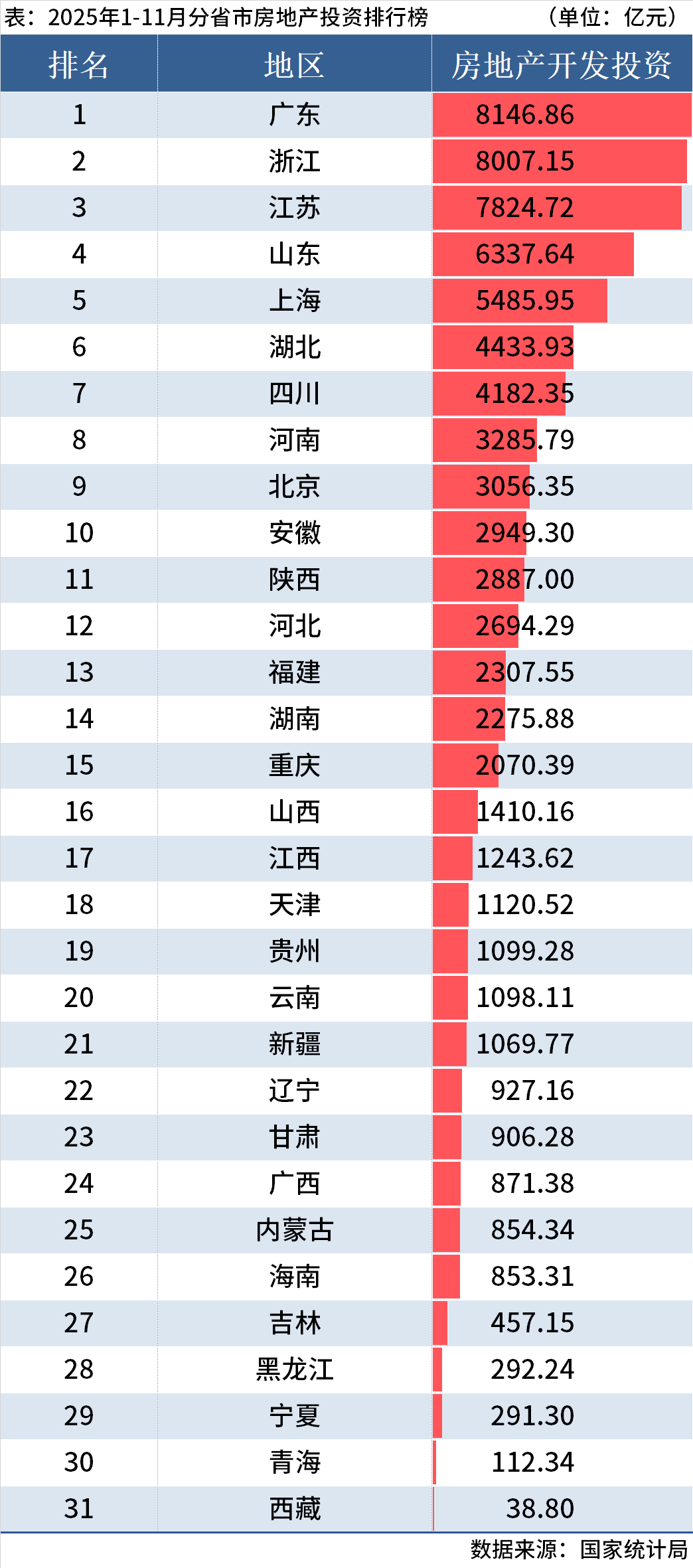
国家统计局:1-11月全国分省市房地产投资数据出炉
Guo Jia Tong Ji Ju· 2025-12-18 02:40
Core Insights - The real estate development investment in China for the first eleven months of 2025 shows significant activity, with 21 provinces and cities exceeding 100 billion yuan in investment [1][2]. Investment Overview - The top three provinces in real estate development investment are Guangdong (814.69 billion yuan), Zhejiang (800.72 billion yuan), and Jiangsu (782.47 billion yuan) [1][2]. - A total of 31 provinces and cities reported a combined real estate investment of over 6.56 trillion yuan [7]. Residential Investment - In residential investment, 17 provinces and cities surpassed 100 billion yuan, with Jiangsu (632.48 billion yuan), Guangdong (623.35 billion yuan), and Zhejiang (565.17 billion yuan) leading the rankings [3][4]. Construction Area - The total construction area for commercial housing across 31 provinces and cities reached 656.07 million square meters, with Guangdong, Shandong, and Henan having the largest areas [7][8]. - The new construction area for housing in the same period totaled 53.46 million square meters, with Shandong, Zhejiang, and Guangdong at the forefront [7][8]. - The completed housing area amounted to 39.45 million square meters, with Zhejiang, Guangdong, and Anhui leading in completions [7].

每周精读 | 2024年中国房企总土储货值排行榜TOP100发布;《阿联酋房地产住宅市场白皮书》重磅发布(5.19-5.23)
克而瑞地产研究· 2025-05-25 01:47
Core Insights - The article discusses the current state and future trends of the Chinese real estate market, highlighting significant declines in inventory value and profitability among major real estate companies [4][6]. Group 1: Inventory and Profitability - The total inventory value of 50 typical listed real estate companies in 2024 is reported at 7.98 trillion yuan, reflecting a substantial decrease of 15% compared to the end of the previous year [4]. - The industry's gross profit margin has dropped to 10%, with 72% of real estate companies reporting net profit losses [6]. - In 2024, the confirmed inventory impairment loss reached 167.7 billion yuan, marking a significant increase of 26% from 2023 [6]. Group 2: Debt and Liquidity - The liquidity pressure in the industry continues to escalate, with 84% of the 50 sample real estate companies having reduced cash holdings compared to the beginning of the period [7]. - 62% of companies have seen a deterioration in their adjusted unrestricted cash to short-term debt ratio, with the proportion of companies on the brink of default increasing by 2 percentage points to 72% [7]. Group 3: Market Trends and Recovery - The real estate market is expected to achieve a phase of "stabilizing expectations" by the first half of 2025, driven by financial policies, special bond storage, and improving indicators such as land auction enthusiasm, housing prices, and inventory reduction [9]. - The second-hand housing market in major cities like Beijing, Shanghai, Shenzhen, and Hangzhou is anticipated to continue its fluctuating trend, with stable demand for high-end and luxury properties [10]. - More than half of the monitored residential communities have seen a month-on-month increase in housing prices, indicating signs of stabilization in the second-hand housing market [11]. Group 4: International Market Insights - The UAE real estate market is analyzed as a high-growth emerging market, with favorable purchasing policies and a welcoming investment environment for global investors [14][15]. - Dubai's real estate market is characterized by active trading and a growing transaction scale, supported by a young population and a high proportion of expatriates [15]. - Abu Dhabi is emerging as a strategic investment hotspot, leveraging economic transformation, population vitality, and real estate appreciation potential [16]. Group 5: Regional Opportunities - Five key areas in Dubai (Downtown, Business Bay, Palm Jumeirah, Dubai Hills, and Al Furjan) are highlighted for their unique advantages and attractive projects [17].