房地产市场稳预期

Search documents
房地产行业第11周周报:本周楼市成交面积同比降幅收窄,《求是》再次强调房地产重要性,持续做好稳预期工作-20260319
Bank of China Securities· 2026-03-19 07:39
Investment Rating - The report rates the real estate industry as "Outperform" [1] Core Insights - New home transaction area increased by 33.2% week-on-week, while the year-on-year decline narrowed to 15.4%, a reduction of 14.5 percentage points compared to the previous week [5] - Second-hand home transaction area rose by 13.9% week-on-week, with a year-on-year decline of 25.1%, narrowing by 7.0 percentage points from the previous week [5] - New home inventory area decreased both month-on-month and year-on-year, while the absorption cycle increased month-on-month [5] - The land market saw a decline in both volume and price month-on-month, but an increase in volume year-on-year [5] - The total issuance of domestic bonds in the real estate sector decreased by 19.0% week-on-week but increased by 77.9% year-on-year [5] - The report suggests that the real estate sector may see opportunities for returns in 2026, with a focus on key cities and companies that have stable fundamentals [5] Summary by Sections 1. New Home Market Tracking - In the 11th week, the new home transaction area in 40 cities was 211.9 million square meters, with a week-on-week increase of 33.2% and a year-on-year decrease of 15.4% [16] - Transaction areas in first, second, and third-fourth tier cities showed respective week-on-week growth rates of 56.5%, 20.4%, and 41.6% [16] 2. Second-hand Home Market Tracking - The second-hand home transaction area in 18 cities was 174.4 million square meters, with a week-on-week increase of 13.9% and a year-on-year decrease of 25.1% [5] 3. Inventory Situation - The inventory of new homes in 12 cities was 11,223 million square meters, with a month-on-month decrease of 0.3% and a year-on-year decrease of 5.1% [44] - The absorption cycle for new home inventory was 23.1 months, increasing by 1.0 month month-on-month and 8.5 months year-on-year [44] 4. Land Market Tracking - The total land transaction area in 100 cities was 1,387.4 million square meters, with a month-on-month decrease of 7.9% and a year-on-year increase of 216.7% [12] - The average land price was 1,670 yuan per square meter, with a month-on-month decrease of 17.2% and a year-on-year decrease of 8.8% [12] 5. Bond Issuance - The total bond issuance in the real estate sector was 134.8 billion yuan, with a week-on-week decrease of 19.0% and a year-on-year increase of 77.9% [13]





港股异动 | 内房股尾盘快速拉升 万科债势创近一年最大涨幅 机构称开年稳预期信号持续强化
智通财经网· 2026-02-11 07:18
Group 1 - The core point of the article highlights a significant rise in the stock prices of Chinese property companies, with Vanke Enterprises (02202) increasing by 3.76% to HKD 3.86, Country Garden (02007) up by 3.57% to HKD 0.29, Longfor Group (03380) rising by 3.05% to HKD 1.35, and Sunac China (01918) gaining 1.6% to HKD 1.27 [1] - Vanke's dollar bonds maturing in November 2029 experienced their largest increase since January 27, 2025, with a 5.7 cents rise to 38.7 cents per dollar for the 3.5% bond, and a 3.3 cents increase to 37.5 cents per dollar for the 3.975% bond maturing in November 2027 [1] - Shanghai is advancing the acquisition of second-hand homes, with a report from Dongfang Securities indicating that this market-oriented approach to purchasing "old, broken, small" properties could provide an exit channel for specific assets and help stabilize price expectations [1][1] Group 2 - The report suggests that if the scope of acquisitions expands, it may create a credit support leverage that significantly improves market confidence [1] - The signals for stabilizing expectations for 2026 are continuously strengthening, with a recommendation to closely monitor the pace and intensity of relevant policy announcements this year [1] - The timing of these policies is expected to correlate with the degree of weakening in the fundamentals, indicating a counter-cyclical approach to policy implementation [1]

一线城市房价降幅收窄 政策将持续发力稳预期
Xin Lang Cai Jing· 2026-01-19 23:21
Core Viewpoint - The 2025 national real estate data indicates that while the market is still adjusting, positive factors are accumulating, suggesting a potential recovery in 2026 [1][5]. Price Trends - In December 2025, new and second-hand home prices in first-tier cities decreased by 0.3% and 0.9% month-on-month, with the decline narrowing by 0.1 and 0.2 percentage points compared to the previous month [2][3]. - Shanghai showed a relatively better performance, with new home prices increasing by 0.2% month-on-month, making it the only first-tier city with a price increase [3]. Sales Performance - The sales area and sales revenue of newly built commercial housing in 2025 decreased by 8.7% and 12.6% year-on-year, respectively, indicating a continued negative growth trend but with signs of support from both supply and demand sides [1][5]. - In December 2025, new home transaction volumes in first-tier cities showed significant month-on-month growth, with Beijing, Shanghai, Guangzhou, and Shenzhen experiencing increases of 56%, 81%, 28%, and 21%, respectively [3]. Market Inventory - By the end of 2025, the nationwide unsold housing inventory reached 76,632 million square meters, an increase of 1.6% year-on-year, but a decrease of 1.0% compared to November [6]. - The growth rate of unsold inventory has significantly narrowed compared to previous years, indicating a market self-balancing effect [6]. Policy Signals - The government has released clear "stabilizing expectations" signals for 2026, including policies such as extending the housing exchange tax refund and lowering the down payment ratio for commercial properties [1][7]. - The article emphasizes the importance of managing market expectations to stabilize the real estate market, advocating for decisive policy measures to avoid prolonged adjustments [7]. Future Outlook - Analysts expect that the effects of various favorable policies will further be released in 2026, leading to positive adjustments and improvements in real estate indicators [1][7]. - The market is anticipated to gradually stabilize and transition towards a phase of high-quality development during the "14th Five-Year Plan" period [7].
积极信号!一线城市新房、二手房价环比降幅双双收窄
2 1 Shi Ji Jing Ji Bao Dao· 2026-01-19 09:01
Group 1 - In 2025, the sales area of newly built commercial housing decreased to 881 million square meters, a year-on-year decline of 8.7%, while the sales revenue reached 8.29 trillion yuan, down 12.6% [1] - Real estate development investment in the same period was 8.28 trillion yuan, reflecting a year-on-year decrease of 17.2% [1] - The overall price of commercial residential properties in 70 large and medium-sized cities continued to decline, with first-tier cities showing signs of resilience as price declines narrowed [4][6] Group 2 - In December 2025, new residential prices in first-tier cities fell by 0.3% month-on-month, but the decline was 0.1 percentage points less than the previous month, indicating a potential stabilization [4] - The second-hand housing market in first-tier cities also showed a reduced decline, with prices down 0.9% month-on-month, a decrease of 0.2 percentage points compared to the previous month [4] - The market is still in an adjustment phase, but the narrowing of price declines in first-tier cities is viewed as a positive signal for recovery [4][6] Group 3 - The demand for second-hand housing is gradually recovering, with the proportion of individuals searching for second-hand homes in 46 key cities averaging 65.4%, an increase of 2.8 percentage points from 2024 [5] - The market is witnessing a shift from passive browsing to active inquiries, particularly among families with multiple children and new citizens, indicating a reduction in market hesitation [9] - The recent increase in second-hand housing transactions in major cities like Shanghai, Shenzhen, and Guangzhou suggests a growing interest from first-time buyers and those looking to upgrade their homes [10] Group 4 - The Central Index Research Institute noted that the decline in sales area is less than 10%, a significant improvement compared to the 12.9% drop in 2024 [7] - The government has initiated several measures to stabilize market expectations, including extending tax rebates for home purchases and structural interest rate cuts [7][8] - The upcoming months are critical for assessing the market's performance, particularly in January and February, as they will reflect the effectiveness of the "stabilizing expectations" policies [8]
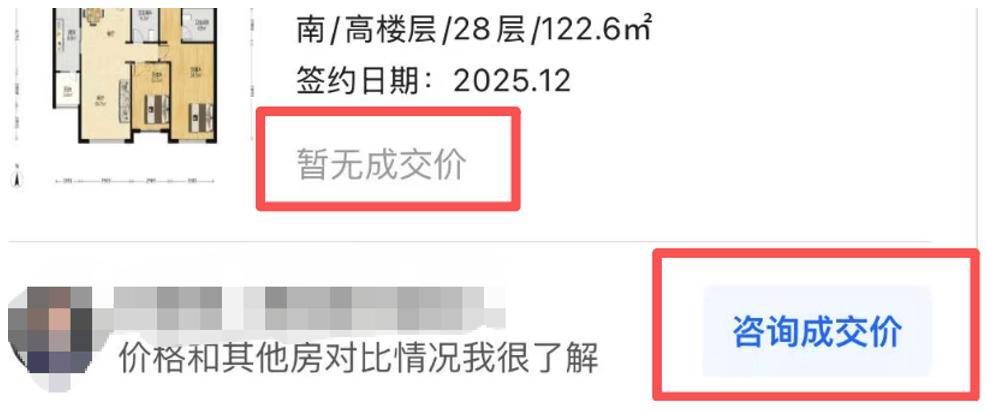
沈阳二手房成交价“隐身”!买卖双方陷入“盲猜”困局?
Sou Hu Cai Jing· 2025-12-28 06:45
Core Viewpoint - The recent decision to hide transaction prices for second-hand homes in various cities aims to stabilize market expectations and reduce panic selling, which has been exacerbated by extreme low-price transactions [3][9]. Group 1: Market Changes - The practice of concealing transaction prices began in July 2025 in major cities like Beijing, Shanghai, and Nanjing, and has now expanded to include cities like Chengdu and Suzhou, with Shenyang being one of the later adopters [3]. - The high volume of second-hand home listings and the economic environment have led to many homeowners selling at prices significantly below regional averages, creating a cycle of declining prices [3][9]. Group 2: Impact on Buyers - Buyers previously relied on public transaction records to gauge market prices, but the removal of this information increases the difficulty of making informed decisions, potentially leading to longer decision-making periods [4][6]. - Without low-price references, buyers may feel pressured to accept higher offers, which could lead to a sense of uncertainty and hesitation in the market [4][5]. Group 3: Impact on Sellers - Sellers face challenges in pricing their properties accurately, as the lack of transparent transaction data shifts pricing from being data-driven to relying on personal judgment [5][6]. - The adjustment in pricing strategies may lead to difficulties in selling homes, as sellers must navigate the balance between setting a competitive price and avoiding losses [5][6]. Group 4: Industry Implications - The change in transaction price visibility is seen as a potential opportunity for real estate agents, as it may increase client inquiries and communication opportunities [9]. - However, the industry faces the challenge of maintaining credibility; agents must provide professional pricing advice and transparent services to build trust in a market where information is less accessible [9]. - The high inventory of 245,000 second-hand homes in Shenyang, with some properties taking up to 18 months to sell, indicates a need for stability in the market, which the price concealment aims to address [9].

每周精读 | 2024年中国房企总土储货值排行榜TOP100发布;《阿联酋房地产住宅市场白皮书》重磅发布(5.19-5.23)
克而瑞地产研究· 2025-05-25 01:47
Core Insights - The article discusses the current state and future trends of the Chinese real estate market, highlighting significant declines in inventory value and profitability among major real estate companies [4][6]. Group 1: Inventory and Profitability - The total inventory value of 50 typical listed real estate companies in 2024 is reported at 7.98 trillion yuan, reflecting a substantial decrease of 15% compared to the end of the previous year [4]. - The industry's gross profit margin has dropped to 10%, with 72% of real estate companies reporting net profit losses [6]. - In 2024, the confirmed inventory impairment loss reached 167.7 billion yuan, marking a significant increase of 26% from 2023 [6]. Group 2: Debt and Liquidity - The liquidity pressure in the industry continues to escalate, with 84% of the 50 sample real estate companies having reduced cash holdings compared to the beginning of the period [7]. - 62% of companies have seen a deterioration in their adjusted unrestricted cash to short-term debt ratio, with the proportion of companies on the brink of default increasing by 2 percentage points to 72% [7]. Group 3: Market Trends and Recovery - The real estate market is expected to achieve a phase of "stabilizing expectations" by the first half of 2025, driven by financial policies, special bond storage, and improving indicators such as land auction enthusiasm, housing prices, and inventory reduction [9]. - The second-hand housing market in major cities like Beijing, Shanghai, Shenzhen, and Hangzhou is anticipated to continue its fluctuating trend, with stable demand for high-end and luxury properties [10]. - More than half of the monitored residential communities have seen a month-on-month increase in housing prices, indicating signs of stabilization in the second-hand housing market [11]. Group 4: International Market Insights - The UAE real estate market is analyzed as a high-growth emerging market, with favorable purchasing policies and a welcoming investment environment for global investors [14][15]. - Dubai's real estate market is characterized by active trading and a growing transaction scale, supported by a young population and a high proportion of expatriates [15]. - Abu Dhabi is emerging as a strategic investment hotspot, leveraging economic transformation, population vitality, and real estate appreciation potential [16]. Group 5: Regional Opportunities - Five key areas in Dubai (Downtown, Business Bay, Palm Jumeirah, Dubai Hills, and Al Furjan) are highlighted for their unique advantages and attractive projects [17].