
招标文件检测模型

Search documents
八部门:招投标领域要加快应用人工智能
Shang Hai Zheng Quan Bao· 2026-02-10 18:09
"这20个场景既是各地有益探索的总结,也是对当前招标投标实际需求的回应。"国家发展和改革委员会 新闻发言人表示:其一是运用数智技术更好保障"阳光交易";其二是运用数智技术更好助力竞争择优; 其三是运用数智技术更好提升监管效能。 ◎记者 于祥明 国家发展和改革委员会等八部门近日联合印发的《关于加快招标投标领域人工智能推广应用的实施意 见》(下称《意见》)提出,2026年底,招标文件检测、智能辅助评标、围串标识别等重点场景在部分 省市实现全覆盖应用;2027年底,更多重点场景在全国范围内推广应用。 国家发展和改革委员会新闻发言人表示,《意见》通过推动招标投标和人工智能深度融合,改进招标投 标范式,提升服务和监管的数智化水平,对于规范招标投标市场秩序,优化招标投标市场环境,推进全 国统一大市场建设具有重要意义。 在加快推进场景应用方面,《意见》围绕招标投标交易全过程和管理重点环节,提出"人工智能+"招 标、"人工智能+"投标、"人工智能+"开标和评标、"人工智能+"定标、"人工智能+"现场管理、"人工智 能+"监管等20个重点场景。 具体来看,招标环节,提出了招标策划、招标文件编制、招标文件检测3个场景;投标环节, ...
国家发改委以AI打破招投标“潜规则” 穿透式发现违法串通行为
Zhong Guo Jing Ying Bao· 2025-12-03 06:37
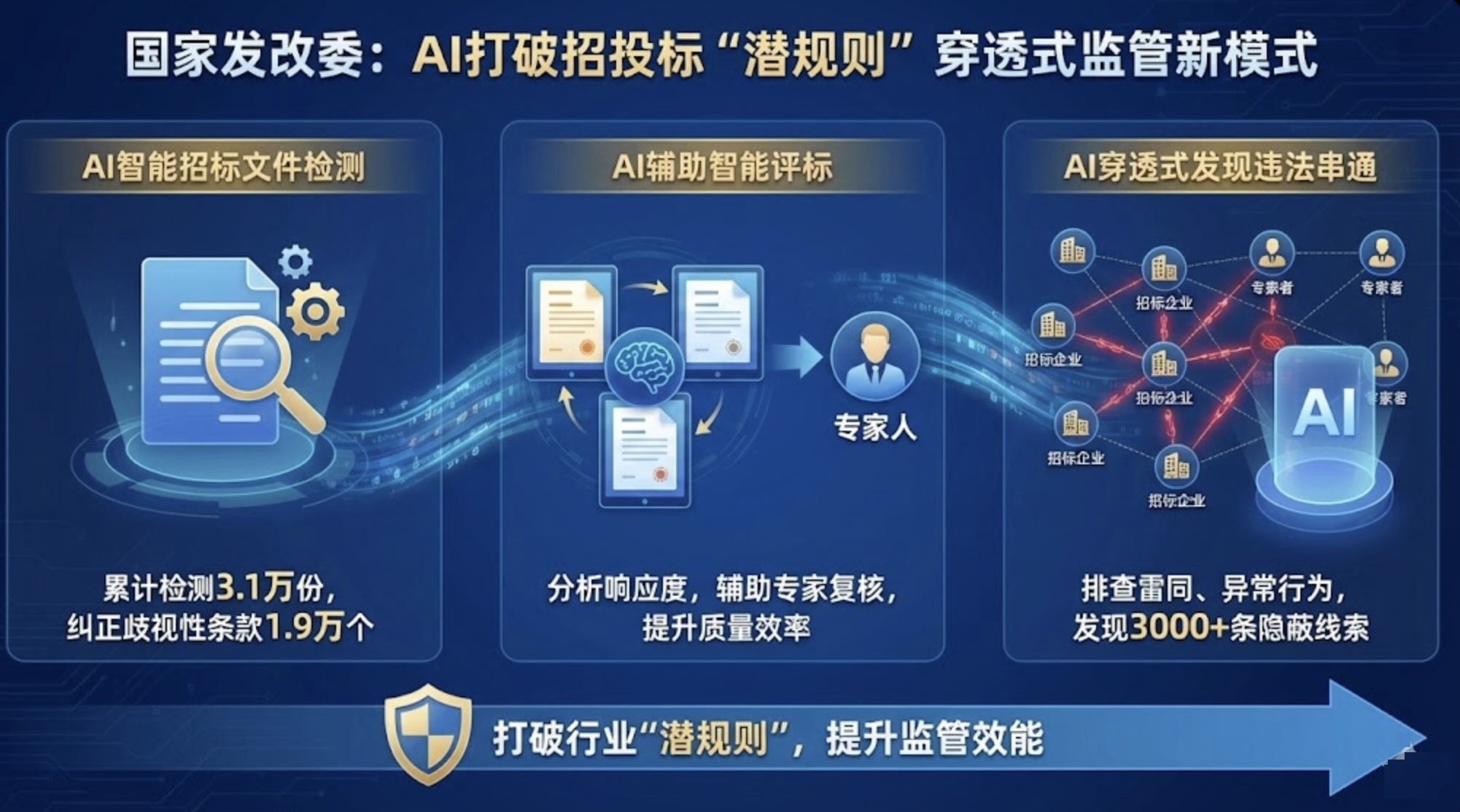
Group 1 - The core viewpoint of the article highlights the increasing application of artificial intelligence (AI) in the bidding process by the National Development and Reform Commission (NDRC) to address long-standing issues in the industry, such as complaints regarding bidding results [2][3] - The NDRC has initiated the use of AI in three key stages of the bidding process: tendering, bidding, and evaluation, aiming to enhance transparency and compliance [2] - AI technology has been employed to identify hidden issues such as collusion and abnormal bidding behaviors, with over 3,000 problem clues discovered in 21,000 projects that traditional regulatory methods failed to detect, thereby improving regulatory efficiency [3] Group 2 - The rapid integration of AI into various business sectors in China is underscored by a report indicating that Chinese respondents rank first in the Asia-Pacific region for the depth of AI application across business functions [4] - By June 2025, the user base for generative AI in China is projected to reach 515 million, with a half-year growth rate exceeding 106% and a penetration rate of 36.5%, indicating widespread adoption of domestic AI models [4] - The proliferation of generative AI is significantly lowering application barriers and providing reliable technological options for various industries, thus accelerating the process of industrial intelligence upgrades [4]

记者观察 | 招投标管理引入AI 不只是“一小步”
Shang Hai Zheng Quan Bao· 2025-11-28 12:10
Core Insights - The application of artificial intelligence (AI) in various sectors in China is gaining momentum, particularly in the public resource bidding sector, as the National Development and Reform Commission (NDRC) actively expands AI technology applications [1][2] Group 1: AI in Public Resource Bidding - The integration of AI in public resource bidding is a key reform task, with the NDRC promoting AI applications in the bidding, tendering, and evaluation processes [1] - In the tendering phase, AI technology is utilized to detect tender documents, automatically identifying unreasonable requirements that restrict competition. A total of 31,000 tender documents have been analyzed, correcting 19,000 discriminatory clauses [1] - During the bidding phase, AI helps uncover hidden issues such as similar characteristics among bidding companies and abnormal scoring tendencies by experts, identifying over 3,000 problem clues in 21,000 projects that traditional regulatory methods could not detect [1][2] Group 2: AI in Evaluation and Other Applications - In the evaluation phase, AI analyzes the responsiveness of tender requirements and bidding documents, facilitating a shift from human evaluations to a model where AI plays a primary role, with nearly 400 projects implementing intelligent evaluation models [2] - The "5G + Drone" low-altitude patrol system in Wuxi is another example of AI application, enhancing urban governance by covering 80 city management scenarios and addressing over 12,000 work orders [2] - The smart hotline system in Guangzhou's Baiyun District utilizes AI algorithms for rapid and accurate dispatch of service requests, achieving over 87% accuracy and reducing manpower by 90% [3] Group 3: Future Prospects and Government Role - The NDRC plans to continue strengthening guidance and exploring AI applications in various local contexts to enhance model functionality and support the healthy development of the bidding market [3] - AI is increasingly playing a significant role in government governance, with multiple departments exploring and implementing AI applications in bidding supervision, urban governance, and public service [3]