生成式人工智能

Search documents
美光崩盘背后:一场被“增长见顶”提前定价的芯片周期
美股研究社· 2026-03-31 13:15
Core Viewpoint - The most dangerous moment in the market is not when the fundamentals deteriorate, but when the fundamentals are still improving while expectations have peaked [1]. Group 1: Market Dynamics - Micron Technology's Q2 2026 earnings report was nearly perfect, with EPS soaring 756% year-over-year and guidance for Q3 showing a 1140% increase, yet the stock price reacted negatively [5]. - The market is transitioning from a focus on "dream rates" to "earnings rates," indicating a harsh return to reality for high-valuation growth stocks [1][6]. - The core misjudgment in the current downturn is that the market continues to interpret stock prices through "fundamental growth," neglecting the critical variable of growth rate inflection points [3]. Group 2: Growth Rate and Market Sentiment - When year-over-year growth reaches four digits, the market struggles to trade on "higher growth," as maintaining high percentage growth becomes increasingly difficult [5]. - Historical examples, such as Tesla in 2021, illustrate that stock price peaks do not equate to fundamental peaks; rather, they signify peaks in growth rates and profit margins [5]. - As the market realizes that a 1140% year-over-year growth is a limit, sequential growth rates are expected to decline from 162% to 58%, indicating a shift from an "acceleration phase" to a "deceleration phase" for the AI-driven storage supercycle [5]. Group 3: Demand and Supply Factors - Demand-side issues are evident as DDR5 spot prices have rapidly declined, with some channels experiencing weekly drops exceeding 30%, indicating a sudden inability to sustain demand [8]. - Global laptop shipment forecasts have been revised down from -9.2% to -14.8%, and smartphone shipments are expected to decline by 10%-15%, suggesting that rising storage prices are undermining their own demand base [8]. - On the supply side, Micron's long-term contracts with major clients are interpreted as a lack of confidence in future demand, as companies typically prefer spot pricing during upcycles [9]. Group 4: Emotional and Psychological Factors - The "反指效应" (reverse indicator effect) in institutional narratives suggests that when positive reports coincide with price declines, it signals a shift in liquidity rather than a trend judgment [9]. - The market consensus has shifted, with institutions now using positive reports as a cover for portfolio adjustments, indicating that when everyone believes in a "super cycle," it is often the time when positions are most vulnerable [9]. Group 5: Helium Supply Risk - Helium's critical role in semiconductor manufacturing, particularly in EUV lithography, presents a unique risk due to its supply chain vulnerabilities, with 64.7% of helium in South Korea dependent on Qatar [11]. - A potential disruption in helium supply could lead to a significant decline in yield and a collapse in supply, marking a different level of risk compared to previous demand shocks [12]. Group 6: Investment Strategy Shift - The combination of peak growth rates, weakening demand, supply uncertainties, and emotional shifts in the market suggests a transition from a "Davis Double" to a "Davis Double Kill" scenario for storage chips [15]. - Investors are moving away from "certainty narratives" towards "structural hedging" strategies, focusing on companies with strong free cash flow and buyback capabilities, rather than those reliant on high capital expenditures and external financing [15]. - The market is transitioning from a "growth faith" to a "value defense" approach, emphasizing the importance of identifying style shifts over predicting quarterly revenues [15].



你的亲友可能被“克隆”!国安部提醒
券商中国· 2026-03-26 04:28
Group 1 - The breakthrough in generative artificial intelligence technology is accelerating the popularization of AI video production, showcasing significant potential in enhancing creative efficiency and revitalizing historical memories, thus becoming a powerful tool for content production in the digital age [1] - However, if the technology is maliciously used for financial fraud, political infiltration, rumor creation, espionage, and other illegal activities, it could infringe on citizens' legitimate rights and interests, disrupt social order, and endanger national security [1] Group 2 - The National Security Agency has issued a warning that the "Regulations on the Management of Deep Synthesis Services for Internet Information Services" clearly state that no organization or individual may use deep synthesis services to engage in activities that harm national security and interests, damage the national image, infringe on social public interests, disrupt economic and social order, or violate others' legitimate rights [3] - Deep synthesis services, which possess public opinion attributes and social mobilization capabilities, must be filed for record, content audited, managed under real-name systems, and must not delete or alter identification marks; unauthorized use of biometric information such as faces and voices for malicious editing is strictly prohibited [3] - The technology itself is neutral; the key lies in how it is used. In the face of deepfake technology, every citizen should consciously enhance their security awareness, improve their discernment abilities, and comply with laws and regulations to actively maintain national security and a clear online environment [3]

让外部知识“长入”模型:动态化与参数化 RAG 技术探索
AI前线· 2026-03-25 04:22
Core Viewpoint - The article discusses the advancements in Retrieval-Augmented Generation (RAG) techniques, emphasizing the need for dynamic and parameterized approaches to enhance the integration of external knowledge into large language models (LLMs) [2][5][21]. Group 1: Background and Motivation - The emergence of large language models has transformed various aspects of life, providing natural interaction, superior language understanding, and remarkable task generalization [6][7]. - Despite their advantages, LLMs face significant limitations, including the "hallucination" problem, lack of traceability in generated results, and high inference costs [7][8]. Group 2: Challenges in Traditional RAG - Traditional RAG methods treat LLMs as static black boxes, relying on external document retrieval and prompt engineering, which leads to three core challenges: when to trigger retrieval, what content to retrieve, and how to inject external knowledge into the model [11][12][14]. - Current systems either default to always retrieving or rely on user-triggered searches, lacking the ability for models to autonomously determine when to retrieve information [11]. Group 3: Dynamic and Parameterized RAG Techniques - The proposed dynamic and parameterized RAG techniques aim to address the challenges of when to retrieve, what to retrieve, and how to inject knowledge by monitoring the internal state of the model in real-time [21][27]. - A lightweight monitor module can observe the model's internal state and determine when new information is needed, allowing for more efficient retrieval [27][29]. Group 4: Experimental Results - The dynamic retrieval model, named DRAGIN, outperformed several baseline models in accuracy while significantly reducing the number of retrieval calls, demonstrating its efficiency [32][35]. - In various public datasets, DRAGIN achieved notable improvements in evaluation metrics compared to traditional static retrieval methods [33][36]. Group 5: Decoupling Retrieval and Generation - The article introduces a framework that decouples the injection of external knowledge from the context input, allowing for real-time dynamic retrieval without overwhelming the model with excessive context [44][46]. - This approach enhances efficiency and performance by processing external documents offline and using a cross-attention mechanism to integrate knowledge without diluting the original instructions [46][49]. Group 6: Parameterized Knowledge Injection - The concept of parameterized knowledge injection involves encoding external documents into low-dimensional vectors or learnable parameters, which can be integrated into the model's feed-forward network during inference [55][62]. - This method allows for seamless integration of external knowledge, enabling the model to utilize it as if it were internal memory, thus overcoming the limitations of traditional prompt-based methods [58][64]. Group 7: Future Directions - The future research agenda includes developing sustainable learning frameworks that bridge the gap between internal parameters, external memory, and real-time perception, ultimately redefining the role of retrieval in general artificial intelligence [75][79].

香农芯创(300475):企业级存储需求旺盛,“海普存储”实现年度盈利
Huaxin Securities· 2026-03-22 12:33
Investment Rating - The investment rating for the company is upgraded to "Buy" [5] Core Insights - The demand for enterprise-level storage is robust, driven by the growth of generative artificial intelligence, leading to an expected revenue increase of over 40% year-on-year in 2025, with net profit projected to reach between 480 million to 620 million yuan, representing a year-on-year growth of 81.77% to 134.78% [3][4] - The company's proprietary brand "Haipu Storage" has entered mass production and is expected to achieve annual profitability for the first time in 2025, with projected sales revenue of 1.7 billion yuan, including 1.3 billion yuan in the fourth quarter [3][4] - The company has established itself as a leader in semiconductor distribution, securing long-term partnerships with renowned manufacturers and gaining distribution rights from major brands like SK Hynix and AMD, which enhances its competitive edge [4] Financial Projections - Revenue forecasts for 2025 to 2027 are 352.73 billion yuan, 462.89 billion yuan, and 570.14 billion yuan respectively, with EPS projected at 1.17 yuan, 2.36 yuan, and 3.47 yuan, corresponding to PE ratios of 134, 67, and 45 times [5][7] - The company anticipates a significant increase in net profit, with projections of 1.1 billion yuan in 2026 and 1.6 billion yuan in 2027, reflecting growth rates of 101.9% and 46.9% respectively [7][8]

香农芯创:公司动态研究报告:企业级存储需求旺盛,“海普存储”实现年度盈利-20260322
Huaxin Securities· 2026-03-22 10:24
Investment Rating - The investment rating for the company is upgraded to "Buy" [2][7] Core Insights - The demand for enterprise-level storage is robust, driven by the growth of generative artificial intelligence, leading to an expected revenue increase of over 40% year-on-year in 2025, with net profit projected to reach between 480 million to 620 million yuan, representing a growth of 81.77% to 134.78% [4] - The company's proprietary brand "Haipu Storage" has entered mass production and is expected to achieve annual profitability for the first time in 2025, with projected sales revenue of 1.7 billion yuan [5] - The company has established itself as a leader in semiconductor distribution, securing long-term partnerships with major manufacturers and gaining distribution rights from notable brands such as SK Hynix and AMD, enhancing its competitive edge [6] Financial Projections - Revenue forecasts for 2025 to 2027 are 352.73 billion yuan, 462.89 billion yuan, and 570.14 billion yuan respectively, with earnings per share (EPS) projected at 1.17 yuan, 2.36 yuan, and 3.47 yuan [7][9] - The company is expected to maintain a strong growth trajectory, with a revenue growth rate of 45.3% in 2025 and 31.2% in 2026 [9] - The return on equity (ROE) is projected to increase significantly, reaching 27.2% by 2027 [9]
英伟达:全球最大半导体供应商!
国芯网· 2026-03-20 04:31
Group 1 - The core viewpoint of the article emphasizes the significant growth and dominance of NVIDIA in the semiconductor industry, particularly due to the rise of generative artificial intelligence [2][4]. - NVIDIA has achieved record revenue for 11 consecutive quarters, reaching $68.127 billion in the fourth quarter of fiscal year 2026, ending January 25, 2023 [2]. - Market research indicates that NVIDIA will continue to lead in revenue, projected to reach $97.395 billion in 2024 and $150.301 billion in 2025, significantly outpacing competitors like Samsung Electronics and TSMC [5]. Group 2 - Samsung Electronics is projected to be the second-highest semiconductor supplier, with revenues of $75.091 billion in 2024 and $85.759 billion in 2025, although the gap with NVIDIA is widening [5]. - TSMC reported revenue of $122.424 billion last year, but is not classified as a chip supplier since it primarily provides foundry services for companies like NVIDIA and Apple [5].

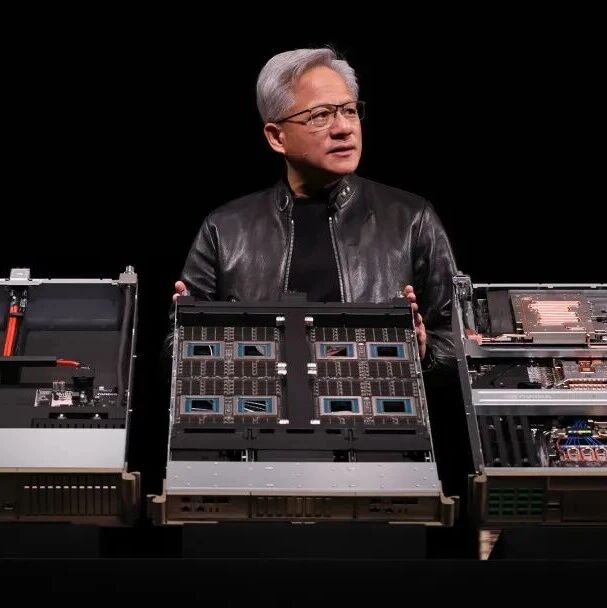
英伟达已连续两年成为全球最大半导体供应商 去年营收遥遥领先
Xin Lang Cai Jing· 2026-03-19 12:01
Core Insights - Nvidia has significantly benefited from the recent surge in generative artificial intelligence, with its computing chips being widely purchased by various manufacturers, leading to a substantial increase in its performance and revenue [2][3] - Nvidia has achieved record revenue for 11 consecutive quarters, reaching $68.127 billion in the fourth quarter of fiscal year 2026, ending January 25 of this year [2][3] - According to market research reports, Nvidia has been the highest revenue-generating semiconductor supplier globally for two consecutive years, with projections of $97.395 billion and $150.301 billion in revenue for 2024 and 2025, respectively [2][3] Competitor Analysis - Samsung Electronics is projected to be the second-highest semiconductor supplier in 2024 and 2025, with revenues of $75.091 billion and $85.759 billion, respectively, although the gap with Nvidia is widening [4] - TSMC, while not classified as a semiconductor supplier due to its role as a foundry for companies like Nvidia and Apple, reported revenue of $122.424 billion last year, making it the closest competitor to Nvidia in the semiconductor field [4]
CVPR 2026 | EmoStyle:情感也能“风格化”?深大VCC带你见证魔法!
机器之心· 2026-03-19 02:59
Core Viewpoint - EmoStyle aims to simplify the process of emotional image stylization by allowing users to express their desired emotions, which the system then translates into artistic images without requiring artistic skills [4][8]. Group 1: EmoStyle Overview - EmoStyle is developed by the Visual Computing Research Center at Shenzhen University, led by Professor Huang Hui, focusing on interdisciplinary innovation in computer graphics and visual analysis [2]. - The project introduces Affective Image Stylization (AIS), which seeks to evoke specific emotions while maintaining semantic consistency with the original image [5][8]. Group 2: Challenges and Contributions - The main challenges addressed include the lack of training data for "content-emotion-stylization" image triplets and establishing a mapping between emotion and style [5][8]. - EmoStyleSet is constructed as the first AIS dataset, containing 10,041 high-quality triplets to advance visual emotion research [8]. Group 3: Methodology - EmoStyle incorporates two key modules: the Emotion-Content Reasoner, which determines the most suitable style based on the content image and target emotion, and the Style Quantizer, which discretizes style features for better interpretability [14][16]. - The training process involves optimizing the network through style loss, flow matching loss, and alignment loss to balance style similarity, pixel similarity, and emotional correctness [18][19]. Group 4: Experimental Results - EmoStyle demonstrates superior performance in emotional expression and content retention compared to other methods, achieving a balance that results in aesthetically pleasing and emotionally impactful stylized images [22][25]. - Quantitative evaluations show EmoStyle surpassing other methods in semantic, style, and emotional metrics, indicating its effectiveness in the AIS task [26]. Group 5: Future Directions - EmoStyle has potential applications beyond image stylization, including text-to-image generation, allowing for the creation of emotionally expressive images based on textual descriptions [31]. - The research group plans to continue exploring the intersection of affective computing and generative AI, contributing new ideas and methods to the field [34].

2026年中国GenAI+教育行业发展报告
艾瑞咨询· 2026-03-17 00:08
Core Insights - The article emphasizes that 2025 will be a pivotal year for smart education in China, driven by advancements in Generative AI (GenAI) technologies, which are set to transform educational productivity and personalized learning experiences [1][7][10] - The report identifies a 40/60 split in education, where 40% of educational tasks can be automated by technology, while 60% remains the domain of human educators, focusing on emotional engagement and complex problem-solving [2][5] Group 1: Technological Impact on Education - GenAI technology is expected to bring significant changes in educational information forms, tool applications, spatial scenarios, and organizational structures, aiming for scalable personalized supply and quantifiable teaching outcomes [3][7] - The report highlights that GenAI will facilitate a shift from static teaching information to dynamic, interactive learning experiences, enhancing the role of AI as a cognitive partner in the learning process [3][10] Group 2: Market Growth and Projections - The Chinese AI industry is projected to maintain a compound annual growth rate (CAGR) of 32.1% from 2025 to 2029, with the market size expected to exceed 1 trillion yuan by 2029 [7][10] - By 2025, the total scale of GenAI-related educational products and services is anticipated to reach approximately 344.2 billion yuan, with a CAGR of 37% expected to drive growth to 891 billion yuan by 2028 [18][19] Group 3: School and Consumer Market Dynamics - In the school sector, GenAI-related procurement is expected to account for 25%-35% of total purchases in higher education and 20%-30% in primary and secondary education, with significant growth anticipated in the coming years [10][12] - The consumer market for education is projected to reach 1.3 trillion yuan by 2025, with GenAI products covering 15%-20% of adult education and 10%-15% of K12 education segments [15][18] Group 4: GenAI Usage in Educational Settings - GenAI is significantly penetrating adult learning, K12 self-study, and parental tutoring scenarios, with 57.3% of parents using GenAI applications to assist their children [12][13] - The report indicates that GenAI applications are becoming integral to daily family education and personal development, with 74.8% of children accessing GenAI through general AI assistants [13][15] Group 5: Parental Attitudes and Concerns - Parents exhibit a cautious yet positive attitude towards GenAI, recognizing its potential to enhance learning while expressing concerns about over-reliance and reduced critical thinking in children [54][60] - The report outlines that GenAI is reshaping parental education spending, transitioning from traditional high-investment strategies to more efficient AI-driven solutions [57][66] Group 6: GenAI Procurement Characteristics - In higher education, approximately 27% of procurement projects involve GenAI, with a focus on smart teaching and campus management solutions [21][24] - Vocational colleges show a 35% involvement of GenAI in procurement, emphasizing its application in smart teaching and practical training environments [27][30] Group 7: Future Trends and Competitive Landscape - The market for educational vertical models is evolving towards a focus on scene-specific applications and value delivery, with competition intensifying among tech giants, traditional education firms, and startups [74][79] - The integration of general and vertical models is becoming a common strategy among leading educational technology companies, enhancing their competitive edge in the AI education sector [79]


2025年中国企业级AI应用行业研究报告
艾瑞咨询· 2026-03-16 00:07
Core Insights - The article emphasizes the transition of enterprise-level AI applications from a technology exploration phase to a large-scale application phase, driven by advancements in large language models and the need for systematic, end-to-end implementation capabilities [1][14][27]. Application Layer - AI Agents are identified as the core vehicle for enterprise-level AI application deployment, facilitating deep integration with business processes through task decomposition and various operational methods [1][29]. - The focus is on enhancing operational efficiency, knowledge augmentation, and value innovation as the three main directions for enterprise-level AI applications [17] Supporting Layer - A data-centric approach is essential for model selection, emphasizing the construction of a Data+AI foundation and a data security system tailored for AI applications [1][41]. Infrastructure Layer - The evolution of AI computing infrastructure is highlighted, with a shift towards heterogeneous systems and the importance of deep collaboration between software and hardware in the context of domestic alternatives [1][50][53]. Organizational Layer - The article discusses the necessity for top-level design and role upgrades among employees to drive AI transformation within enterprises [1][56][60]. Vendor Landscape - The enterprise-level AI application market is characterized by four main types of vendors: application software, technical services and solutions, cloud services, and AI model providers, creating a dynamic competitive landscape [2][65]. Development Trends - Key trends include the evolution of large models from single Transformer architectures to multi-architecture iterations, the deep integration of AI into business processes, and the emergence of AI-native applications [2][8]. Policy Support - The article outlines the supportive policies driving AI integration across various sectors, aiming for widespread application and deep integration by 2027 [6][8]. Financing Landscape - Over 50% of financing events in the AI sector are concentrated in the application layer, with AI+ healthcare emerging as a popular investment area [12]. Challenges in Scaling - The article identifies data quality, talent shortages, and the lack of quantifiable value measurement as the three main bottlenecks hindering the large-scale deployment of enterprise-level AI applications [23]. AI Agent Framework - The framework for AI Agent deployment emphasizes a triadic support system of AI technology, software engineering, and human intervention to ensure reliability in complex task execution [31][37]. Data Management - The construction of AI-Ready data platforms is crucial for effective data governance, enabling real-time, multi-modal data processing to enhance AI application value [45]. Talent Transformation - The article stresses the need for a fundamental shift in roles and capabilities within organizations, with business personnel becoming AI collaborators and technical teams transitioning to value enablers [60]. ROI Assessment - The challenges in assessing ROI for AI projects are discussed, advocating for a layered, dynamic evaluation framework rather than a singular, precise ROI figure [63].