
文远知行GXR自动驾驶套件

Search documents
文远、小马世纪和解:敲钟现场握手 然后双双破发
Di Yi Cai Jing· 2025-11-06 09:35
Core Insights - Both Xiaoma Zhixing and Wenyuan Zhixing listed on the Hong Kong Stock Exchange on November 6, with share prices falling over 9% on their debut [2][4] - A dispute arose between the two companies regarding allegations of false claims made by Xiaoma Zhixing against Wenyuan Zhixing, which was publicly addressed by Wenyuan's CFO [2][6] - The two CEOs appeared together at the listing ceremony, indicating a resolution to their previous conflicts [3] Company Performance - Xiaoma Zhixing issued 48.249 million shares at a price of 139 HKD per share, raising approximately 6.707 billion HKD, while Wenyuan Zhixing issued 88.25 million shares at 27.1 HKD, raising around 2.39 billion HKD [4] - Both companies reported significant losses, with Xiaoma Zhixing's net losses projected at 148 million USD, 125 million USD, and 274 million USD from 2022 to 2024, and Wenyuan Zhixing's losses at 1.299 billion CNY, 1.949 billion CNY, and 2.517 billion CNY over the same period [5] Market Competition - The autonomous driving industry is entering a critical phase of commercialization, with increasing competition among companies [6] - Wenyuan Zhixing claims to have a fleet of over 700 Robotaxi vehicles and has been providing services in multiple cities, countering Xiaoma Zhixing's assertions of limited operations [6] - The Robotaxi market is projected to reach 66.6 billion USD by 2030 and 352.6 billion USD by 2035, indicating significant growth potential [7]

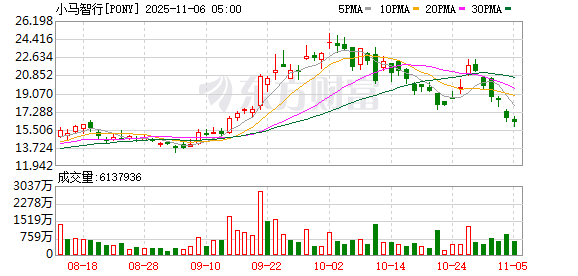
文远、小马世纪和解:敲钟现场握手,然后双双破发
Di Yi Cai Jing· 2025-11-06 09:26
Core Insights - The recent dual listing of Pony.ai and WeRide on the Hong Kong Stock Exchange has seen both companies experience significant share price declines, with losses exceeding 9% on their first trading day [1][3] - A public dispute arose between the two companies regarding allegations of false claims made by Pony.ai against WeRide, which were subsequently addressed by WeRide's CFO [1][5] - Both companies are competing for dominance in the Robotaxi market, with significant revenue growth reported in their Robotaxi operations [3][5] Company Performance - Pony.ai's global offering consisted of approximately 48.25 million shares, priced at 139 HKD per share, raising around 6.707 billion HKD, while WeRide's offering totaled approximately 88.25 million shares at 27.1 HKD, raising about 2.39 billion HKD [3] - Despite revenue growth in their Robotaxi segments, both companies remain in a loss-making position, with projected losses for Pony.ai and WeRide from 2022 to 2024 amounting to 148 million USD and 1.299 billion CNY respectively [4] Market Competition - The autonomous driving industry is entering a critical phase of commercialization, with intensified competition among companies [5][6] - WeRide claims to have a more extensive operational footprint and technological capabilities compared to Pony.ai, which has not publicly responded to these assertions [5] - The Robotaxi market is projected to grow significantly, with estimates suggesting a global market size of 66.6 billion USD by 2030 and 352.6 billion USD by 2035 [6]

文远知行与联想合作,首发搭载NVIDIA DRIVE Thor芯片车规级HPC 3.0计算平台
news flash· 2025-07-21 11:35
Core Insights - The autonomous driving technology company, WeRide, has officially launched the HPC 3.0 high-performance computing platform, co-developed with Lenovo Vehicle Computing, featuring NVIDIA's latest DRIVE Thor X chip [1] - The new computing platform has been first applied in WeRide's next-generation Robotaxi GXR, resulting in a 50% reduction in the cost of the GXR autonomous driving suite [1] Summary by Categories - **Product Launch** - WeRide has introduced the HPC 3.0 high-performance computing platform [1] - The platform is developed in collaboration with Lenovo Vehicle Computing [1] - It utilizes NVIDIA's latest DRIVE Thor X chip [1] - **Cost Efficiency** - The implementation of the HPC 3.0 platform has led to a 50% decrease in the cost of the GXR autonomous driving suite [1] - **Application** - The new computing platform is first used in WeRide's next-generation Robotaxi GXR [1]


