新型热控涂层

Search documents
“星际快递”送达!新认识、新发现 在轨实验长期滚动实施“全”释硬科技↓
Yang Shi Wang· 2025-11-15 05:54
Core Points - The Shenzhou-20 astronaut crew safely returned to Beijing on November 14, 2023, and will undergo a recovery period with medical evaluations [1] - Accompanying the astronauts were space medicine experiment samples weighing 3.2 kilograms, supporting 19 space medicine research projects [2][4] - The ninth batch of space science experiment samples, weighing 46.67 kilograms, was also successfully delivered for further research [4][6] Group 1: Astronaut Return and Medical Samples - The Shenzhou-20 astronaut crew, including Chen Dong, Chen Zhongrui, and Wang Jie, received a warm welcome upon their return [1] - The medical samples include 199 samples across seven categories, such as blood and urine, aimed at analyzing the effects of microgravity on human health [2][4] - The research will focus on various aspects, including bone metabolism and brain homeostasis, using advanced omics technologies [4] Group 2: Space Science Experiment Samples - The ninth batch of space science samples includes living organisms like mice and zebrafish, as well as various materials for testing [6][8] - Scientists will conduct biological analyses on the returned cell samples to understand the impact of microgravity on biological functions [8] - Material samples will be tested for their growth and composition under microgravity, contributing to future applications in space exploration [10][13] Group 3: Research and Development Goals - The ongoing experiments in the space laboratory are expected to yield original and internationally influential scientific results [12] - Research on combustion samples aims to provide insights for new energy systems and advanced nanocarbon materials [13]


大批空间科学实验样品随神二十乘组返回 都有啥?108秒快速了解→
Yang Shi Wang· 2025-11-14 10:14
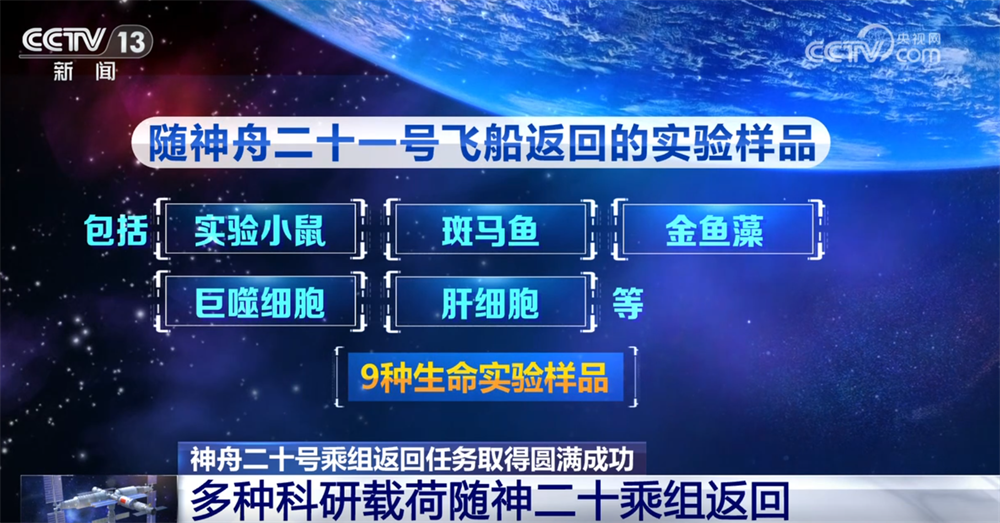
Core Insights - A large number of space science experiment samples, including mice, successfully returned with the Shenzhou 21 spacecraft [1] - The experiment mice lived in the Chinese space station for nearly two weeks, which is about double the planned duration [4] - The research aims to understand the stress responses and adaptive changes of mice in space, providing scientific basis for the effects of space environments on living organisms [4] Group 1: Experiment Samples - The returned samples include nine types of biological experiment samples such as mice, zebrafish, and macrophages [1] - Various material samples were also included, such as tungsten-hafnium alloys, soft magnetic materials, and new thermal control coatings [1] Group 2: Research and Development - The entire process of feeding and caring for mice in space has been successfully established, laying a solid foundation for future large-scale mammal cultivation and research in space [6] - The research on mice is expected to help understand potential impacts on humans in microgravity, including effects on muscles and bones [6]