智能电器馆

Search documents
美凯龙:截至2025年第三季度,公司自营商场平均出租率已从年初的83%提升至84.72%
Zheng Quan Ri Bao Zhi Sheng· 2026-01-05 13:17
Core Viewpoint - The company is leveraging government subsidy policies to reduce consumer purchasing costs, stimulate demand, and enhance sales and tenant confidence, leading to improved rental rates [1] Group 1: Government Policies and Market Impact - The continuous optimization of national subsidy policies directly lowers consumer costs, stimulates demand, and effectively increases foot traffic in malls [1] - The company is actively including its malls in government subsidy lists, positioning them as key channels for policy implementation [1] Group 2: Business Performance and Metrics - As a result of improved merchant sales, the average rental rate of the company's self-operated malls increased from 83% at the beginning of the year to 84.72% by the third quarter of 2025 [1] - Core operational indicators are stabilizing and showing positive trends [1] Group 3: Strategic Initiatives and New Business Development - The company has established over 150 smart appliance stores and is deeply integrated with leading brands, reinforcing its position as a critical industry channel [1] - The expansion of policy coverage to smart home and elderly-friendly products aligns with the company's "3+Star Ecosystem" strategy, allowing for the development of new business areas such as high-end appliances, smart home solutions, elderly care facilities, and automotive integration [1] - The influx of customer traffic and sales from these policies enhances the company's brand strength and expansion capabilities in light-asset models like managed malls and franchising, enabling growth with lower capital expenditure [1]

红星美凯龙:亏了31亿,关店33家
Xin Lang Cai Jing· 2025-11-27 10:13
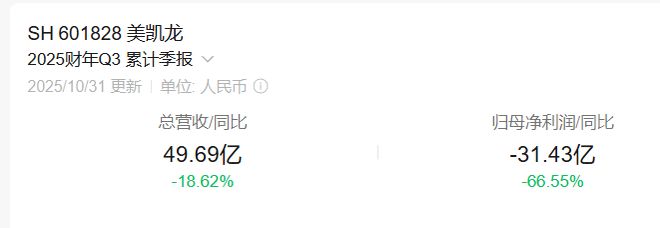
Core Insights - The financial report of Red Star Macalline for Q3 2025 reveals significant challenges faced by the company in the current market environment, with a quarterly revenue of 4.969 billion yuan, a year-on-year decline of 18.6%, and a net loss attributable to shareholders of 3.143 billion yuan, down 66.55% year-on-year [1][2] Financial Performance - The net loss of 3.143 billion yuan is largely attributed to a 3.327 billion yuan decline in the fair value of investment properties, reflecting the impact of real estate market fluctuations and the deep ties between the home furnishing industry and the real estate market [2] - Revenue decreased by 18.6% to 4.969 billion yuan, influenced by the company's strategic decision to downsize non-core businesses and the pressure on rental prices in a saturated market [2] Operational Developments - Despite the losses, there are signs of operational improvement, with core business operating profit doubling to approximately 200 million yuan, and net cash flow from operating activities increasing by 1.17 billion yuan to 640 million yuan compared to the same period last year [3] - The occupancy rate of self-operated malls improved from 83% to 84.7%, indicating a slight recovery in business fundamentals [3] Strategic Initiatives - The company has initiated a comprehensive self-rescue strategy focusing on three main lines: 1. "Survival through Disengagement" by closing 33 malls to reallocate resources to more promising areas, such as smart appliance stores and new energy vehicle showrooms, which are expected to drive future growth [4] 2. Building a "Commercial Ecosystem" by introducing innovative business formats that enhance consumer experiences, aiming to create a more integrated shopping environment [4] 3. Implementing lean operations across the entire chain, with sales and management expenses decreasing by 18% and 19.9% respectively, reflecting cost-cutting efforts [4] Market Positioning - The company is navigating a challenging landscape, balancing the need to contract traditional business while investing in new formats for future growth, which tests its strategic resolve and execution capabilities [4] - The approach of integrating various business formats raises questions about its effectiveness compared to competitors focusing on digitalization, and whether the development cycle of new formats can outpace asset depreciation [4]