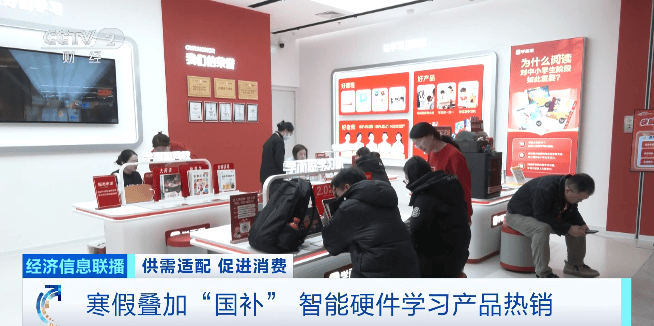
智能硬件学习产品

Search documents
寒假叠加“国补”智能硬件学习产品热销 市场广阔产品技术更新“快马加鞭”
Yang Shi Wang· 2026-01-30 06:18
Group 1 - The core viewpoint of the articles highlights the growing demand for intelligent hardware learning products in the education sector, driven by seasonal sales peaks and government subsidies [1][2] - The market for educational intelligent hardware is projected to reach 96.2 billion yuan in 2024, with an expected growth to 112.5 billion yuan by 2025, indicating a significant increase in consumer interest and spending [1] - The intelligent learning machine market is expected to grow to 27.072 billion yuan in 2024, reflecting a year-on-year increase of 48.27%, with projections of reaching 51.441 billion yuan by 2027 [1] Group 2 - The demand for intelligent hardware learning products is becoming increasingly segmented, with companies accelerating their technology updates to meet specific consumer needs [2] - A notable example includes a portable Q&A pen that has been upgraded to include features such as guided Q&A and video responses, demonstrating the rapid pace of innovation in the sector [2] - The active usage rate of traditional intelligent learning hardware has increased from 20% to 50-60% due to faster software iteration cycles, now occurring monthly instead of every three months [2] Group 3 - The development of intelligent hardware products is focusing on personalization, proactivity, and companionship to cater to diverse application needs in educational settings [3] - A platform has been created for teachers that offers over 170 intelligent agents, allowing them to generate interactive lesson materials with simple commands, showcasing the integration of AI in teaching [3] Group 4 - The market for student-oriented intelligent products, such as emotional support robots and eye-health-conscious hardware, is expanding, but product development must align with actual user needs rather than just emphasizing "intelligence" [4] - There is a call for improved functionality in AI tools used in classrooms, particularly for simulating real-life experiments in science education [4] Group 5 - The implementation plan by various government departments emphasizes enhancing the supply of quality student products and integrating traditional stationery with intelligent hardware [5] - The focus on practical intelligent products that fit learning scenarios is crucial for both students and teachers, with a push for embedding comprehensive teaching processes into intelligent systems [5] - Industry standards for student products are being developed to ensure better adaptability to diverse consumer needs, which is essential for upgrading the student supplies market [5]
寒假叠加“国补”,智能学习产品迎销售高峰,消费者青睐AI定制方案
Sou Hu Cai Jing· 2026-01-29 14:59
Core Insights - The article highlights a surge in sales of smart hardware learning products due to the winter vacation and government education subsidies, indicating a shift in consumer expectations towards higher functionality [1][5]. Group 1: Market Trends - Many regions are experiencing a peak in sales of smart learning hardware as winter vacations begin and government subsidies are introduced [1]. - In Beijing, the price range for smart learning products is between 2,000 to over 10,000 yuan, with additional subsidies of 300 to 500 yuan available [5]. - A store manager reported that foot traffic and sales are at their highest in six months, with daily sales reaching nearly 100 units in Beijing [7]. Group 2: Consumer Expectations - Consumers are increasingly looking for smart learning products to evolve from mere "content players" to "intelligent learning partners" as AI technology becomes more integrated into educational settings [9]. - The market for educational smart hardware in China is projected to reach 96.2 billion yuan in 2024, with an expected growth to 112.5 billion yuan by 2025 [11]. - The market for smart learning machines alone is anticipated to grow to 27.072 billion yuan in 2024, reflecting a year-on-year increase of 48.27%, and is expected to reach 51.441 billion yuan by 2027 [11].