智能运动追踪器

Search documents
行业聚焦:全球智能运动追踪器行业头部生产商市场份额及排名调查(附核心企业名单)
QYResearch· 2026-01-29 03:47
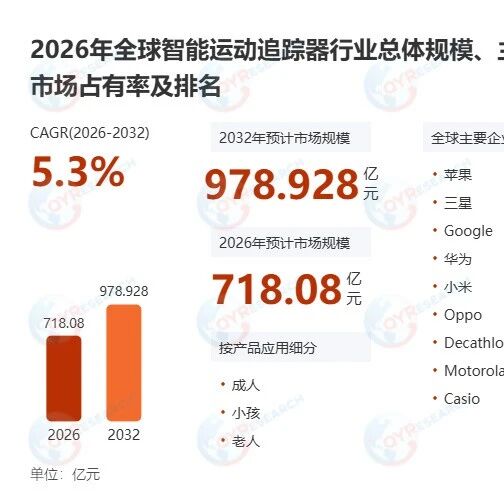
Core Viewpoint - The global smart fitness tracker market is projected to reach $14.4 billion by 2032, with a compound annual growth rate (CAGR) of 5.3% from 2026 to 2032 [3][19]. Global Market Overview - The smart fitness tracker market is expected to grow significantly, with a forecasted market size of $14.4 billion by 2032, reflecting a CAGR of 5.3% [3][19]. - Major manufacturers in the global market include Apple, Samsung, Google, Huawei, Xiaomi, Oppo, Decathlon, Motorola, and Casio, with a concentration of manufacturing in East Asia due to its robust supply chain and cost-effective production capabilities [5]. Industry Chain Analysis - The industry chain consists of upstream components such as sensors and core electronic parts, midstream brand owners and product engineering, and downstream consumers and enterprise applications [7]. - Upstream components include PPG optical heart rate modules, accelerometers, GPS, and various electronic parts [7]. - Midstream activities involve industrial design, firmware development, and product management [7]. - Downstream, consumers utilize fitness trackers for monitoring health metrics, while enterprises leverage aggregated data for health programs [7]. Regulatory Environment - The EU's AI Act classifies fitness trackers with clinical-grade monitoring functions as "high-risk AI systems," requiring third-party audits and transparency reports [8]. - The FDA is reclassifying fitness trackers with ECG or continuous blood pressure monitoring capabilities as Class II medical devices, necessitating pre-market approval [8]. - The EU Digital Product Passport initiative mandates manufacturers to provide lifecycle data for devices to enhance supply chain transparency [8]. Industry Development Trends - There is a shift towards clinical-grade health functionalities and medical validation, with manufacturers integrating advanced biometric sensors and seeking regulatory certifications [9]. - AI-driven personalized services are being embedded in trackers to provide tailored health insights and proactive health guidance [9]. - The industry is moving towards sustainable manufacturing practices, including the use of recyclable materials and modular designs [9]. - Fitness trackers are increasingly integrating into broader smart ecosystems, enhancing user experience through seamless data flow across devices [9]. Development Opportunities - Emerging markets in Southeast Asia, Africa, and Latin America present significant opportunities for localized innovations in affordable fitness trackers [10]. - The integration of clinical-grade fitness trackers into formal healthcare systems offers growth potential, particularly for chronic disease monitoring [10]. - B2B opportunities are expanding as companies invest in employee health management programs, creating demand for customized fitness tracker solutions [10]. - There is a notable unmet demand for inclusive products targeting underserved populations, such as the elderly and individuals with disabilities [10]. Industry Challenges - The industry faces regulatory complexities and fragmentation, with varying regional regulations impacting compliance costs and market entry [11]. - Data privacy and cybersecurity concerns are heightened as fitness trackers collect sensitive biometric data, necessitating robust security measures [11]. - Market saturation and commoditization pressures are leading to intense price competition and challenges in product differentiation [11]. - Limitations in accuracy and user trust regarding biometric tracking can hinder the adoption of fitness trackers in clinical applications [11].