
可持续制造

Search documents
行业聚焦:全球智能运动追踪器行业头部生产商市场份额及排名调查(附核心企业名单)
QYResearch· 2026-01-29 03:47
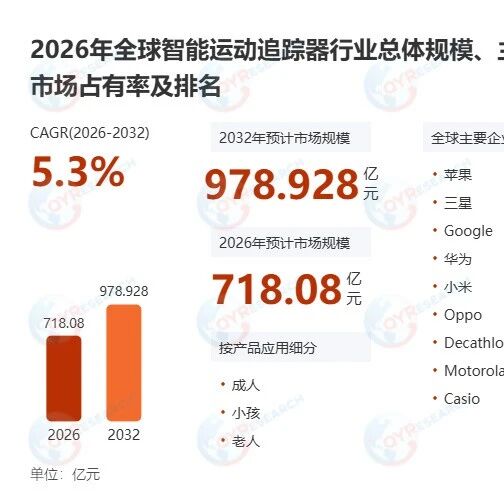
Core Viewpoint - The global smart fitness tracker market is projected to reach $14.4 billion by 2032, with a compound annual growth rate (CAGR) of 5.3% from 2026 to 2032 [3][19]. Global Market Overview - The smart fitness tracker market is expected to grow significantly, with a forecasted market size of $14.4 billion by 2032, reflecting a CAGR of 5.3% [3][19]. - Major manufacturers in the global market include Apple, Samsung, Google, Huawei, Xiaomi, Oppo, Decathlon, Motorola, and Casio, with a concentration of manufacturing in East Asia due to its robust supply chain and cost-effective production capabilities [5]. Industry Chain Analysis - The industry chain consists of upstream components such as sensors and core electronic parts, midstream brand owners and product engineering, and downstream consumers and enterprise applications [7]. - Upstream components include PPG optical heart rate modules, accelerometers, GPS, and various electronic parts [7]. - Midstream activities involve industrial design, firmware development, and product management [7]. - Downstream, consumers utilize fitness trackers for monitoring health metrics, while enterprises leverage aggregated data for health programs [7]. Regulatory Environment - The EU's AI Act classifies fitness trackers with clinical-grade monitoring functions as "high-risk AI systems," requiring third-party audits and transparency reports [8]. - The FDA is reclassifying fitness trackers with ECG or continuous blood pressure monitoring capabilities as Class II medical devices, necessitating pre-market approval [8]. - The EU Digital Product Passport initiative mandates manufacturers to provide lifecycle data for devices to enhance supply chain transparency [8]. Industry Development Trends - There is a shift towards clinical-grade health functionalities and medical validation, with manufacturers integrating advanced biometric sensors and seeking regulatory certifications [9]. - AI-driven personalized services are being embedded in trackers to provide tailored health insights and proactive health guidance [9]. - The industry is moving towards sustainable manufacturing practices, including the use of recyclable materials and modular designs [9]. - Fitness trackers are increasingly integrating into broader smart ecosystems, enhancing user experience through seamless data flow across devices [9]. Development Opportunities - Emerging markets in Southeast Asia, Africa, and Latin America present significant opportunities for localized innovations in affordable fitness trackers [10]. - The integration of clinical-grade fitness trackers into formal healthcare systems offers growth potential, particularly for chronic disease monitoring [10]. - B2B opportunities are expanding as companies invest in employee health management programs, creating demand for customized fitness tracker solutions [10]. - There is a notable unmet demand for inclusive products targeting underserved populations, such as the elderly and individuals with disabilities [10]. Industry Challenges - The industry faces regulatory complexities and fragmentation, with varying regional regulations impacting compliance costs and market entry [11]. - Data privacy and cybersecurity concerns are heightened as fitness trackers collect sensitive biometric data, necessitating robust security measures [11]. - Market saturation and commoditization pressures are leading to intense price competition and challenges in product differentiation [11]. - Limitations in accuracy and user trust regarding biometric tracking can hinder the adoption of fitness trackers in clinical applications [11].

格力金湾智能制造工厂构建“格力协同屋”模式
Zhong Guo Zheng Quan Bao· 2025-12-10 20:17
Core Insights - The Ministry of Industry and Information Technology and five other departments have announced the first batch of leading smart factories, with Gree Electric's Zhuhai Jinwan Smart Manufacturing Factory being one of the 15 selected [1] - Gree's smart factory boasts a digital coverage rate of 100% and an overall automation rate exceeding 80%, utilizing advanced smart processing equipment, industrial robots, and logistics equipment [1][2] - The factory has implemented the "Gree Collaborative House" smart manufacturing model, enhancing efficiency across the entire value chain through data-driven insights and dynamic optimization [2] Group 1: Smart Manufacturing Achievements - Gree's smart factory has achieved a 200% increase in production efficiency, with 86 out of 103 processes in the assembly line automated, reducing the workforce from over 70 to approximately 20 [2] - Key processes such as helium testing, welding, vacuum infusion, and quality inspections have been automated, enabling real-time data collection and quality traceability [2] - The factory's autonomous operations extend to warehousing, utilizing unmanned forklifts and intelligent algorithms for full automation [2] Group 2: Sustainable Manufacturing Model - Gree is integrating green and low-carbon principles into its manufacturing system, employing "light-storage-air" technology for energy optimization and aiming for a circular development goal of producing green products [4] - The company is committed to a sustainable manufacturing model that emphasizes energy efficiency and low consumption [4] Group 3: Diversification and Future Growth - Gree's smart manufacturing factory has a 100% self-research equipment rate, with over 2,000 self-developed industrial robots in operation, serving both air conditioning and industrial equipment production [4] - The company is transitioning into a diversified, technology-driven global industrial group, with its smart equipment segment reporting a 20.90% year-on-year revenue growth [5][6] - Gree aims to continue innovating its smart manufacturing systems and exploring new models and paradigms for future factories [6]

上海银汀:提供项目整体解决方案,立志打造全球不锈钢工程第一品牌
Sou Hu Cai Jing· 2025-11-01 03:53
Core Insights - Stainless steel has evolved from a functional material to an important medium for aesthetic expression and brand identity in contemporary architecture and space design [1] - Shanghai Yinting has demonstrated the depth and height of Chinese high-end manufacturing through its decade-long focus and innovation in the stainless steel customization sector [1] Group 1: Company Overview - Shanghai Yinting specializes in high-end stainless steel customization, targeting luxury hotels, real estate exhibition centers, corporate headquarters, high-end clubs, villas, commercial spaces, and large international conference centers [2] - The founder, Wang Qinghua, has over 20 years of industry experience and recognized the potential of the high-end customization market early on, emphasizing the need for stainless steel to be both durable and aesthetically pleasing [2] - The company has established a comprehensive service platform that includes in-depth design, precision processing, professional installation, and after-sales service, supported by a production base of approximately 20,000 square meters and 120 assembly stations [2] Group 2: Industry Position and Achievements - Shanghai Yinting has earned trust from renowned international luxury hotel brands and Fortune 500 companies, supported by certifications such as ISO9001, ISO45001, and ISO14001, which ensure quality management, occupational health and safety, and environmental management [4] - The company is recognized as a "High-tech Enterprise," "Specialized and Innovative Enterprise," and "Shanghai Design Innovation Center," reflecting its technical innovation capabilities [4] - Shanghai Yinting collaborates with prestigious academic institutions like Tongji University, integrating academic research with industry practice to fuel continuous innovation [4] Group 3: Project Portfolio - The company has completed over 1,000 classic projects across various countries and regions, including China, Japan, Qatar, Egypt, Mauritius, the Netherlands, Australia, the United States, Mexico, the Philippines, Cambodia, Myanmar, and Hong Kong [6] - Projects span hotels, consulates, luxury residences, and public commercial spaces, showcasing the blend of beauty and resilience in stainless steel products [6] Group 4: Future Vision - Shanghai Yinting aims to establish itself as a century-old brand in high-end stainless steel customization, focusing on sustainable manufacturing and the integration of craftsmanship into every stage of development [9] - The company is committed to exploring the deep connections between materials, space, and culture, promoting the branding, greening, and globalization of Chinese manufacturing [9] - The vision is to represent the era's understanding of quality and aesthetics through stainless steel, contributing to the architectural identity of cities worldwide [9]
裕元集团(00551) - 2025 Q1 - 电话会议演示
2025-05-12 11:35
Group Financial Performance - Yue Yuen Group's revenue increased by 1.3% YoY to $2,029.5 million in 1Q25 [12, 48] - Profit attributable to owners decreased by 24.2% YoY to $75.8 million [37, 48] - Gross profit margin decreased by 2.2 percentage points to 22.9% [37, 48] Manufacturing Business - Manufacturing revenue increased by 5.9% YoY to $1,328.3 million in 1Q25 [37, 42, 61] - Shoe volume increased by 5.3% YoY to 61.9 million pairs [36, 44] - Average selling price (ASP) increased by 2.5% YoY to $20.04 per pair [36] - Manufacturing gross profit margin decreased by 2.6 percentage points to 17.7% [36, 37, 61] - Capital expenditure increased significantly by 239.2% YoY to $67.5 million [49, 83] Retail Business - Pou Sheng - Pou Sheng's revenue decreased by 5.4% YoY in RMB terms [37, 41] - Pou Sheng's online contribution reached a historical high, accounting for 32% of total sales, up 20% YoY [40, 93] - Profit attributable to owners of Pou Sheng decreased by 20.7% YoY [37, 94] - Same Store Sales Growth increased 13.9% YoY [93]