
智能运检系统

Search documents
中国首个智能化无人风电场在宁夏投运
Zhong Guo Xin Wen Wang· 2025-12-17 14:10
Core Insights - The first intelligent unmanned wind farm in China has commenced operations in Ningxia Wuzhong City, featuring a total installed capacity of 70 megawatts [1][3] - The wind farm, known as the Sanxia Energy Ningxia Tongli Third Wind Farm, is capable of generating approximately 130 million kilowatt-hours of green electricity annually, equivalent to the annual electricity consumption of 100,000 households [3] Group 1: Technological Advancements - The operational model of the wind farm has fundamentally changed, relying on over 300 intelligent devices instead of manual inspections, with 5,000 inspection points managed by these devices [3] - Drones autonomously take off from their nests to scan wind turbine blades and transmission towers, while quadruped robots conduct "health checks" on transformers and other equipment [3] - The efficiency of inspections has significantly improved, with drones completing inspections in 40 minutes compared to 2 hours for manual inspections, achieving an accuracy rate exceeding 98% [3] Group 2: Industry Impact - The project reflects Wuzhong City's efforts to promote high-quality development in the renewable energy sector, with significant advancements in power structure transformation and energy storage capabilities [4] - Since the 14th Five-Year Plan, the region has built 66 substations of 110 kV and above, and 23 electrochemical energy storage stations, with a total storage capacity of 2.693 million kilowatts, accounting for 43% of the entire autonomous region [4] - The operationalization of this wind farm marks a critical step towards the intelligent and unmanned operation of wind energy in China, providing a replicable model for quality improvement and safety assurance in the renewable energy sector [4]


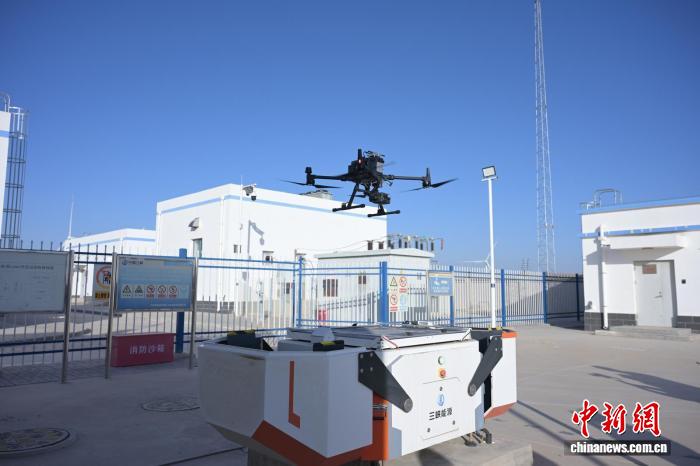
无人化风电场来了
Zhong Guo Jing Ji Wang· 2025-10-13 23:40
Core Insights - The article highlights the successful implementation of China's first unmanned wind farm, the Sanxia Energy Ningxia Tongli Third Wind Farm, which has transitioned to a fully intelligent operation model since April 2023 [1][3]. Group 1: Management Model Transformation - Traditional wind farm operations have faced challenges such as high personnel dependency, safety risks, and low operational efficiency, necessitating a shift to intelligent operations [2][3]. - The Tongli Third Wind Farm has achieved significant operational improvements, reducing inspection time from two weeks to one week through the use of drones for routine inspections [2][3]. - The new operational model integrates data collection, analysis, decision-making, and feedback into a complete closed-loop process, enhancing management efficiency [3]. Group 2: Technological Framework - The wind farm employs a "cloud-edge-end" architecture, where the "cloud" serves as the central brain for data analysis and decision-making, the "edge" manages local operations, and the "end" consists of on-site sensors and drones [5][6]. - This architecture addresses the core pain point of traditional operations by converting engineers' experiences into transferable knowledge assets, allowing for the replication of effective practices across different sites [6][8]. Group 3: Industry Standards and Future Directions - The Sanxia Energy has initiated the publication of the first industry white paper on intelligent station construction, outlining the transition needs, system architecture, core technologies, and implementation pathways for the industry [7]. - The promotion of this white paper aims to standardize the construction and application of intelligent wind farms, facilitating a shift from scale expansion to quality improvement in the renewable energy sector [7][8]. - Future wind farm management is expected to evolve from a decentralized to a centralized model, optimizing resources across multiple sites [8].