智霁

Search documents
天气预报装上“AI大脑”
Nan Fang Du Shi Bao· 2025-12-07 23:09
Core Insights - Shenzhen is accelerating the exploration of artificial intelligence (AI) to enhance precise weather forecasting, with the World Meteorological Organization's first AI pilot project for near-term forecasting launched in the city [2][8] - The Shenzhen Meteorological Bureau, in collaboration with Huawei Cloud, released the AI regional ensemble forecasting model "Zhiji" 2.0 in March 2025 [4] - The application of AI in weather forecasting in Shenzhen aims to address challenges in disaster prevention and mitigation, particularly in the context of extreme weather events [7] Group 1: AI Integration in Meteorology - Shenzhen has focused on integrating AI into meteorology since 2017, addressing issues such as the timeliness and clarity of severe weather warnings [7] - The city is building a collaborative innovation system for AI and meteorology, guided by the "Measures to Accelerate High-Quality Development of Meteorology in Shenzhen" [7] - The "six ones" collaborative innovation system aims to enhance the accuracy of early warning systems for extreme weather events [7] Group 2: AI Weather Forecasting Products - Three AI-driven weather forecasting products have emerged: "Zhiji," "Zhitong," and "Afufu," each targeting specific forecasting challenges [9][10] - "Zhiji" is designed to improve the resolution of forecasts, providing detailed predictions for temperature, rainfall, and wind speed with a spatial resolution of 3 kilometers and a temporal resolution of 1 hour [9] - "Zhitong" focuses on short-term severe weather warnings, successfully extending the effective warning time from 1 hour to 3 hours during significant rainfall events [10] Group 3: Global Impact and Collaboration - Shenzhen's AI meteorological services are redefining the role of meteorology in urban governance, extending beyond weather reporting to include traffic management and emergency response [11] - The city is participating in the World Meteorological Organization's AI Near-Term Weather Prediction pilot project, showcasing its collaborative efforts with international tech giants [12] - Successful case studies, such as the response to Typhoon "Hagupit" and the "8.5" heavy rainfall, demonstrate the effectiveness of AI in enhancing urban disaster prevention capabilities [12]


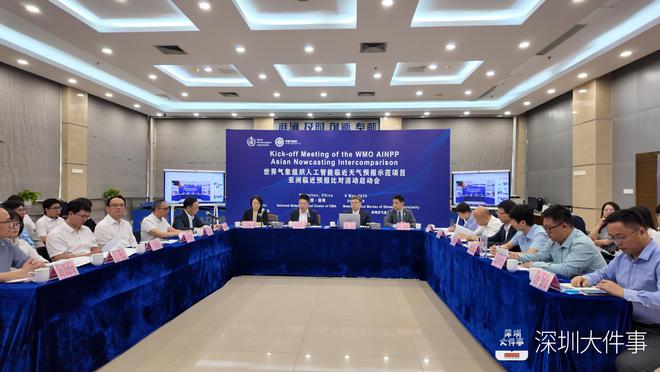
世界气象组织首个AI试点项目亚洲临近预报比对活动在深启动
Nan Fang Du Shi Bao· 2025-05-10 07:53
Core Insights - The launch of the first World Meteorological Organization (WMO) Artificial Intelligence Near-Term Weather Forecasting Demonstration Project (AINPP) in Asia marks a significant milestone in advancing modern early warning and forecasting technologies [3][5] - The project aims to enhance collaboration among multiple disciplines, countries, and public-private sectors to develop AI-based near-term forecasting models, particularly in regions vulnerable to extreme weather events [3][6] Group 1: Project Overview - The AINPP project is designed to set a global standard for AI applications in meteorology, focusing on improving the accuracy of early warning systems to save lives and reduce losses associated with severe weather [3][6] - The project involves participation from meteorological experts from various countries, including Japan, South Korea, Thailand, Vietnam, India, UAE, and Saudi Arabia, as well as institutions like the Hong Kong Observatory and Microsoft [3][6] Group 2: Technological Advancements - AI-driven models integrate various data sources, such as satellite images, radar networks, and ground sensors, to enhance the accuracy and delivery time of local extreme weather predictions [5] - Shenzhen's meteorological bureau has developed AI applications for early warning services, including the "Zhiji" regional forecasting model with a 3 km resolution and the "Zhitong" short-term forecasting model, which extends effective warning time from 1 hour to 3 hours [6][7] Group 3: Future Plans and Collaboration - The AINPP project has collected 13 AI-based forecasting technologies related to lightning, precipitation, and radar echoes, which will be tested during the upcoming flood season [7] - Shenzhen's meteorological bureau plans to establish a data-sharing platform and engage in cross-regional product testing and application, contributing to disaster prevention and mitigation efforts in developing countries [7]