朱雀二号遥三运载火箭

Search documents
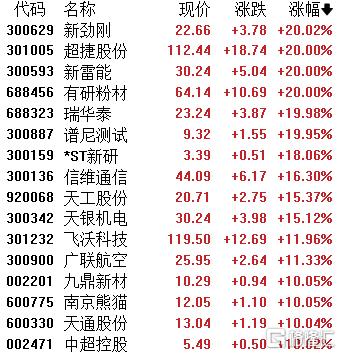
强势行情延续 商业航天概念股再度爆发
Huan Qiu Lao Hu Cai Jing· 2025-12-26 03:43
Group 1 - The A-share commercial aerospace sector experienced a strong rally, with 32 stocks hitting the daily limit or rising over 10% by market close [1] - Key drivers for this surge include favorable policies, technological breakthroughs, and increased industry demand [1] - The National Space Administration of China released an action plan for the high-quality and safe development of commercial aerospace from 2025 to 2027, incorporating low-orbit satellite internet into national strategy [1] Group 2 - Significant technological advancements have been achieved, including successful launches of various rockets and accelerated domestic production of key technologies like satellite chips and laser communication [1] - The demand side is witnessing a surge, with projects like China Star Network and G60 low-orbit constellation entering mass networking phases, and an increase in domestic rocket launch frequency [1] - Global market sentiment is also positive, with SpaceX planning an IPO in 2026 and Blue Arrow Aerospace completing IPO guidance, boosting investment expectations in the industry [2] Group 3 - The commercial aerospace industry is expected to enter a new phase of rapid development, with over 600 companies and 25 launch sites in operation or under construction in China [3] - The industry is transitioning from technology validation to large-scale commercialization, with a notable increase in launch activities and advancements in reusable rocket technology [3] - Analysts suggest that the commercial aerospace sector is at a turning point, with potential for significant growth and investment opportunities [3]
全线升空!商业航天利好扎堆,板块迎来爆发时刻
Ge Long Hui· 2025-12-24 06:59
Group 1 - The A-share commercial aerospace sector has shown strong momentum, becoming a leading market trend with multiple stocks hitting the daily limit up [1] - The sector has seen a cumulative increase of over 20% since November 24, with notable performances from companies like Shenjian Co. and Guoji Precision Engineering [3] - Recent policy support, technological breakthroughs, and demand for satellite constellations have catalyzed the commercial aerospace sector, making it one of the most sustainable market hotspots [4][5] Group 2 - Blue Arrow Aerospace, a leading private aerospace company, has made significant progress, including completing its IPO guidance, which is seen as a key milestone for the industry [6][7] - Recent technological advancements include the successful launch of reusable rockets, marking a significant step towards commercial viability for domestic private aerospace companies [8] - The upstream supply chain is entering a phase of substantial expansion, with companies like Jiufeng Energy announcing investments in specialized fuel production and storage for aerospace applications [8] Group 3 - Continuous policy support has injected long-term momentum into the commercial aerospace sector, with the establishment of dedicated regulatory bodies and action plans to promote high-quality development [9] - The global commercial aerospace market has surpassed $700 billion, with China's market expected to grow at an annual compound growth rate of over 22%, providing a solid foundation for the sector's growth [9] Group 4 - The global commercial aerospace landscape is accelerating, with the U.S. government reinforcing its commitment to lunar exploration and space resource development, which is expected to intensify competition in the sector [10][11] - SpaceX, a benchmark in the global commercial aerospace field, is planning an IPO in 2026, with expectations of a valuation reaching approximately $800 billion, highlighting the potential for significant growth in the industry [12] Group 5 - Analysts are optimistic about the commercial aerospace sector's growth trajectory, noting that the current market dynamics are characterized by high catalytic density and substantial real-world impacts [13] - The industry is expected to undergo transformative changes with advancements in technology and infrastructure, potentially achieving a launch frequency of 100 times per year in China by 2030, with significant economic implications [13]