李未可City Air AI眼镜

Search documents
AI眼镜行业深度报告:从技术融合到生态构建,把握穿戴智能化新浪潮
Shanghai Aijian Securities· 2026-04-01 06:54
Investment Rating - The report rates the industry as "Outperform" [1] Core Insights - The AI glasses industry has experienced explosive growth since 2023, with global sales projected to surge from 240,000 units in 2023 to 7.66 million units by 2025, driven by advancements in edge AI models, hardware upgrades, and major players entering the market [3][19] - The industry is still in its nurturing phase, with pricing concentrated in the mid-to-high-end range, and the penetration rate remains low, particularly in the Chinese market, which is in the early stages of product introduction and user education [3][23] - The competition landscape is diverse, with domestic manufacturers leveraging their advantages to create differentiated barriers, while global players like Meta dominate the market [3][52] Summary by Sections Industry Overview - The AI glasses market is categorized into AI glasses, AR, VR, and XR devices, with AI glasses being the most promising for mass adoption due to their integration of AI technology and traditional eyewear form [6][10] - The market is expected to grow significantly, with the global AI glasses market projected to reach 766 million units by 2025, largely driven by the success of products like Ray-Ban Meta AI glasses [19][21] Product Development - AI glasses are divided into three main types: AI audio glasses, AI video glasses, and AI+AR glasses, each targeting different user needs and market segments [7][31] - The industry faces a "trilemma" of balancing lightweight design, long battery life, and high performance, but advancements in technology are helping to overcome these challenges [40][44] Competitive Landscape - The global market is characterized by a duopoly, with Meta's Ray-Ban series accounting for 85.2% of the market share by 2025, while domestic brands in China are rapidly gaining ground due to the absence of Meta's direct involvement [52][56] - Key players in the Chinese market include Xiaomi, Rokid, and Alibaba, each focusing on different aspects such as lightweight design, AR capabilities, and ecosystem integration [58][59] Investment Opportunities - The report suggests two main investment opportunities: companies with technological leadership in optical display, specialized chips, and AI algorithms, and companies with strong ecosystem integration and supply chain advantages [3][29]



阿里入局、“百镜”开打! 哪家能成为你的“第二双眼”? | WAIC 观察
Xin Lang Ke Ji· 2025-07-27 03:22
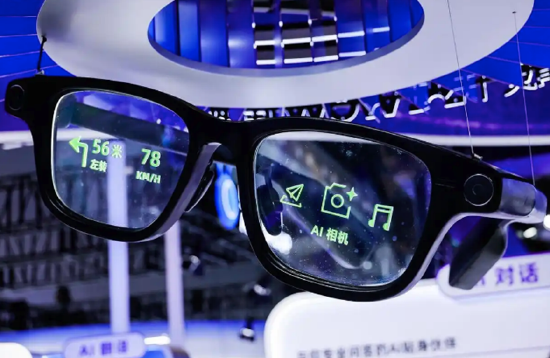
Core Insights - The article discusses the increasing competition in the smart glasses market, particularly highlighted at the World Artificial Intelligence Conference (WAIC) 2025, with major Chinese companies showcasing their advancements in this technology [3][5]. Group 1: Industry Trends - The smart glasses sector is experiencing a surge in interest from large manufacturers, moving away from smaller niche players, with companies like Alibaba, ByteDance, and 360 entering the market [3]. - Emphasis is shifting towards the functionality and practicality of smart glasses, focusing on user interaction and real-world applications [3]. - A trend towards lighter designs is emerging, with companies promoting reduced weight as a key selling point for their products [3][19]. Group 2: Alibaba's Entry - Alibaba's new AI smart glasses, the "Wow Quark Glasses," are set to launch in October, featuring a design similar to traditional smart glasses but enhanced with AI capabilities [5][7]. - The glasses aim to address common issues in existing products, such as weak AI performance, short battery life, and poor user experience, through a complete hardware redesign [5]. - The glasses will support various applications, including navigation, payment, and travel reminders, leveraging Alibaba's AI and ecosystem [5][7]. Group 3: Competitors and Innovations - Rokid's smart glasses have gained significant attention, with a pre-order volume of 250,000 units, showcasing features like real-time translation and object recognition [11]. - XREAL's glasses offer a unique viewing experience with an internal screen, targeting entertainment and gaming markets [13][15]. - Competitors are focusing on lightweight designs, with Rokid's glasses weighing 49g and other brands like Li Weike and Halliday offering even lighter options, enhancing user comfort [19][21].

对话李未可创始人茹忆:40克,AI眼镜的及格线
Tai Mei Ti A P P· 2025-05-27 03:23
Core Viewpoint - The AI glasses market, valued in trillions, is experiencing a surge in product launches, with the upcoming 618 shopping festival expected to serve as a significant industry evaluation [1] Group 1: Company Overview - Li Weike secured several million yuan in strategic financing in April and subsequently launched three new products, including two AI audio glasses and one AI photography glasses, targeting business travel scenarios and supporting over 180 languages [1] - The founder and CEO of Li Weike, Ru Yi, emphasizes that AI will be the most crucial driving force for humanity in the next decade, and all smart interaction hardware needs to be reimagined, with glasses being the optimal carrier for AI [1][4] Group 2: Product Features and Strategy - Li Weike's new products do not include iterations of display-equipped AI glasses, as the company prioritizes lightweight designs, aiming for all AI glasses to weigh under 40 grams for long-term wearability [3][6] - The company has launched three products with key selling points being their lightweight design: City AI glasses weigh 33g with a 12-hour battery life, City Air glasses weigh 27g (23g for the frameless version) with a 14-hour battery life, and the AI photography glasses View weigh 38g with an 8-hour battery life [6] Group 3: Market Positioning and Competition - Li Weike positions itself not merely as a hardware company but as an AI company, focusing on enhancing AI capabilities to improve user experience [4][5] - The company aims to focus on the business travel segment, believing that specialization in niche markets will allow it to compete effectively against larger companies like Xiaomi and Meta [8][9] - Ru Yi asserts that startups can succeed in niche markets by fully committing to a single focus, contrasting with larger companies that operate as divisions [9]