比特币钱包

Search documents
区块链钱包地址生成:加密技术原理深度拆解
Sou Hu Cai Jing· 2025-12-27 06:48
Core Insights - The article emphasizes the importance of wallet addresses in blockchain transactions, highlighting their role as the core identifier for receiving digital assets and the underlying cryptographic technology that ensures their security [1]. Group 1: Wallet Address Generation Process - The generation of a wallet address relies on asymmetric encryption algorithms, specifically the process of deriving "private key - public key - address," ensuring security through irreversibility and uniqueness at each step [1][5]. - The private key is a 64-character hexadecimal string generated randomly by encryption algorithms, with absolute randomness being crucial to prevent cracking [3]. - The public key is derived from the private key using asymmetric encryption, where the private key can generate the public key, but not vice versa, ensuring address security [3]. Group 2: Hashing and Address Format - Wallet addresses are not directly derived from public keys; instead, they undergo multiple hashing operations to create a more concise and secure address format [4]. - The process involves SHA-256 hashing of the compressed public key, followed by RIPEMD-160 hashing to produce a 160-bit hash, known as the public key hash [4]. - A version byte is added to the public key hash, and a checksum is generated through double SHA-256 hashing to prevent input errors, ensuring the integrity of the address [4]. Group 3: Security Measures - The entire address generation process is conducted offline, mitigating the risk of key information being compromised online [5]. - The uniqueness of addresses is guaranteed by the uniqueness of private keys, ensuring that each private key corresponds to a unique public key and address, facilitating accurate asset transactions [5]. - Understanding the cryptographic principles behind address generation is crucial for users, emphasizing the need to securely manage private keys and verify addresses during transactions to prevent asset loss [6].


区块链钱包接口开发指南:从技术原理到安全实践
Sou Hu Cai Jing· 2025-12-15 12:42
Group 1: Wallet Overview - Digital wallets serve as a bridge connecting users to blockchain technology, with a focus on asset security and management [1] - Wallets can be categorized into custodial and non-custodial types, with the former managed by third parties and the latter fully controlled by users [1] - The development cost of wallets is low, but the potential for malicious activities is even lower, highlighting the importance of open-source wallets [1] Group 2: RPC Protocol - The Remote Procedure Call (RPC) protocol is essential for enabling interaction between wallets and blockchains, allowing programs to call subroutines on other computers without additional programming [3] - RPC can be synchronous, requiring the client to wait for a response, or asynchronous, allowing for callback notifications [3] - JSON-RPC has become a mainstream choice due to its stateless and lightweight characteristics, facilitating a focus on business logic rather than protocol details [3] Group 3: Wallet Development Architecture - Reliable wallet construction requires solid underlying blockchain technology support, with developers needing to adapt to various blockchain protocols [3] - For Bitcoin wallets, understanding the UTXO (Unspent Transaction Output) model is crucial for handling transaction creation, signing, and broadcasting [3] - Mobile wallet development frameworks are critical, with iOS favoring Swift or Objective-C and Android preferring Java or Kotlin, while cross-platform frameworks like ReactNative and Flutter enhance code reuse and development efficiency [3] Group 4: Core Functionality - Asset storage and management are central to wallet functionality, necessitating secure storage solutions and encryption algorithms to protect private keys [5] - Transaction functionality must balance convenience and security, ensuring accurate transaction signing and broadcasting, including gas fee calculations for Ethereum transfers [5] - Multi-currency support is becoming a competitive advantage for wallets, requiring developers to understand the technical characteristics of different cryptocurrencies [5] Group 5: Security Practices for Payment Interfaces - Key security elements can be derived from established payment platforms like Alipay, including authorization password verification for sensitive operations and mandatory parameters for transactions [6] - A comprehensive exception handling mechanism is essential for traceability of issues [6] - The development of blockchain wallet interfaces must incorporate these security practices to ensure the wallet acts as a guardian of assets [6]

比特币钱包成机器人经济新支柱,XBIT Wallet打造安全便捷资产管理入口
Sou Hu Cai Jing· 2025-09-16 08:28
近日,多个机器人概念代币表现亮眼。例如基于Polkadot的peaq(PEAQ)两周涨幅84.9%,Base生态的Auki (AUKI)涨幅高达129%,Solana上的Codec Flow(CODEC)涨幅107.4%,以太坊上的Robora(RBR)更是暴涨 183.8%。这些项目不仅获得数百万至数千万美元融资,更在技术上实现了从机器自主交易、空间数据交换到AI代 理训练等多方面的突破。 然而,无论是参与机器人经济项目的投资,还是进行日常的数字资产交易,用户都离不开一个安全、可靠、功能 强大的资产管理工具——比特币钱包。正是在这样的背景下,XBIT Wallet 作为一款集安全、便捷、多功能于一体 的去中心化Web3钱包,逐渐成为众多加密爱好者和投资者的首选。 XBIT Wallet:更智能的数字资产守护者 XBIT Wallet 不仅支持比特币、以太坊、Solana、BNB Chain等多链资产,还深度融合了DeFi、NFT、跨链交换等 核心功能,为用户提供一站式的数字资产管理体验。尤其是在机器人经济概念币火爆的当下,用户可通过XBIT Wallet轻松管理包括PEAQ、AUKI、CODEC、RBR等在 ...

全球比特币钱包市场发展现状分析及前景趋势预测
Sou Hu Cai Jing· 2025-05-06 13:32
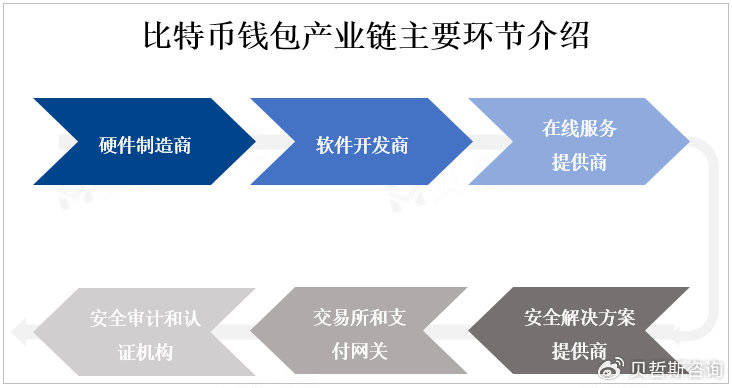
Core Insights - The Bitcoin wallet is a digital currency wallet used for storing, sending, and receiving Bitcoin, consisting of public and private key pairs for transaction management [1] - The Bitcoin wallet industry includes various segments such as hardware manufacturers, software developers, online service providers, security solution providers, exchanges, and auditing institutions [2] Industry Chain Analysis - Hardware manufacturers design, produce, and sell hardware wallets and ensure their security and reliability [2] - Software developers create and maintain wallet applications, focusing on user interface and encryption [2] - Online service providers offer web-based wallet services, ensuring secure storage and transaction processing [2] - Security solution providers focus on protecting wallets from hacking through measures like multi-signature and cold storage [2] - Exchanges and payment gateways facilitate transactions and allow users to buy and sell Bitcoin [2] - Security auditing institutions assess wallet security and compliance with privacy standards [2] Regulatory Policies - KYC and AML regulations require wallet providers to verify user identities and monitor transactions [4] - Licensing and registration requirements ensure compliance with regulatory standards, including capital and security measures [5] - Transaction regulations mandate reporting of suspicious activities to prevent illegal uses of Bitcoin [5] - Data privacy policies protect user information and limit data sharing [5] - Security standards require wallet providers to implement necessary measures to safeguard user assets [5] Market Overview - The Bitcoin wallet market is rapidly growing, driven by increasing demand for secure and convenient wallet services, with millions of global users [6] - The market is highly competitive, featuring well-known providers like Coinbase, Trezor, and Ledger [6] - The market encompasses various wallet types, including software, hardware, online, and paper wallets, each catering to different user needs [8] User Experience and Innovation - User experience is crucial, with demands for intuitive and feature-rich applications that provide real-time transaction information [9] - The market is seeing innovations such as biometric technology and decentralized identity verification to enhance security and user experience [9]