加密技术

Search documents
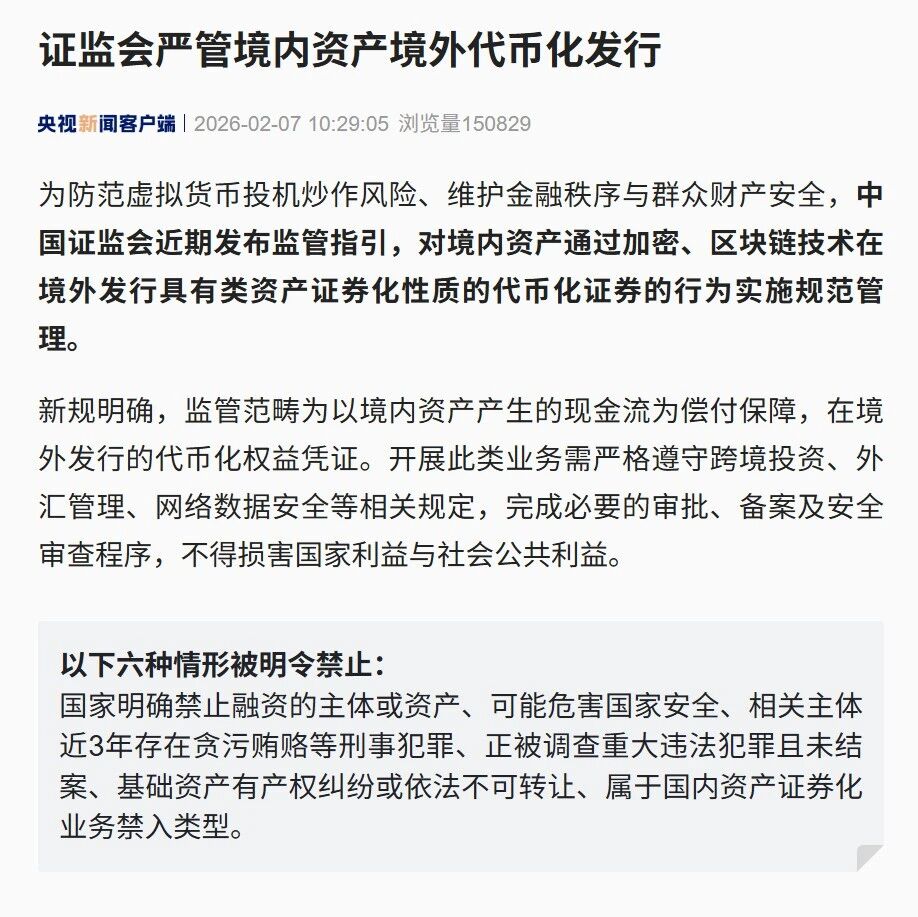
中国证监会:严管境内资产通过加密、区块链技术在境外代币化发行!“不得损害国家利益与社会公共利益”
新浪财经· 2026-02-07 08:25
Core Viewpoint - The China Securities Regulatory Commission (CSRC) has issued regulatory guidelines to manage the issuance of tokenized securities abroad that are backed by domestic assets, aiming to prevent speculative risks associated with virtual currencies and maintain financial order and public asset safety [2]. Regulatory Scope - The new regulations cover tokenized equity certificates issued abroad that are backed by cash flows generated from domestic assets. Such activities must comply with cross-border investment, foreign exchange management, and data security regulations, and require necessary approvals and safety reviews [2]. Prohibited Circumstances - Six specific scenarios are explicitly prohibited, including: - Entities or assets that are banned from financing by the state - Activities that may endanger national security - Entities with criminal records related to corruption in the past three years - Ongoing investigations for major illegal activities that are unresolved - Assets with ownership disputes or that are legally non-transferable - Types of domestic asset securitization that are restricted [2]. Core Regulatory Mechanism - The core of the regulation is a filing management system, requiring entities that control relevant assets domestically to submit complete and truthful filing reports and issuance materials to the CSRC. Approved filings will be publicly disclosed, and non-compliant entities will not be allowed to file [2]. Risk Reporting and Collaboration - After filing is completed, any significant risks or major events must be reported promptly. Additionally, the CSRC will enhance collaboration with overseas regulatory bodies to share information and prevent cross-border risk transmission, while legally combating violations [2].

中国证监会:严管境内资产通过加密、区块链技术在境外代币化发行!“不得损害国家利益与社会公共利益”
Mei Ri Jing Ji Xin Wen· 2026-02-07 03:45
Core Viewpoint - The China Securities Regulatory Commission (CSRC) has issued regulatory guidelines to manage the issuance of tokenized securities abroad that are backed by domestic assets, aiming to prevent speculative risks associated with virtual currencies and protect financial order and public property safety [1] Regulatory Scope - The new regulations cover tokenized equity certificates issued abroad that are backed by cash flows generated from domestic assets [1] - Businesses engaging in such activities must comply with cross-border investment, foreign exchange management, and data security regulations, and must complete necessary approvals, filings, and security reviews [1] Prohibited Activities - Six specific scenarios are explicitly prohibited, including: - Entities or assets that are explicitly banned from financing by the state - Activities that may endanger national security - Entities with criminal records related to corruption or bribery in the past three years - Entities currently under investigation for major illegal activities that are unresolved - Assets with ownership disputes or that are legally non-transferable - Types of domestic asset securitization that are prohibited [1] Core Regulatory Mechanism - The core of the regulation is a filing management system, requiring entities that control relevant assets domestically to submit complete and truthful filing reports and issuance materials to the CSRC [1] - Upon approval, relevant information will be publicly disclosed, and non-compliant entities will not be allowed to file [1] - After filing, any significant risks or major events must be reported promptly [1] International Cooperation - The CSRC will enhance collaboration with overseas regulatory bodies to share information and prevent cross-border risk transmission, while also legally combating illegal activities to strengthen financial security [1]
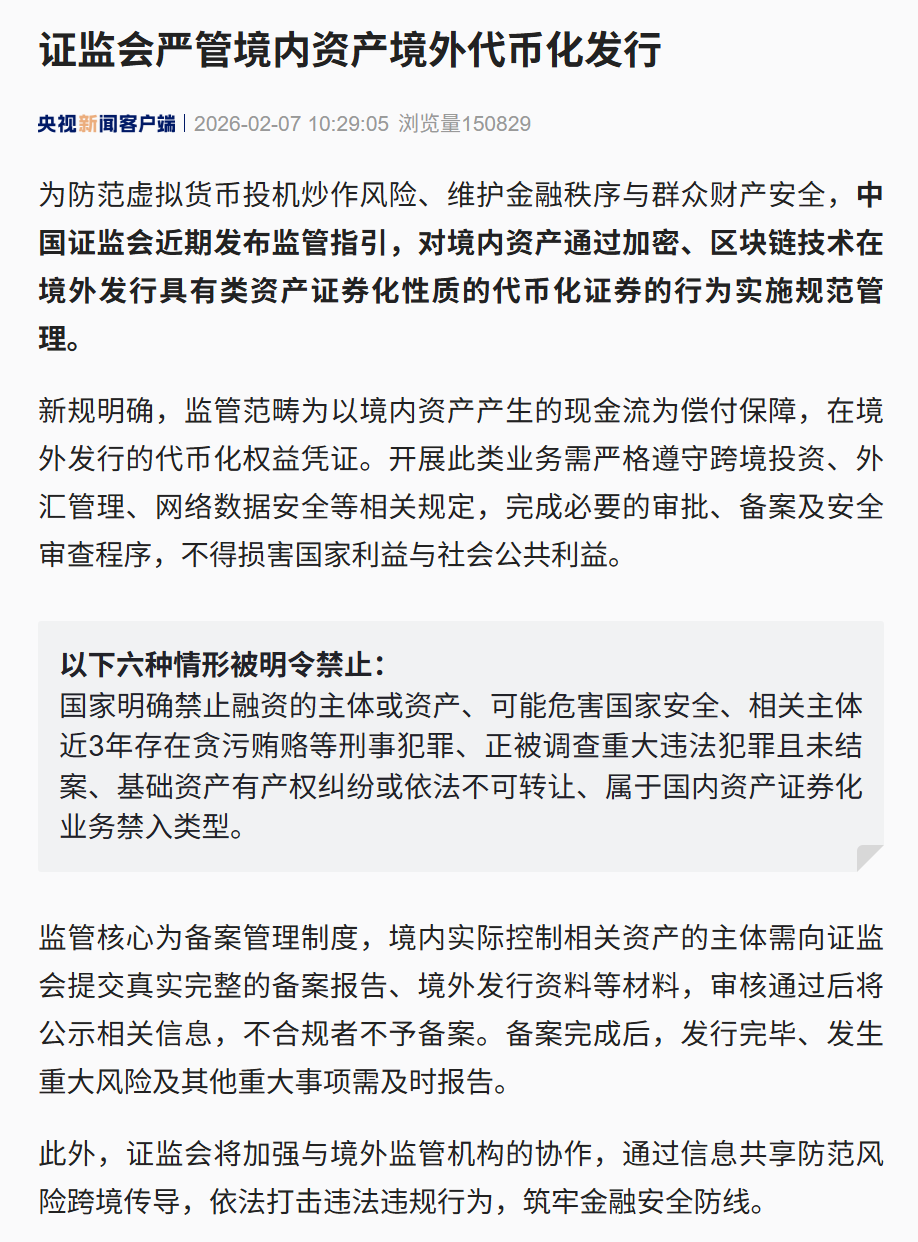
证监会严管境内资产境外代币化发行
Jing Ji Guan Cha Wang· 2026-02-07 03:04
Core Viewpoint - The China Securities Regulatory Commission (CSRC) has issued regulatory guidelines to manage the issuance of tokenized securities based on domestic assets abroad, aiming to prevent speculative risks associated with virtual currencies and maintain financial order and public asset safety [1] Group 1: Regulatory Scope - The new regulations specify that the scope of supervision includes tokenized equity certificates issued abroad, backed by cash flows generated from domestic assets [1] - Businesses engaging in such activities must comply with cross-border investment, foreign exchange management, and cybersecurity regulations, and must complete necessary approvals, filings, and security reviews [1] Group 2: Prohibited Circumstances - Six specific scenarios are explicitly prohibited, including financing entities or assets that are banned by the state, those that may endanger national security, and entities involved in serious criminal activities within the last three years [2] - The core of the regulation is a filing management system, requiring entities controlling relevant assets to submit complete and truthful filing reports to the CSRC for approval [2] Group 3: Compliance and Cooperation - Upon approval, relevant information will be publicly disclosed, and non-compliant entities will not be allowed to file [2] - The CSRC will enhance cooperation with overseas regulatory bodies to share information and prevent cross-border risk transmission, while also taking legal action against illegal activities [2]
Vitalik Buterin:加密技术进步与应用落地出现割裂,治理愿景正在被遗忘
Xin Lang Cai Jing· 2026-01-28 18:54
Core Insights - Vitalik Buterin highlighted significant advancements in Ethereum's infrastructure over the past year, particularly in scaling, zkEVM, and wallet development, but expressed growing concerns regarding application-level issues [1] - The initial diverse vision surrounding DAOs and decentralized collaboration is increasingly being forgotten, overshadowed by the recent popularity of Memecoins [1] - The example of Memecoins is illustrated by the involvement of public figures like Donald Trump, whose issuance of a second token, MELANIA, suggests a decline in the value of his first token, TRUMP [1]
吴说周精选:越南启动加密交易所牌照申请、Vitalik 呼吁抵制中心化工具、纽交所开发代币化证券平台与新闻 Top10
Xin Lang Cai Jing· 2026-01-24 01:05
Group 1: Regulatory Developments - Vietnam has officially launched a pilot program for licensing cryptocurrency trading platforms, requiring local companies to have a minimum capital of 100 billion VND [1] - The New York Stock Exchange (NYSE) is developing a tokenized securities trading and on-chain settlement platform, aiming for regulatory approval to support 24/7 trading and stablecoin-based settlements [1] - The American Bankers Association (ABA) has prioritized the restriction of interest-bearing stablecoins as a key policy issue for 2026, citing concerns over their impact on community bank deposits [2] - President Trump has indicated that cryptocurrency legislation is a significant agenda item, with Congress working on broader market structure legislation [3] Group 2: Market Trends and Insights - PwC's report indicates that institutional adoption of cryptocurrency has reached a point of no return, with a shift in focus from usage to integration within existing financial systems [6] - Ethereum co-founder Vitalik Buterin predicts that 2026 will be a year for reclaiming computational self-sovereignty, emphasizing the need to reduce reliance on centralized services [5][6] - Robert Kiyosaki expresses indifference to short-term price fluctuations of gold, silver, Bitcoin, and Ethereum, focusing instead on long-term monetary trends amid rising U.S. debt [8] Group 3: Financial Activities - Strategy has announced the purchase of 22,305 BTC for approximately $2.13 billion, with an average price of about $95,284 per coin, bringing their total holdings to 709,715 BTC [7] - Cork has completed a $5.5 million seed round financing, led by a16z and CSX [9] - Argentine fintech company Pomelo has raised $55 million in a C round financing [9] - Dutch crypto platform Finst has announced an €8 million A round financing [9] - Warden Protocol has completed a $4 million strategic financing, achieving a valuation of $200 million [9] - Bitcoin payment and gaming infrastructure company ZBD has raised $40 million in a C round financing [9] - Fintech and tokenization company Superstate has completed an $82.5 million B round financing [9]
价值存储叙事面临量子计算威胁!比特币酝酿反弹之际资深策略师转身撤退
Zhi Tong Cai Jing· 2026-01-16 10:49
Group 1 - A senior market strategist has removed 10% of Bitcoin from his investment portfolio due to concerns about quantum computing potentially undermining the cryptocurrency's value [1] - The strategist, Christopher Wood, emphasizes that advancements in quantum computing could weaken Bitcoin's argument as a reliable store of value, particularly for long-term investors like pension funds [1] - The Bitcoin network relies on cryptographic technology for token protection and transaction verification, which current computers cannot easily break, but quantum computers may change this dynamic [1] Group 2 - Christopher Wood was an early institutional supporter of Bitcoin, initially adding it to his portfolio in December 2020 and increasing exposure to 10% in 2021, but has now shifted to 5% in physical gold and 5% in gold mining stocks [2] - The debate over whether quantum computing poses a threat to Bitcoin has intensified, with notable developers refuting the concerns raised by Wood [2] - Wood believes that the long-term issues posed by quantum computing could be beneficial for gold, which has historically served as a hedge in uncertain geopolitical environments [2] Group 3 - Bitcoin is showing signs of a potential sustained recovery, trading at $95,400, after a period of volatility and market skepticism [3] - The current upward trend is supported by improvements in technical structure rather than mere sentiment or momentum, with prices regaining key moving averages [3] - Analysts suggest that the recent weakness in cryptocurrencies has been attributed to the strength of traditional safe-haven assets like gold and silver, but Bitcoin is demonstrating independent momentum [3] Group 4 - As Bitcoin approaches the significant $100,000 mark, short-term consolidation may occur, but overall momentum remains clear [4] - Despite ongoing discussions about Bitcoin, some ETFs tracking it have shown lackluster performance over the past year, with prices still over 20% below their recent 52-week highs [4] - Recently, these ETFs have shown signs of recovery, with an 8% increase over the past week and the potential for a consecutive three-week rise for the first time in six months [4] Group 5 - The technical patterns for Bitcoin-related ETFs are gradually improving, with the fund regaining key moving averages earlier this year [5] - A significant price breakout from an ascending triangle pattern has heightened market expectations for further short-term gains [5]
a16z crypto:2026 年加密技术将从三方面走向更广泛应用
Xin Lang Cai Jing· 2026-01-09 12:32
Core Insights - The article emphasizes that by 2026, crypto technology will see broader applications through three main developments: integration of prediction markets with AI, reduction in zero-knowledge proof costs, and the rise of "Staked Media" for content credibility [1] Group 1: Integration with AI - Prediction markets will deeply integrate with AI, enhancing both scale and intelligence in applications [1] Group 2: Zero-Knowledge Proofs - The cost reduction of zero-knowledge proofs will enable "verifiable cloud computing," expanding cryptographic proofs beyond blockchain to general computing and cloud service scenarios [1] Group 3: Staked Media - The emergence of "Staked Media" will allow creators to enhance content credibility through on-chain assets and verifiable commitments [1]
区块链钱包地址生成:加密技术原理深度拆解
Sou Hu Cai Jing· 2025-12-27 06:48
Core Insights - The article emphasizes the importance of wallet addresses in blockchain transactions, highlighting their role as the core identifier for receiving digital assets and the underlying cryptographic technology that ensures their security [1]. Group 1: Wallet Address Generation Process - The generation of a wallet address relies on asymmetric encryption algorithms, specifically the process of deriving "private key - public key - address," ensuring security through irreversibility and uniqueness at each step [1][5]. - The private key is a 64-character hexadecimal string generated randomly by encryption algorithms, with absolute randomness being crucial to prevent cracking [3]. - The public key is derived from the private key using asymmetric encryption, where the private key can generate the public key, but not vice versa, ensuring address security [3]. Group 2: Hashing and Address Format - Wallet addresses are not directly derived from public keys; instead, they undergo multiple hashing operations to create a more concise and secure address format [4]. - The process involves SHA-256 hashing of the compressed public key, followed by RIPEMD-160 hashing to produce a 160-bit hash, known as the public key hash [4]. - A version byte is added to the public key hash, and a checksum is generated through double SHA-256 hashing to prevent input errors, ensuring the integrity of the address [4]. Group 3: Security Measures - The entire address generation process is conducted offline, mitigating the risk of key information being compromised online [5]. - The uniqueness of addresses is guaranteed by the uniqueness of private keys, ensuring that each private key corresponds to a unique public key and address, facilitating accurate asset transactions [5]. - Understanding the cryptographic principles behind address generation is crucial for users, emphasizing the need to securely manage private keys and verify addresses during transactions to prevent asset loss [6].

区块链技术保障数字资产安全
Sou Hu Cai Jing· 2025-11-21 06:16
Core Insights - Digital assets have become an essential part of personal and corporate wealth, encompassing various forms such as cryptocurrencies, digital copyrights, game items, and identity credentials [1] - Blockchain technology is emerging as a critical foundation for securing digital assets due to its unique architecture [1] Group 1: Blockchain Technology - Blockchain is fundamentally a distributed ledger technology that offers decentralization, immutability, and transparency [3] - Traditional digital asset storage relies on centralized servers, which pose direct threats to user assets if attacked or altered [3] - Blockchain mitigates single point of failure risks by distributing data across multiple global nodes, each maintaining a complete copy of the ledger [3] - Hash algorithms and timestamp technology provide a "anti-counterfeiting label" for blockchain data, making unauthorized modifications nearly impossible [3] Group 2: Smart Contracts - The introduction of smart contracts enhances the automation and security of digital asset management [5] - Smart contracts are self-executing agreements based on blockchain, automatically fulfilling terms when preset conditions are met [5] - In digital copyright transactions, smart contracts can automate copyright verification, payment settlement, and rights distribution, ensuring transparency and immutability [5] Group 3: Security and Privacy - Blockchain's encryption technology establishes dual defenses for user asset privacy and access control [5] - Asymmetric encryption ensures that only asset owners can authorize access and transactions, protecting data even if intercepted during transmission [5] - Privacy-preserving technologies like zero-knowledge proofs allow users to complete identity verification and transaction authorization without revealing specific data [5] Group 4: Future Implications - Blockchain technology is reshaping the security ecosystem of digital assets, serving as both a technical tool and a trust mechanism [6] - As technology matures, blockchain will play a broader role in asset verification, circulation, and traceability, providing a solid security foundation for the digital economy [6] - Blockchain may become an "invisible guardian" of digital wealth, enabling individuals to create and trade confidently in the digital world [6]

Apple Won't Have to Provide an Encryption Backdoor in the UK, Says US Official
CNET· 2025-08-19 15:38
Group 1 - The US Director of National Intelligence announced that Apple will not be required to provide an encryption backdoor in the UK, alleviating concerns about privacy and security [1][2] - The UK had initially demanded that Apple provide access to iCloud data for both British citizens and citizens of other countries for criminal investigations [3] - Apple previously removed the Advanced Data Protection feature in the UK due to the government's demands, expressing disappointment with the UK's Home Office [4] Group 2 - Recent reports indicated that the UK was reconsidering its original demands and seeking a resolution [5] - The agreement reached is expected to protect Americans' private data and uphold constitutional rights and civil liberties [2]