
区块链钱包

Search documents
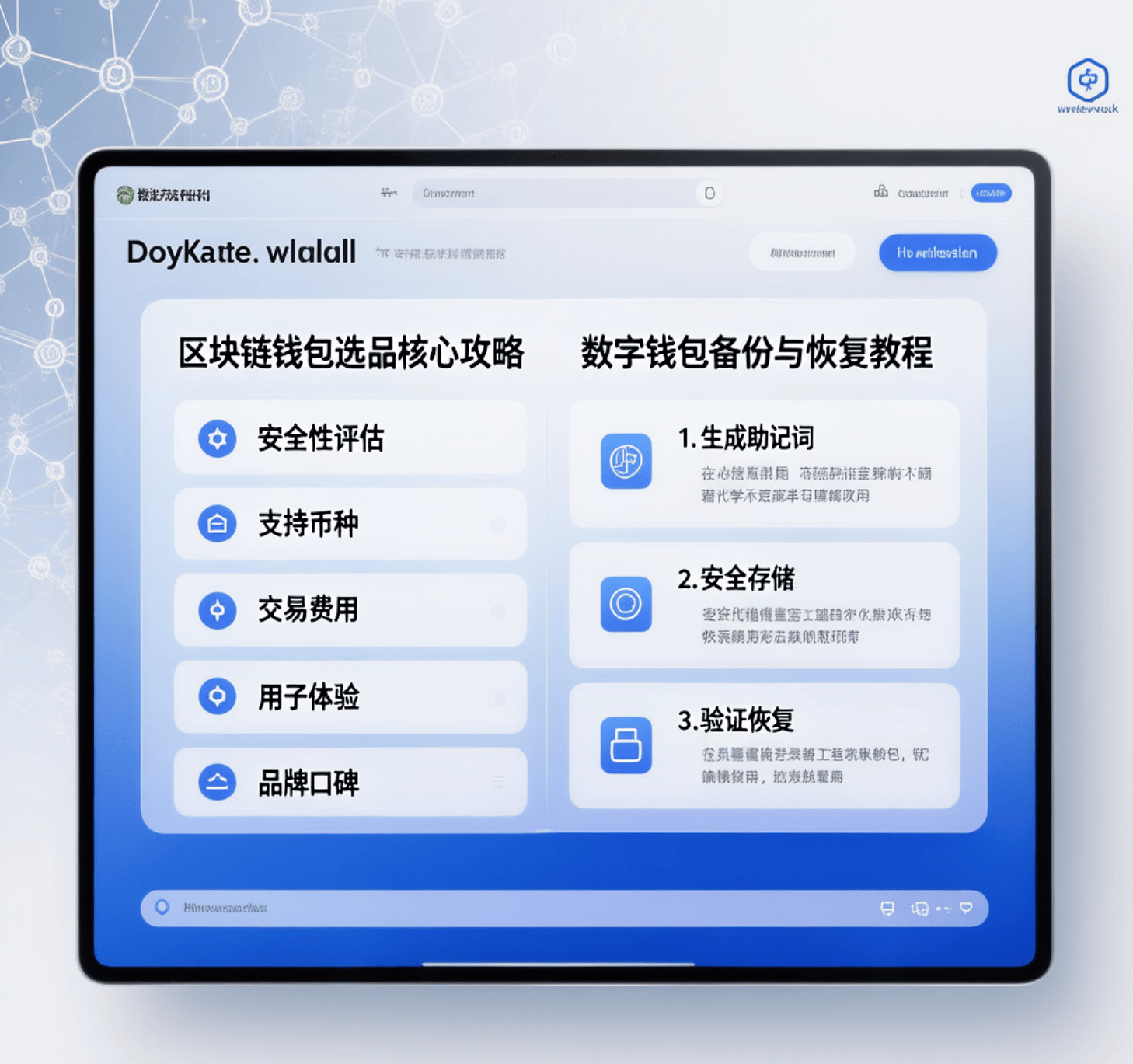
区块链钱包中国入口: 【tpokn.中国】选品核心攻略,数字钱包备份与恢复教程
Sou Hu Cai Jing· 2026-01-28 13:30
Group 1: Core Insights - The article emphasizes the importance of selecting the right blockchain wallet, focusing on key functions such as key management and on-chain interactions [1] - It highlights the need for a balance between security, adaptability, and usability when choosing a wallet, advising against following trends blindly [3] Group 2: Wallet Selection Criteria - Security is the top priority, recommending non-custodial wallets that allow users to control their private keys, thus reducing the risk of leaks [3] - Multi-chain compatibility is crucial, as wallets need to support major public chains and protocols to meet diverse interaction needs [4] - Usability should match user experience levels, with beginners preferring simple interfaces and advanced users looking for features like offline signing [4] - Reputation and compliance are additional factors, suggesting users choose well-established brands with a history of security and compliance with regulations [4] Group 3: Backup Procedures - Backup involves creating an emergency access channel for keys, focusing on offline storage, accurate recording, and secure safekeeping [5] - The first step is to obtain and accurately record the mnemonic phrase, which should be handwritten on fireproof and moisture-proof material [5] - A multi-location storage strategy is recommended to mitigate risks of physical damage or loss [5] - Common risks should be avoided, such as storing the mnemonic phrase with passwords or sharing it with anyone, including platform support [5] Group 4: Recovery Process - The recovery process must be meticulous, starting with ensuring a secure environment and downloading the wallet application from official channels [6] - Users should follow the process to import the mnemonic phrase accurately, paying attention to order and case sensitivity [6] - After recovery, users should verify the wallet's synchronization and reset security settings to enhance protection [6] Group 5: Safety Practices - Users are encouraged to adopt good habits, such as regularly checking wallet versions and avoiding suspicious links to prevent phishing attacks [7] - A combination of hardware and software wallets is recommended to balance convenience and security [7] Group 6: Conclusion - The security of blockchain wallets fundamentally relies on user operational norms, emphasizing the selection of compliant and reliable wallets, proper backup, and adherence to security guidelines [8]

区块链钱包地址生成:加密技术原理深度拆解
Sou Hu Cai Jing· 2025-12-27 06:48
Core Insights - The article emphasizes the importance of wallet addresses in blockchain transactions, highlighting their role as the core identifier for receiving digital assets and the underlying cryptographic technology that ensures their security [1]. Group 1: Wallet Address Generation Process - The generation of a wallet address relies on asymmetric encryption algorithms, specifically the process of deriving "private key - public key - address," ensuring security through irreversibility and uniqueness at each step [1][5]. - The private key is a 64-character hexadecimal string generated randomly by encryption algorithms, with absolute randomness being crucial to prevent cracking [3]. - The public key is derived from the private key using asymmetric encryption, where the private key can generate the public key, but not vice versa, ensuring address security [3]. Group 2: Hashing and Address Format - Wallet addresses are not directly derived from public keys; instead, they undergo multiple hashing operations to create a more concise and secure address format [4]. - The process involves SHA-256 hashing of the compressed public key, followed by RIPEMD-160 hashing to produce a 160-bit hash, known as the public key hash [4]. - A version byte is added to the public key hash, and a checksum is generated through double SHA-256 hashing to prevent input errors, ensuring the integrity of the address [4]. Group 3: Security Measures - The entire address generation process is conducted offline, mitigating the risk of key information being compromised online [5]. - The uniqueness of addresses is guaranteed by the uniqueness of private keys, ensuring that each private key corresponds to a unique public key and address, facilitating accurate asset transactions [5]. - Understanding the cryptographic principles behind address generation is crucial for users, emphasizing the need to securely manage private keys and verify addresses during transactions to prevent asset loss [6].

绿色挖矿与区块链钱包:低碳时代的新选择
Sou Hu Cai Jing· 2025-12-26 16:41
Core Insights - The blockchain industry is accelerating its transition away from the "high energy consumption" label, focusing on green mining and blockchain wallets as key components of this transformation [1][6] Group 1: Green Mining - Green mining is characterized by innovations in energy structure and technology, utilizing renewable energy sources to significantly reduce energy consumption [3] - Traditional Bitcoin mining consumes energy comparable to several households, while green mining can lower energy consumption by 62% through solar power and achieve "zero carbon emissions" using wind and hydro energy [3] - New 7nm mining machines have reduced energy consumption per terahash by 40%, and some facilities are implementing heat recovery technologies for energy recycling [3] Group 2: Blockchain Wallets - Blockchain wallets are evolving to lower the barriers for users to participate in green mining, with features like "green mining navigation" that provide information on compliant green mining sites [4] - GroveWallet integrates carbon credit systems, allowing users to earn points for participating in green mining, which can be exchanged for eco-friendly donations or discounts on low-carbon products [4] - Security is a primary concern in the design of green mining wallets, with mechanisms like local private key storage and dynamic identity verification to protect user assets [5] Group 3: Industry Trends - The collaboration between green mining and blockchain wallets signifies a shift in the blockchain industry's focus from "computational power competition" to "sustainable development" [6] - Future developments may include more diverse low-carbon applications within wallets, such as green NFT minting and carbon-neutral DeFi investments [6] - Blockchain wallets are evolving from mere digital asset tools to vital links connecting individuals with global green ecosystems, promoting the alignment of blockchain technology with sustainable development goals [6]

稳定币 + 区块链钱包:日常支付新选择解析
Sou Hu Cai Jing· 2025-12-26 13:17
Core Insights - The integration of stablecoins and blockchain wallets is transforming payment methods, providing a stable value linked to fiat currencies and enhancing user experience in daily transactions [1][3] Group 1: Stablecoin and Wallet Integration - Stablecoins, pegged to currencies like the US dollar and euro, mitigate value volatility, making them suitable for everyday purchases [3] - Blockchain wallets serve as convenient management tools for stablecoins, allowing users to easily receive, store, and transfer funds, and some wallets enable direct conversion to local fiat currencies [3][4] Group 2: Advantages in Cross-Border Payments - Traditional cross-border payments via SWIFT incur high fees (1%-3% of transaction amounts) and take 3-5 business days, while stablecoin transfers can be completed in minutes with fees as low as $1 or even free [4] - A case study from a Yiwu exporter shows that using USDT for transactions reduced processing time from 3 days to 5 minutes and cut costs from $200 to under $10, saving nearly $10,000 annually [4] Group 3: Daily Consumption Integration - Increasing numbers of merchants are adopting stablecoin payments, with examples including restaurants in Hong Kong accepting USDC and online platforms in China allowing DAI for membership purchases [5] - Blockchain wallets are enhancing user experience with features like small-amount payments without passwords and automatic transaction record synchronization [5] Group 4: Security and Compliance - Security measures in reputable blockchain wallets include local storage of private keys, biometric authentication, and transaction limit settings to protect user assets [5] - Regulatory frameworks, such as the U.S. Stablecoin Innovation Act and Hong Kong's Stablecoin Regulation, are establishing standards for stablecoin issuance and ensuring user confidence [5] Group 5: Challenges and Future Outlook - The adoption of stablecoin payments faces challenges, including a limited number of participating merchants and user misconceptions about stablecoins [6] - As more payment institutions integrate stablecoin functionalities and wallet providers enhance user experiences, the barriers are gradually being addressed [6] - The combination of stablecoins and blockchain wallets is redefining convenient payment standards, potentially making stablecoin payments as common as current QR code payments in the near future [6]

区块链钱包入门指南:新手必懂核心概念与分类全解析
Sou Hu Cai Jing· 2025-12-26 13:17
Core Concept - Blockchain wallets are essential tools for managing digital assets, focusing on private keys and public keys for transaction signing and verification [1] Key Concepts - Private keys serve as the highest authority credential for digital assets, akin to a combination of a bank card password and an ID card, and their loss or leakage can lead to irreversible asset loss [1] - Public keys are derived from private keys and can be shared publicly, functioning as the "receiving address" for digital assets [1] - Mnemonic phrases, consisting of 12-24 random words, are a user-friendly representation of private keys and are crucial for wallet recovery [3] Wallet Classification - Wallets can be categorized based on storage methods into cold wallets and hot wallets. Cold wallets, such as hardware wallets, are offline and highly secure, suitable for long-term storage of large amounts of digital assets, but have a complex usage process [3] - Hot wallets are internet-connected and include mobile apps, web wallets, and desktop clients, offering convenience for daily small transactions but are more vulnerable to hacking [3] - Wallets can also be classified as decentralized or centralized. Decentralized wallets allow users to control their private keys, aligning with blockchain's core principle, while centralized wallets manage private keys on behalf of users, providing faster transactions but requiring trust in the platform [4] Security Considerations - Users should select reputable wallet products, safeguard private keys and mnemonic phrases, verify recipient addresses before transactions, and choose wallets based on asset size and usage scenarios [5] - Cold wallets are recommended for large assets, while hot wallets are suitable for daily transactions, with regular data backups advised [5] Industry Trends - The blockchain wallet technology is continuously evolving, and users are encouraged to stay informed about developments to better protect their digital assets [5]

2025 区块链钱包十大预测:技术与应用新突破
Sou Hu Cai Jing· 2025-12-26 13:17
Core Insights - Blockchain wallets are evolving from simple asset storage tools to multifunctional hubs within the Web3 ecosystem, driven by technological advancements and user experience improvements. Group 1: Technological Innovations - Account abstraction technology will become mainstream, significantly lowering user entry barriers, with over 60% of mainstream wallets supporting "keyless access" by 2025 [3] - Multi-chain compatibility will be a basic feature, enabling seamless cross-chain experiences, with 82% of users needing to manage assets across three or more public chains [4] - Privacy protection technologies will be widely adopted, with "certificate-free stealth addresses" becoming standard, enhancing transaction anonymity and security [5] Group 2: Market Dynamics - Emerging markets will serve as growth engines, with regions like Southeast Asia and Africa seeing wallet user growth rates of 180%, contributing to 65% of global wallet activity by 2025 [6] - Regulatory compliance will balance with decentralization, leading to the rise of compliant wallets that integrate KYC/AML modules while allowing users to retain control over their private keys [7] Group 3: User Experience Enhancements - Generation Z will drive interaction design, with 48% of users desiring social features in wallets, integrating social plugins for direct asset transfers and community participation [8] - Real-world asset (RWA) tokenization will create new demands, allowing users to manage tokenized real estate and participate in fractional ownership investments [9] Group 4: Integration of AI and Hardware - AI will be integrated into wallets as "smart assistants," enhancing decision-making and user retention rates by 35% [10] - Hardware wallets will become more portable, with trends towards Bluetooth-enabled devices and integration into wearable technology [11] Group 5: Ecosystem Development - Wallets will transition to platform ecosystems, integrating DApp stores, NFT markets, and on-chain gaming, creating a closed-loop experience for users [12]

区块链钱包接口开发指南:从技术原理到安全实践
Sou Hu Cai Jing· 2025-12-15 12:42
Group 1: Wallet Overview - Digital wallets serve as a bridge connecting users to blockchain technology, with a focus on asset security and management [1] - Wallets can be categorized into custodial and non-custodial types, with the former managed by third parties and the latter fully controlled by users [1] - The development cost of wallets is low, but the potential for malicious activities is even lower, highlighting the importance of open-source wallets [1] Group 2: RPC Protocol - The Remote Procedure Call (RPC) protocol is essential for enabling interaction between wallets and blockchains, allowing programs to call subroutines on other computers without additional programming [3] - RPC can be synchronous, requiring the client to wait for a response, or asynchronous, allowing for callback notifications [3] - JSON-RPC has become a mainstream choice due to its stateless and lightweight characteristics, facilitating a focus on business logic rather than protocol details [3] Group 3: Wallet Development Architecture - Reliable wallet construction requires solid underlying blockchain technology support, with developers needing to adapt to various blockchain protocols [3] - For Bitcoin wallets, understanding the UTXO (Unspent Transaction Output) model is crucial for handling transaction creation, signing, and broadcasting [3] - Mobile wallet development frameworks are critical, with iOS favoring Swift or Objective-C and Android preferring Java or Kotlin, while cross-platform frameworks like ReactNative and Flutter enhance code reuse and development efficiency [3] Group 4: Core Functionality - Asset storage and management are central to wallet functionality, necessitating secure storage solutions and encryption algorithms to protect private keys [5] - Transaction functionality must balance convenience and security, ensuring accurate transaction signing and broadcasting, including gas fee calculations for Ethereum transfers [5] - Multi-currency support is becoming a competitive advantage for wallets, requiring developers to understand the technical characteristics of different cryptocurrencies [5] Group 5: Security Practices for Payment Interfaces - Key security elements can be derived from established payment platforms like Alipay, including authorization password verification for sensitive operations and mandatory parameters for transactions [6] - A comprehensive exception handling mechanism is essential for traceability of issues [6] - The development of blockchain wallet interfaces must incorporate these security practices to ensure the wallet acts as a guardian of assets [6]

千循科技盘中涨超7% 公司拟斥资2500万港元收购朋克代码科技100%股权
Zhi Tong Cai Jing· 2025-09-17 05:52
Core Viewpoint - Qianxun Technology (01640) has signed a non-binding memorandum of understanding for a potential acquisition of 100% equity in Web3 fintech company Punk Code Limited for no more than HKD 25 million, aiming to explore blockchain-based financial technology products [1] Group 1 - Qianxun Technology's stock price increased by over 7% during trading, currently up 5.29% at HKD 4.98, with a trading volume of HKD 10.24 million [1] - The acquisition is intended to leverage the company's existing second-hand digital trading business to develop a blockchain wallet and customized blockchain payment solutions for the second-hand digital industry [1] - The target company, Punk Code Limited, was founded in Hong Kong and has a founding team primarily from Tencent, indicating strong industry expertise [1] Group 2 - The board believes that the potential acquisition will enable the company to develop new business opportunities in the blockchain wallet application field, which is experiencing rapid global growth [1] - The acquisition could expand the company's customer base and strengthen its leading position in the industry [1] - The board is confident that if the acquisition is realized, it will effectively enhance the company's core competitive barriers and create strategic leverage for long-term shareholder value enhancement and returns [1]
港股异动 | 千循科技(01640)盘中涨超7% 公司拟斥资2500万港元收购朋克代码科技100%股权
智通财经网· 2025-09-17 05:46
Core Viewpoint - Qianxun Technology (01640) has signed a non-binding memorandum of understanding for a potential acquisition of 100% equity in Web3 fintech company Punk Code Limited for no more than 25 million HKD, aiming to explore blockchain-based financial technology products [1] Group 1: Acquisition Details - The acquisition price for Punk Code Limited is set at a maximum of 25 million HKD [1] - Punk Code Limited is a Web3 fintech company founded in Hong Kong, with a founding team primarily from Tencent [1] Group 2: Strategic Implications - The board believes that the acquisition will enable the company to develop new business in the blockchain wallet application area, which is experiencing rapid global growth [1] - The acquisition is expected to expand the company's customer base and strengthen its leading position in the industry [1] - The board is confident that if the acquisition is realized, it will effectively enhance the company's core competitive barriers and create strategic leverage for long-term shareholder value enhancement [1]
千循科技就拟收购朋克代码科技100%股权订立谅解备忘录
Zhi Tong Cai Jing· 2025-09-16 14:57
Group 1 - The company, Qianxun Technology, has signed a non-binding memorandum of understanding for a potential acquisition of 100% equity in Punk Code Technology Hong Kong Limited, with a maximum consideration of HKD 25 million [1] - The final consideration will be determined based on an independent valuation report and the results of the company's due diligence, considering comparable industry transaction prices [1] - The target company is a Web3 fintech firm founded in Hong Kong, with a founding team primarily from Tencent, focusing on blockchain technology and digital asset solutions [2] Group 2 - The potential acquisition is expected to enable the company to develop new business in the blockchain wallet application field, which is rapidly growing globally [3] - The acquisition could expand the company's customer base and strengthen its industry leadership position [3] - The board believes that if the acquisition is realized, it will effectively enhance the company's core competitive barriers and create strategic leverage for long-term shareholder value enhancement [3]