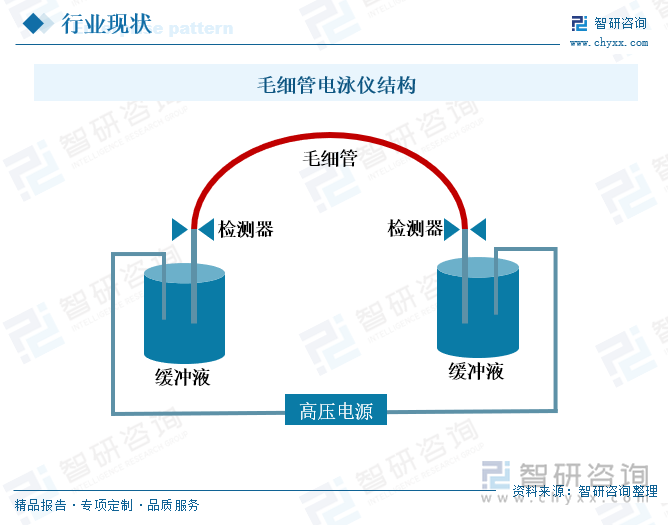
毛细管电泳仪

Search documents
七项标准夯实国产分析测试仪器质量“标尺” 产业升级全面加速
Zhong Guo Jing Ji Wang· 2026-02-12 10:36
Core Viewpoint - The release of five industry standards for domestic analytical testing instruments marks a significant breakthrough, enhancing the modernization of testing capabilities and the self-sufficiency of key equipment in China [1][2]. Group 1: Industry Standards and Development - The China Quality Inspection and Testing Research Institute is leading the development of a verification and evaluation system for domestic testing instruments, with five new standards officially published on December 1, 2025 [2]. - The newly established standards cover seven mainstream analytical testing instruments, indicating a systematic and standardized support framework for domestic instruments [2][3]. Group 2: Market Dynamics and Challenges - Historically, the high-end analytical testing instrument market in China has relied heavily on imports, with domestic instruments facing challenges due to a lack of unified and authoritative verification standards [3]. - The newly released standards provide a comprehensive evaluation framework that includes performance, key technical indicators, stability, safety, and domestic production rates, addressing the previous challenges faced by domestic instruments [3]. Group 3: Impact on Industry Ecosystem - The implementation of these standards is reshaping the analytical testing instrument industry by providing authoritative criteria for equipment selection, procurement, and quality evaluation, thereby lowering market entry barriers for high-quality domestic equipment [3]. - The standards also compel manufacturers to increase R&D investment and focus on core technology breakthroughs, shifting the industry competition from price to technology, quality, and service [3]. Group 4: Strategic Significance and Future Outlook - The introduction of these standards is strategically significant for supply chain security and industrial self-sufficiency, as analytical testing instruments are crucial for food safety, environmental governance, and biomedicine [4]. - With the full implementation of these standards and ongoing updates, domestic analytical testing instruments are expected to seize opportunities for "technical recognition" and "market expansion," potentially leading the industry towards a more competitive position globally [4].
认监委发布《国产化检测仪器设备验证评价指南》,涉及液相色谱仪等7类仪器
仪器信息网· 2025-11-19 09:08
Core Viewpoint - The National Certification and Accreditation Administration (NCAA) has released seven new industry standards for the verification and evaluation of domestically produced testing instruments, aimed at promoting the localization and quality enhancement of mid-to-high-end testing and inspection equipment in China [2][3]. Summary by Relevant Sections - **New Standards Released**: In November 2025, NCAA published the "Guidelines for Verification and Evaluation of Domestic Testing Instruments" covering various devices including liquid chromatographs, liquid chromatography-mass spectrometry systems, ion chromatographs, UV spectrophotometers, capillary electrophoresis instruments, tire-coupled road simulation test machines, and flexible traffic targets [2][3][4]. - **Implementation Timeline**: The new standards were approved on November 1, 2025, and are set to be implemented starting January 1, 2026 [4]. - **Previous Standards**: This is not the first set of guidelines issued by NCAA; five standards were previously released in May 2024, which included gas chromatographs, atomic absorption spectrophotometers, AC power chassis dynamometers, flexible target-driven platform vehicles, and hydrogen fuel cell stack testing equipment [4][5][6][7]. - **Industry Impact**: The establishment of these guidelines is a crucial step towards the high-quality development of domestic testing instruments. It is expected to promote the standardization and normalization of the domestic testing instrument industry, fostering a competitive environment among companies and driving the industry to new heights [8].


2025-2031年毛细管电泳仪行业全产业结构深度分析及投资战略可行性评估预测报告-中金企信发布
Sou Hu Cai Jing· 2025-10-09 07:29
Global Market Overview - The global capillary electrophoresis market is steadily growing, with a projected market size of $500 million by 2030 and a compound annual growth rate (CAGR) of 8.7% from 2024 to 2030, driven by increased R&D investments in pharmaceuticals and life sciences [3][9]. Market Competition Landscape - The capillary electrophoresis industry is characterized by a dominance of leading companies and high technical barriers. The top ten manufacturers held approximately 77.0% of the market share in 2022, leveraging advantages in technology development, full industry chain layout, and brand influence [5][6]. Product Types and Applications - Fully automated capillary electrophoresis instruments have become the mainstream product, accounting for about 58.1% of the global market share. These instruments are widely used in clinical diagnostics and pharmaceutical R&D, meeting the high efficiency and precision demands of large-scale sample analysis [6][7]. - Research institutions are the largest downstream market for capillary electrophoresis instruments, holding about 32.0% of the market share, driven by strong demand for biomolecular separation analysis in proteomics and genomics [6][7]. Regional Market Segmentation - North America and Europe are the primary consumption markets for capillary electrophoresis instruments, benefiting from mature medical R&D systems and high research investments. In contrast, South America, the Middle East, and Africa have a combined market share of less than 5%, indicating significant growth potential in these regions [7]. Market Drivers - The demand for high-resolution and high-throughput protein/nucleic acid separation in the pharmaceutical and life sciences sectors is increasing, driving up the procurement of capillary electrophoresis instruments. The rise of personalized medicine and biomarker research is also creating new application scenarios for these devices [9][10]. Market Barriers - The high acquisition cost and operational complexity of capillary electrophoresis instruments pose significant barriers to entry for small laboratories or resource-limited institutions. Additionally, poor compatibility with laboratory information management systems (LIMS) and insufficient reimbursement support in certain regions further complicate market promotion [11][12]. Industry Development Opportunities - Future opportunities in the capillary electrophoresis industry include deep integration with automated workstations and microfluidic high-throughput platforms to enhance efficiency and intelligence. Expanding the application of CE technology in molecular diagnostics for proteomics and genomics, as well as benefiting from increased government and private investment in precision medicine and infectious disease research, will further open market space [13].

研判2025!中国毛细管电泳仪行业产业链、市场规模及未来前景展望:生物医药研究爆发与环境监管趋严,驱动全球毛细管电泳仪需求持续攀升[图]
Chan Ye Xin Xi Wang· 2025-07-12 02:30
Industry Overview - The global capillary electrophoresis (CE) industry is in a critical phase of technological deepening and application expansion, driven by the growing demand for high-precision analysis in biomedicine, environmental monitoring, and food safety [1][10] - The global CE market is projected to reach $250 million in 2024 and approximately $400 million by 2030, with the life sciences sector being the core growth engine [1][10] - The demand for CE instruments is significantly influenced by the explosive growth in gene sequencing and proteomics research, as well as stringent quality control requirements in the biopharmaceutical industry [1][10] Industry Development History - The CE industry in China has undergone four main stages: inception (1981-1989), domestic exploration (1990-1999), rapid development (2000-2010), and internationalization (2010-present) [4][5][6] - The introduction of commercial CE instruments in 1989 marked the beginning of the technology's practical application, with domestic institutions initially relying on imported equipment [4] - By 2000, CE applications expanded rapidly in biomedical fields, with domestic companies increasing R&D investments to develop competitive products [5] Industry Current Status - The CE industry is experiencing continuous growth due to increased regulatory scrutiny on water quality and pesticide residues, leading to deeper applications in heavy metal analysis and food additive screening [1][10] - The demand for high-end CE models is rising, particularly in the biopharmaceutical sector, where there are strict requirements for antibody drug purity testing and mRNA vaccine quality control [1][10] Industry Supply Chain - The upstream supply chain includes materials such as elastic quartz capillaries, high molecular polymers, and components like high-voltage power supplies and temperature control systems [8] - The midstream involves the manufacturing of CE instruments, while the downstream applications span life sciences, biomedicine, environmental monitoring, and food safety [8] Key Companies and Competitive Landscape - The industry is characterized by a competitive landscape where international giants dominate the high-end market, while domestic companies are rapidly gaining ground in the mid-to-low-end segments [14] - Companies like Beijing Huayang Limin and Shanghai Tongwei are making significant strides in technology and market penetration, offering products that match international standards at lower prices [14][21] - The domestic market is seeing a shift towards high-performance CE instruments with independent intellectual property rights, breaking the monopoly of foreign brands [21] Industry Development Trends - The CE industry is poised for technological upgrades and smart development, with advancements in nanotechnology and automation expected to enhance separation efficiency and sensitivity [19] - The application fields of CE instruments are diversifying, particularly in biomedicine, environmental monitoring, and food safety, driven by rapid technological advancements and cost reductions [20] - The acceleration of domestic substitution is evident, with local companies responding quickly to market demands and enhancing their competitive edge through innovation and collaboration [21]