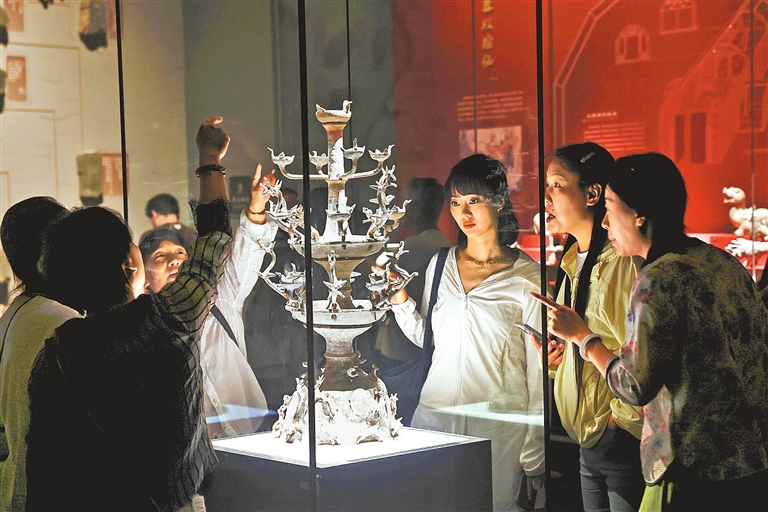
汉魏洛阳故城遗址博物馆

Search documents
营都六百载 恢弘洛阳城
Ren Min Ri Bao Hai Wai Ban· 2025-12-23 06:59
Core Insights - The article highlights the historical significance and archaeological value of the Han-Wei Luoyang City Ruins, which served as a capital for various dynasties over nearly 1,600 years, showcasing the evolution of ancient Chinese urban planning and culture [5][6][8]. Historical Significance - The Han-Wei Luoyang City Ruins is recognized as a key cultural heritage site, having been designated as a national key cultural relic protection unit and included in the World Heritage List as part of the "Silk Road" heritage [5][6]. - The city was established during the Western Zhou period and served as a capital for the Eastern Zhou, Eastern Han, Cao Wei, Western Jin, and Northern Wei dynasties, reflecting a continuous urban development from the pre-Qin era [6][7]. Archaeological Findings - Archaeological excavations have revealed approximately 20,000 artifacts, providing insights into the layout and evolution of the city, including the core palace complex and ceremonial buildings [8][10]. - The museum associated with the site features over 1,300 valuable artifacts, including significant cultural relics that illustrate the historical narrative of the city over 1,600 years [9][10]. Urban Planning Influence - The planning of Han-Wei Luoyang City established a precedent for future Chinese capitals, influencing the design of cities such as Chang'an during the Sui and Tang dynasties, and Beijing during the Ming and Qing dynasties [8][14]. - The city layout included a central axis and a structured palace city, which became a model for subsequent urban designs in China [8][14]. Cultural Exchange - The city served as a political, economic, and cultural center, playing a crucial role in the exchange of ideas and goods along the Silk Road, which facilitated cultural interactions between the East and West [11][12]. - Artifacts such as Eastern Roman coins and Persian silver coins found at the site highlight the international significance of Luoyang as a cosmopolitan hub [11][12]. Preservation Efforts - The site has undergone extensive preservation efforts, including the construction of a museum and the implementation of a multi-faceted protection strategy to maintain the integrity of the ruins while enhancing visitor experience [13][14]. - The local government has initiated various projects to promote the site, including seasonal floral displays and educational programs to engage visitors with the historical context of the ruins [14].

新华全媒+丨汉魏洛阳故城遗址博物馆开馆
Xin Hua Wang· 2025-07-17 02:17
Core Points - The Han-Wei Luoyang Ancient City Ruins Museum officially opened to the public on July 16, as part of the national "14th Five-Year" cultural protection and utilization project [3][4][8] - The museum focuses on the historical culture of the Han and Wei periods, showcasing over 1,300 valuable cultural relics that comprehensively display the civilization of the Han-Wei Luoyang ancient city [3][4][8] Summary by Categories - **Museum Opening** - The museum is a significant component of the "Five Major Capital Ruins Museum Group" in Luoyang [3][4][8] - It aims to enhance cultural heritage protection and transmission during the "14th Five-Year" period [3][4][8] - **Exhibits and Collections** - The museum features more than 1,300 pieces (sets) of precious artifacts [3][4][8] - It provides a comprehensive exhibition of the cultural prosperity of the Han-Wei Luoyang ancient city [3][4][8]
文化中国行 主根主脉看河南 行走大遗址丨打开一千六百年历史画卷 遗址中“长”出博物馆
He Nan Ri Bao· 2025-07-16 23:36
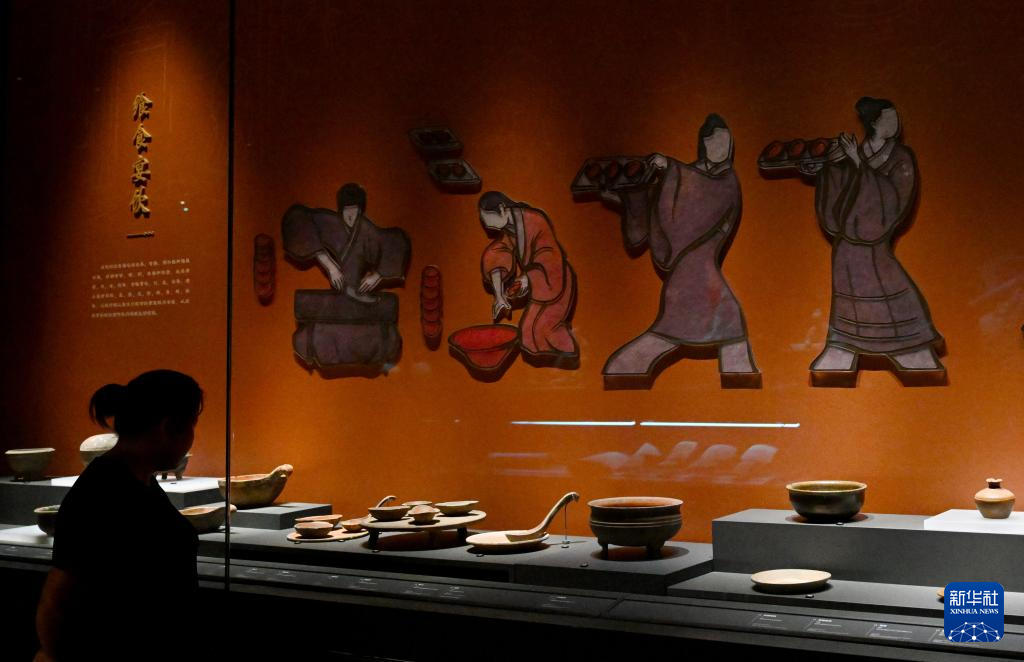
Core Viewpoint - The newly opened Han-Wei Luoyang City Ruins Museum aims to revitalize the historical significance of Luoyang, a key birthplace of Chinese civilization, through the construction of a cultural hub that showcases ancient artifacts and promotes cultural heritage [8][10][14]. Group 1: Museum Overview - The Han-Wei Luoyang City Ruins Museum, covering an area of 219 acres and with a total construction area of 29,000 square meters, is designed to reflect the grandeur of the Han and Wei dynasties [10]. - The museum features a series of architectural elements that recreate the spatial order of the ancient capital, allowing visitors to experience the historical layout of the city [10][13]. - The museum is part of a broader initiative to establish Luoyang as a "Museum City of the East," enhancing the visibility and accessibility of its rich cultural heritage [8][13]. Group 2: Exhibition and Artifacts - The museum's main exhibition, titled "The History of China - Han-Wei Luoyang City Ruins Museum," is organized around three thematic halls: "Central," "Harmony," and "Unity," providing a multi-dimensional understanding of the ancient city [11]. - The "Central" hall emphasizes the strict governance and order of the capital, showcasing artifacts such as roof tiles inscribed with "Heavenly Spirits" and models of the palace layout [11]. - The "Harmony" hall features over a thousand precious artifacts that illustrate the cultural exchanges and integration of various ethnic groups during the Wei, Jin, and Northern Dynasties [11][12]. Group 3: Cultural Significance - The Han-Wei Luoyang City was historically one of the largest cities in the world, with a population exceeding one million at its peak, underscoring its significance as a "world capital" [12]. - The museum serves as a cultural hub, integrating archaeological research, artifact restoration, and academic activities, positioning itself as a center for the study of early Chinese capital culture [13][14]. - The establishment of the museum aligns with national efforts to protect and promote cultural heritage, making it a key player in the innovative practice of immersive heritage display [13].