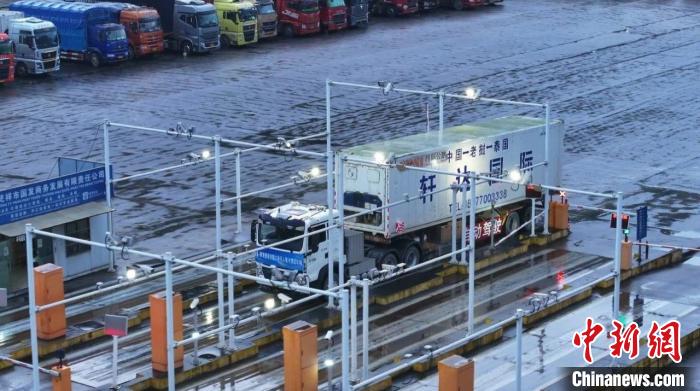
浦寨—新清通道智慧口岸项目

Search documents
“智”汇边关 广西凭祥加速“链”接东盟
Zhong Guo Xin Wen Wang· 2025-11-03 12:07
Core Viewpoint - The Guangxi Pingxiang city is accelerating the construction of smart ports to enhance trade connections with ASEAN countries, leveraging advanced technologies for automation and efficiency in customs clearance processes [1][2]. Group 1: Smart Port Development - The "Puzhai-New Qing" smart port project utilizes technologies such as 5G communication and Beidou navigation to achieve 24/7 automated customs clearance through systems like unmanned vehicle dispatch and intelligent inspection platforms [1]. - The daily customs clearance capacity of the Puzhai-New Qing freight dedicated channel is expected to increase to 2,000 vehicles after the project becomes operational, significantly improving efficiency [2]. Group 2: Infrastructure and Automation - At the Friendship Pass port, the number of vehicle lanes has increased from 6 to 12, with a daily traffic volume exceeding 1,500 vehicles. The smart port features remote-controlled lifting equipment and autonomous vehicles for efficient cargo transfer [4]. - The Friendship Pass smart port project aims to simplify customs processes by reducing required documentation and minimizing manual operations, thereby lowering costs and enhancing efficiency [4]. Group 3: Cross-Border E-commerce and Logistics - Pingxiang is innovating in cross-border e-commerce, collaborating with domestic and international e-commerce and manufacturing sectors to leverage its logistics advantages for rapid delivery to ASEAN markets [5]. - Future plans include improving multi-modal transport networks and developing cross-border logistics hubs, as well as exploring cross-border data flow cooperation to establish a smart port system between China and Vietnam [5].

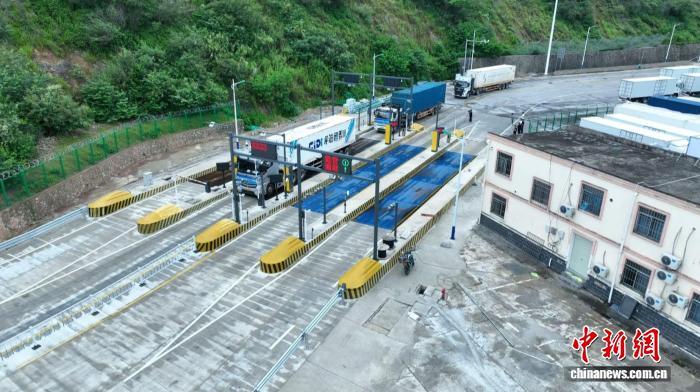
浦寨—新清通道智慧口岸 打造智慧化智能化边境口岸通关示范
Jing Ji Ri Bao· 2025-10-29 22:04
Core Viewpoint - The project in Pingxiang City aims to enhance the efficiency and automation of cross-border trade between China and Vietnam through the development of a smart port and autonomous driving systems, significantly improving customs clearance capabilities and reducing transportation costs [1][2][4]. Group 1: Project Overview - The smart port project covers an area of approximately 176.48 acres with an investment of about 760 million yuan, focusing on the construction of dedicated autonomous driving lanes and a smart port command and dispatch system [1]. - The dedicated lane for the Chinese section is approximately 2395 meters long, consisting of roads, bridges, and tunnels, facilitating a seamless cross-border transport experience [1]. Group 2: Technological Integration - The project utilizes advanced technologies such as 5G communication, Beidou navigation, and cloud integration to enable 24/7 automated customs clearance, significantly enhancing clearance capacity and efficiency [2]. - The autonomous vehicles are equipped with intelligent driving systems to navigate complex scenarios, ensuring safety during operations [2]. Group 3: Operational Efficiency - During the trial phase, the project has streamlined the business processes for freight forwarding companies, allowing all operations to be conducted online, thus saving time and resources [3]. - Once fully operational, the channel's daily clearance capacity is expected to reach 2000 vehicles, improving the smart and convenient level of border ports between China and Vietnam [3]. Group 4: Future Goals - The project aims to achieve the "two 24-hour" goals, enabling 24-hour automated customs clearance and ensuring that goods from industrial parks around Hanoi can be delivered within 24 hours [4]. - The initiative is set to create an efficient and convenient cross-border logistics system, establishing a model for smart and automated customs clearance at border ports [4].
中越边境浦寨—新清通道智慧口岸项目进入建设冲刺阶段
Zhong Guo Xin Wen Wang· 2025-07-08 21:15
Core Insights - The article highlights the progress of the Smart Port Project at the Puzhai-Xinqing Channel in Pingxiang, Guangxi, which aims to enhance cross-border logistics efficiency and facilitate trade between China and Vietnam [1][5]. Group 1: Project Overview - The Smart Port Project is a significant initiative to improve cross-border customs efficiency and strengthen port economy, currently in the critical construction phase [1]. - The project covers an area of approximately 202 acres with a total investment of about 760 million yuan [2]. Group 2: Technological Advancements - The project features an autonomous driving system equipped with three laser radars, seven perception cameras, and one ultrasonic radar, ensuring 360° awareness of surrounding obstacles [3]. - The first phase of smart container truck driving tests has been completed, achieving autonomous driving from the regulatory center to the Vietnamese Baoyuan cargo yard [3]. Group 3: Future Developments - The next phase will focus on the construction of roadside equipment for smart container trucks to enable regular autonomous cargo transport operations [3]. - Upon completion, the project aims to achieve 24-hour automated customs clearance at the border, significantly enhancing inspection efficiency and customs capacity [5]. Group 4: Operational Capacity - Once operational, the dedicated freight passage at Puzhai-Xinqing is expected to handle over 2,000 vehicles daily, with inspection efficiency projected to double [5].