
浦银兴耀优选一年持有混合A

Search documents
浦银安盛蒋佳良“三连亏”:新发医药基金上市即亏
Sou Hu Cai Jing· 2025-10-20 07:35
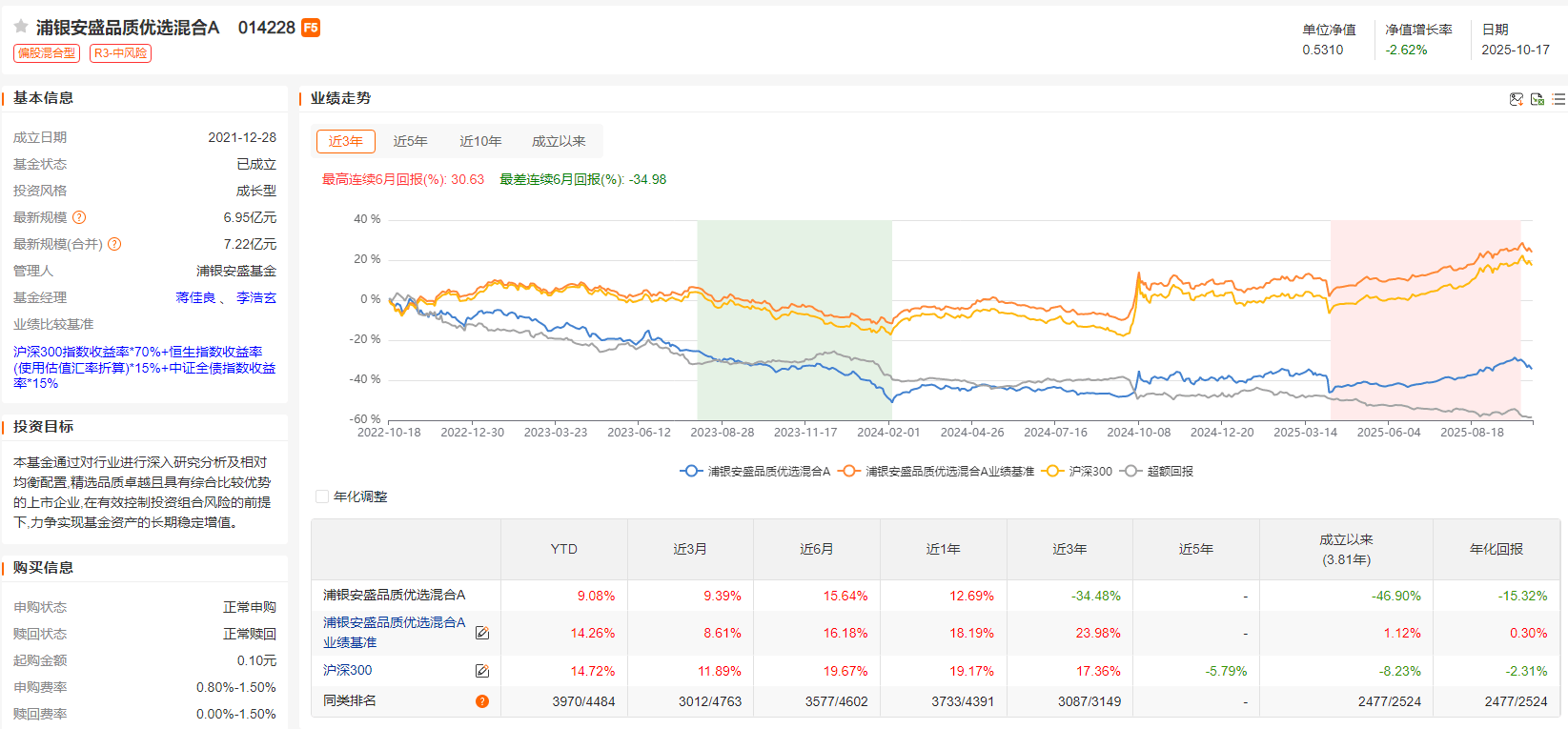
Core Insights - The public fund industry in China has surpassed 33 trillion yuan, but浦银安盛基金 is facing a "performance dilemma" in equity investments, with all three core products managed by CIO 蒋佳良 showing negative returns exceeding 15% [1][2] - The flagship product, 浦银安盛品质优选混合A, has declined by 46.9% since its inception at the end of 2021, ranking near the bottom among similar funds [1][2] - Despite the poor performance of existing products, the company continues to launch new funds, with 10 new funds issued in 2025, including 4 active equity products, three of which have already reported losses [1][7] Performance Analysis - 蒋佳良 manages 8 products with a total scale of approximately 1.17 billion yuan, representing about one-fifth of the company's equity fund assets [2] - The three actively managed equity products have returns of -46.90%, -18.76%, and -6.78% as of October 17, 2025, all negative [2] - The flagship fund has seen its net value drop to 0.531 yuan, with an annualized return of -15.32%, significantly underperforming the benchmark [2][5] Investment Strategy Issues - The investment strategy has shown clear misalignment, with a focus on new energy and vehicle manufacturing in 2022 leading to losses, and a missed opportunity in the AI sector in 2023 [5] - The fund's turnover rate has remained high, exceeding 480% in 2024, indicating a lack of stability in investment style [5] - High management fees have drawn criticism, as the flagship fund has incurred over 690 million yuan in management fees while reporting significant losses [5][6] New Fund Launches - In 2025, the company launched 10 new funds, including 4 active equity funds, but three of these have already reported losses shortly after their inception [7] - The newly launched active equity products have underperformed significantly compared to the market, with losses of -7.21% and -11.74% for two of the funds [7] Company Growth and Challenges - Despite a high frequency of fund launches, the overall growth in fund size has been limited, with the company managing approximately 361.7 billion yuan in public fund assets as of mid-2025 [8] - The reliance on frequent product launches without a strong flagship fund has weakened investor confidence [8] - Regulatory changes are pushing for higher quality in fund management, emphasizing the need for clear performance benchmarks and investment positioning [8]

浦银安盛基金首席权益投资官遭投资者吐槽 在管部分产品净值“腰斩”
Shen Zhen Shang Bao· 2025-05-19 16:55
Core Insights - The performance of Jiang Jialiang, the Chief Equity Investment Officer at Puyin Ansheng Fund, has been disappointing, with five out of six managed products showing negative returns, some with declines exceeding 50% [1][2] Group 1: Performance Metrics - Jiang Jialiang's managed fund, Puyin Ansheng Quality Selected Mixed A, has a three-year return of -52.87%, the worst among the company's equity fund managers, while the average return for similar funds is -18.07% [2] - Other funds managed by Jiang also underperformed, with Puyin Ansheng Yingyao Selected One-Year Holding Mixed A showing a return of -37.17% compared to -8.56% for peers, and Puyin Ansheng Balanced Selected Six-Month Holding Mixed A at -25.37% against -14.96% for similar funds [2] - The only fund with a positive return under Jiang's management is Puyin Ansheng New Economic Structure Mixed A, which has a six-year return of 103.27%, although its C share has a three-year return of -50.74% [2] Group 2: Management Fees and Fund Size - Despite poor performance, the funds continue to charge significant management fees, with Puyin Ansheng Quality Selected Mixed A/C collecting a total of 10.16 million yuan in management fees for 2024, while fees for 2022 and 2023 were approximately 35 million yuan and 20 million yuan, respectively [3] - As of the first quarter of 2025, Puyin Ansheng Fund's public asset management scale reached 356.21 billion yuan, ranking 28th among around 200 institutions, but several products face liquidation pressure due to low asset sizes [3]