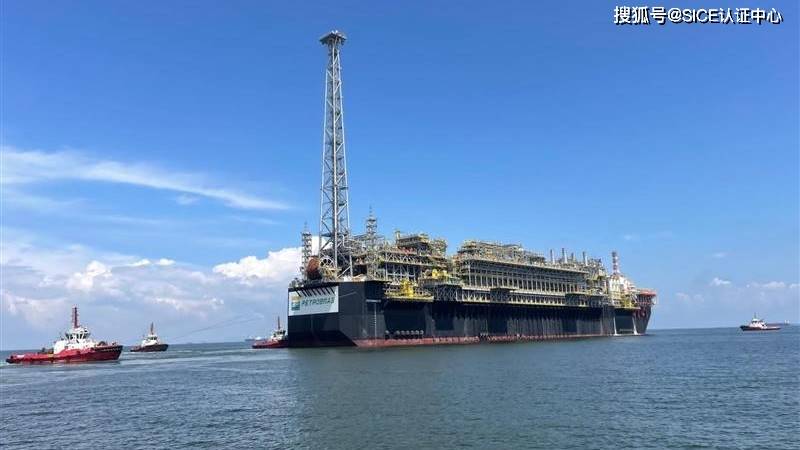
浮式生产储卸油装置(FPSO)

Search documents
未来6年内,将有哪21座浮式生产储卸油装置(FPSO)在巴西投入运营?
Sou Hu Cai Jing· 2026-01-11 05:08
Core Insights - Petrobras has released its strategic plan for 2026-2030, focusing on updating the next FPSO in the offshore market [1] - The FPSO P-78 is a key project in the Búzios oil field, expected to start production in December 2025, contributing to Petrobras's goal of increasing daily oil production to 1.6 million barrels over the next decade [3][4] - The FPSO P-79, a sister project to P-78, is set to begin operations in early 2026, with similar production capacity and a different construction strategy [6][7] - FPSOs P-80, P-82, and P-83 are planned for 2027, each with a production capacity of 225,000 barrels per day and a focus on reducing carbon emissions [11] - The FPSO Raia project, expected to be operational by 2028, will include a gas export capacity of 16 million cubic meters per day [10][15] - FPSOs P-84 and P-85, scheduled for 2029 and 2030, will be the largest in Petrobras's history, with a daily processing capacity of 225,000 barrels of oil [17][19] - The SEAP FPSOs I and II contracts were officially approved in 2025, marking a significant step in the revitalization of the Sergipe state industrial sector [37][38] Summary by Category FPSO Projects - FPSO P-78 is the sixth project in the Búzios field, with a production capacity of 180,000 barrels per day and gas processing of 7.2 million cubic meters per day [4] - FPSO P-79, a direct sibling to P-78, will also have a capacity of 180,000 barrels per day and is set to sail from Korea in November 2025 [6][7] - FPSOs P-80, P-82, and P-83 are designed for high productivity, each with a capacity of 225,000 barrels per day and a focus on carbon emission reduction [11][12] - FPSO Raia will serve as a floating gas processing platform with a significant gas export capacity [15] - FPSOs P-84 and P-85 will be the largest FPSOs in Petrobras's history, with a focus on gas export capabilities [17][19] Strategic Developments - Petrobras's strategic plan emphasizes the need for innovation and sustainability in its FPSO projects, including the integration of carbon capture and utilization technologies [21][22] - The company is shifting to a BOT (Build-Operate-Transfer) model for new projects to enhance ownership and operational efficiency [26][37] - The SEAP FPSOs represent a significant investment in the Sergipe region, with a focus on local workforce reintegration and economic sustainability [38]


巴西Bacalhau油田正式投产
Zhong Guo Hua Gong Bao· 2025-10-22 02:29
Core Insights - Equinor and partners have officially commenced production at the Bacalhau oil field in Brazil, marking a significant milestone for the company's largest deepwater development project globally [1] - The Bacalhau project has recoverable reserves exceeding 1 billion barrels of oil equivalent, with a peak production capacity of 220,000 barrels per day [1] - The project is expected to support approximately 50,000 jobs over its 30-year lifecycle and provide long-term economic benefits to Brazil [2] Group 1 - The Bacalhau oil field is located in the Santos Basin, with production starting on October 15 at 22:56 (Rio time) [1] - The project is a joint operation involving Equinor, ExxonMobil Brazil, Petrogal Brazil, and the Brazilian National Petroleum Agency (PPSA) [1] - Equinor's CEO highlighted that Bacalhau represents a new generation of oil and gas projects that combine scale, cost-effectiveness, and low carbon intensity [1] Group 2 - The Bacalhau oil field is situated at a water depth exceeding 2,000 meters and utilizes the most advanced Floating Production Storage and Offloading (FPSO) technology [1] - The FPSO, constructed and operated by MODEC, measures 370 meters in length and 64 meters in width, featuring combined cycle gas turbine technology to reduce carbon emissions [1] - Equinor anticipates that the carbon emissions per barrel of oil equivalent from this project will be approximately 9 kilograms, setting a new low for offshore operations [1]

中国海油:圭亚那Yellowtail项目投产
Zheng Quan Shi Bao Wang· 2025-08-08 14:20
Core Viewpoint - CNOOC announced the early production of the Yellowtail project in Guyana, which is expected to significantly increase the oil production capacity of the Stabroek block [1] Group 1: Project Overview - The Yellowtail project is located in the Stabroek block of Guyana, at a water depth of 1600 to 2100 meters [1] - The main production facilities include a Floating Production Storage and Offloading (FPSO) unit and a subsea production system, with plans for 26 production wells and 25 water injection wells [1] - The FPSO for the Yellowtail project is the largest in the Stabroek block, designed with a storage capacity of approximately 2 million barrels [1] Group 2: Production Capacity - The Yellowtail project has a production capacity of 250,000 barrels per day, which will increase the total production capacity of the Stabroek block to 900,000 barrels per day [1] - Currently, the average daily oil production from the Stabroek block, including the Liza Phase 1, Liza Phase 2, and Payara projects, is approximately 650,000 barrels [1] Group 3: Stakeholder Information - CNOOC Petroleum Guyana Limited, a wholly-owned subsidiary of China National Offshore Oil Corporation (CNOOC), holds a 25% interest in the Stabroek block [1] - The operator, ExxonMobil Guyana Limited, holds a 45% interest, while Hess Guyana Exploration Ltd. owns a 30% interest in the block [1]

海上油气超级工厂完成原油外输第800船
Xin Lang Cai Jing· 2025-08-01 02:37
Core Viewpoint - China National Offshore Oil Corporation (CNOOC) has successfully completed the 800th oil export operation using the "Haiyang Shiyou 115" FPSO, marking a significant milestone in its offshore oil production capabilities [1] Group 1 - The "Haiyang Shiyou 115" FPSO has cumulatively exported over 293 million barrels of crude oil [1] - This volume is equivalent to filling more than 158,000 standard oil tankers [1]
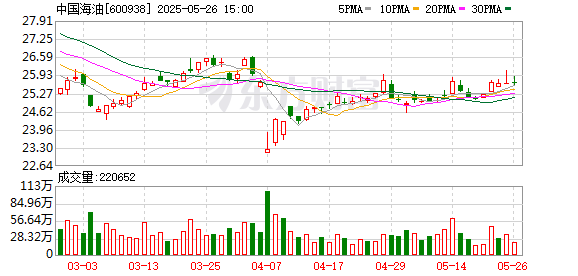
中国海油巴西Mero4项目投产
Xin Hua Cai Jing· 2025-05-26 12:01
Core Insights - China National Offshore Oil Corporation (CNOOC) announced the safe production launch of the Mero4 project in Brazil [2] - CNOOC holds a 9.65% stake in the Mero oil field, with Petrobras, TotalEnergies, Shell, and CNPC holding significant shares [2] - The Mero oil field is located in the Santos Basin, approximately 180 kilometers from Rio de Janeiro, at depths between 1,800 to 2,100 meters [2] Project Details - The Mero4 project utilizes a traditional deepwater development model, featuring a Floating Production Storage and Offloading (FPSO) unit and subsea production systems [2] - The project includes 12 development wells, comprising 5 production wells, 6 water-gas alternating injection wells, and 1 injection well [2] - Smart completion technology is employed to maximize production, allowing remote control of the production wells [2] Environmental Considerations - The project adopts a green low-carbon development approach, utilizing subsea associated gas separation and reinjection technology to promote production while reducing emissions [2] FPSO Specifications - The FPSO used in the Mero4 project is one of the largest in the world, with a design capacity of 180,000 barrels of crude oil per day and 12 million cubic meters of natural gas per day [3] - The FPSO was integrated in China and is expected to arrive at the target sea area in March 2025 [3] - The overall daily crude oil production from the oil field is projected to increase to 770,000 barrels following the project's launch [3]