海山一腔镜手术机器人

Search documents
强生将携十余款首发、首秀产品亮相进博会
Zheng Quan Shi Bao Wang· 2025-10-30 11:59
Core Viewpoint - The 8th China International Import Expo (CIIE) will take place from November 5 to 10 at the National Exhibition and Convention Center in Shanghai, featuring over a hundred innovative products from Johnson & Johnson's medical technology and innovative pharmaceutical sectors, including several debut products [1][2] Group 1: Product Innovations - Johnson & Johnson will showcase the world's first 3D stapler endoscope, which utilizes a new 3D stapling technology to ensure optimal tissue alignment and a dynamic adjustment feature for the stapling process [1] - The Haishan endoscopic surgical robot, China's first modular endoscopic surgical robot, will make its debut at the expo, approved for four major specialty indications: general surgery, thoracic surgery, gynecology, and urology [1] Group 2: Strategic Partnerships - In September, Johnson & Johnson Medical Technology announced a strategic partnership with Chinese company RuLong Surgical to advance the commercialization of surgical technology in China, combining their product strengths to meet clinical needs [1] Group 3: CIIE Participation - Johnson & Johnson has evolved from a "first-time exhibitor" to a "permanent partner" at the CIIE, showcasing over a thousand innovative products and solutions, including hundreds of global and China debuts [2] - The company views the CIIE as a strategic platform for open innovation and collaboration in the healthcare sector, successfully creating a virtuous cycle of "exhibits - products - investments" that resonates with the high-quality development of China's healthcare industry [2]

手术机器人市场狂飙背后的危机
3 6 Ke· 2025-06-16 01:54
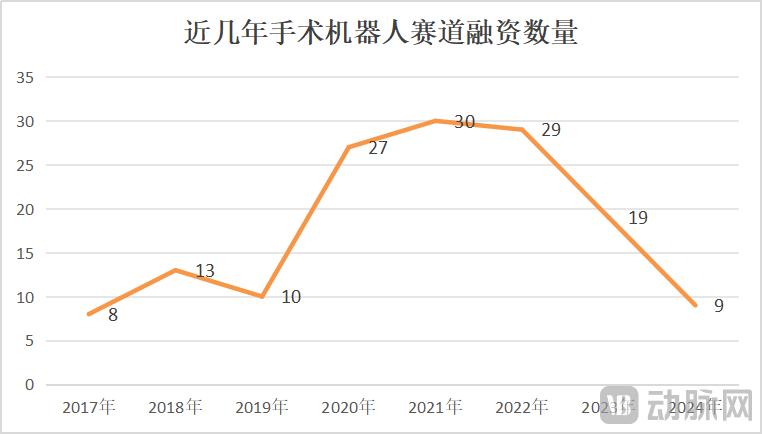
Core Viewpoint - The surgical robot market in China is experiencing significant growth, with a 82.9% year-on-year increase in the number of surgical robots awarded contracts in the first five months of 2025, despite some companies facing bankruptcy and liquidation [1] Group 1: Market Dynamics - The surgical robot industry is highly competitive, with numerous domestic companies participating in various segments, including over 16 approved laparoscopic surgical robots and more than 50 orthopedic surgical robots [1] - The number and amount of financing in the surgical robot sector have sharply decreased, leading to potential funding crises for companies that have not yet achieved commercial revenue [1][3] - The market is witnessing a price war among companies, with various surgical robots being commercialized at significantly different price points, yet the market leader, the Da Vinci surgical robot, remains unaffected in terms of sales [4][5] Group 2: Clinical and Technological Challenges - Some surgical robots are limited to simple procedures, and their clinical value has not yet been fully realized, as evidenced by a study showing that 11% of robot-assisted coronary interventions required conversion to manual operation [2][4] - The commercial success of surgical robots is heavily influenced by policies and macroeconomic conditions, with some companies experiencing significant declines in sales and revenue due to factors like anti-corruption measures and slowed bidding processes [5] Group 3: Innovations and Strategies - Companies are focusing on technological innovations, including the integration of AI to enhance the capabilities of surgical robots, with several firms already developing AI-enabled products [8][9] - Efforts are being made to reduce product costs to make surgical robots more accessible to hospitals, such as the modular design of the HaiShan laparoscopic surgical robot [9] - Companies are exploring remote surgical technologies to expand their market reach and improve access to quality healthcare, with several firms successfully conducting remote surgeries [9][10] Group 4: Market Expansion and Accessibility - Surgical robot companies are increasingly looking to international markets for growth, with firms like MicroPort achieving significant revenue increases through overseas orders [12] - There is a trend of surgical robots being adopted in county-level hospitals, which allows for more complex procedures to be performed locally, thus improving healthcare access for patients [14][15]


腔镜、骨科之外,又有手术机器人要突破了
3 6 Ke· 2025-04-07 00:45
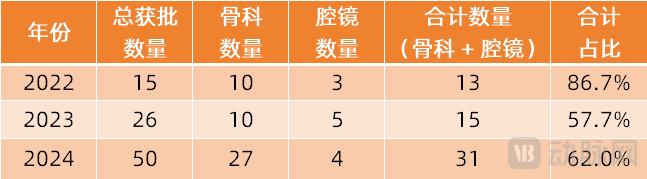
Core Insights - The surgical robot market is experiencing significant growth, with various segments such as endoscopic, orthopedic, and interventional robots gaining traction. The approval rates for these robots have increased substantially from 2022 to 2024, indicating a robust expansion in the market [1][2][4]. Approval Statistics - In 2022, 15 surgical robots were approved, with orthopedic robots accounting for 10 and endoscopic robots for 3, together making up 86.7% of the total approvals. In 2023, 26 robots were approved, with orthopedic robots still at 10 and endoscopic robots increasing to 5, resulting in a combined share of 57.7%. By 2024, the number of approvals is expected to reach 50, with orthopedic robots at 27 and endoscopic robots at 4, leading to a combined share of 62% [2][4]. Market Share - By 2024, the market share for endoscopic and orthopedic surgical robots is projected to be 81% based on sales revenue, highlighting their dominance in the surgical robot market [2][4]. Emerging Segments - The market is witnessing breakthroughs in other surgical robot segments, such as natural orifice transluminal endoscopic surgery (NOTES) and percutaneous puncture robots. Notable approvals include the EndoFaster digestive endoscopic robot and various percutaneous puncture robots, indicating a diversification of applications beyond traditional segments [4][5][6]. Commercialization and Sales - Several surgical robots have successfully completed their first commercial sales, such as the Ion bronchoscope robot and the R-ONE coronary intervention robot, which generated significant revenue for their respective companies [5][6]. Natural Orifice Transluminal Endoscopic Surgery (NOTES) Robots - The EndoFaster robot, designed for digestive endoscopic surgery, has been approved and is expected to enhance the precision and stability of procedures like endoscopic submucosal dissection (ESD), addressing challenges such as long learning curves and high operational demands [6][7]. Percutaneous Puncture Robots - The percutaneous puncture robot market is crowded, with over ten companies developing products. The introduction of advanced technologies, such as 3D structure light fusion positioning, is expected to improve accuracy and efficiency in procedures [11][12][13]. Specialized Surgical Robots - The market is expanding to include specialized surgical robots for hair transplantation, oral surgery, and vascular interventions. Recent approvals in these areas indicate a growing trend towards the commercialization of niche surgical robots [15][16][17]. Future Outlook - The surgical robot market is anticipated to continue its rapid growth, with increasing integration of AI and advanced technologies. The expansion of indications and applications for surgical robots is expected to further enhance their adoption in clinical settings [18].