
海底柔性直流输电技术

Search documents
阳江海上风电为什么行?
Zhong Guo Neng Yuan Wang· 2025-06-04 01:40
Core Viewpoint - China's offshore wind power capacity reached 43.51 million kilowatts by the end of April this year, maintaining the world's largest cumulative installed capacity for four consecutive years, accounting for over 50% of the global total [1] Group 1: Offshore Wind Power Development in Yangjiang - Yangjiang has built and connected over 6 million kilowatts of offshore wind power by the end of last year, representing about half of Guangdong Province's total and ranking second nationwide [2] - Yangjiang's coastal advantages include a long coastline of over 400 kilometers and rich offshore wind resources, with a planned total installed capacity of 20 million kilowatts and an investment of approximately 207 billion yuan [4] - The local government is actively promoting offshore wind power development as part of the national "dual carbon" strategy, aiming to optimize energy structure and foster high-quality marine economic development [4][6] Group 2: Future Projections and Environmental Impact - By 2030, Yangjiang is projected to achieve an offshore wind power capacity of 40 million kilowatts, generating over 100 billion kilowatt-hours of electricity, which is equivalent to about 1/9 of Guangdong's estimated electricity consumption in 2024 [5] - This development is expected to reduce carbon dioxide emissions by 80 million tons annually, highlighting significant environmental benefits [6] Group 3: Industry Ecosystem and Innovation - Yangjiang has established a comprehensive offshore wind power industry chain covering resource development, equipment manufacturing, research and design, testing, certification, and operation services [7] - The city has attracted major companies and developed innovative construction and transmission technologies, setting a benchmark for global marine development [7][9] - Yangjiang aims to become a world-class wind power equipment manufacturing base, targeting an industry chain output value exceeding 200 billion yuan by 2035 [8] Group 4: Trends and Strategic Directions - The offshore wind power industry in China is entering a market-driven phase characterized by large-scale, deep-sea development, and continuous technological upgrades [10] - The industry is encouraged to focus on new floating foundation research, enhance cross-departmental collaboration, and explore integrated uses of marine resources [10] - Yangjiang is positioned as both an industrial hub and an innovation source, leveraging its resource advantages and technological advancements to lead in offshore wind power development [11]

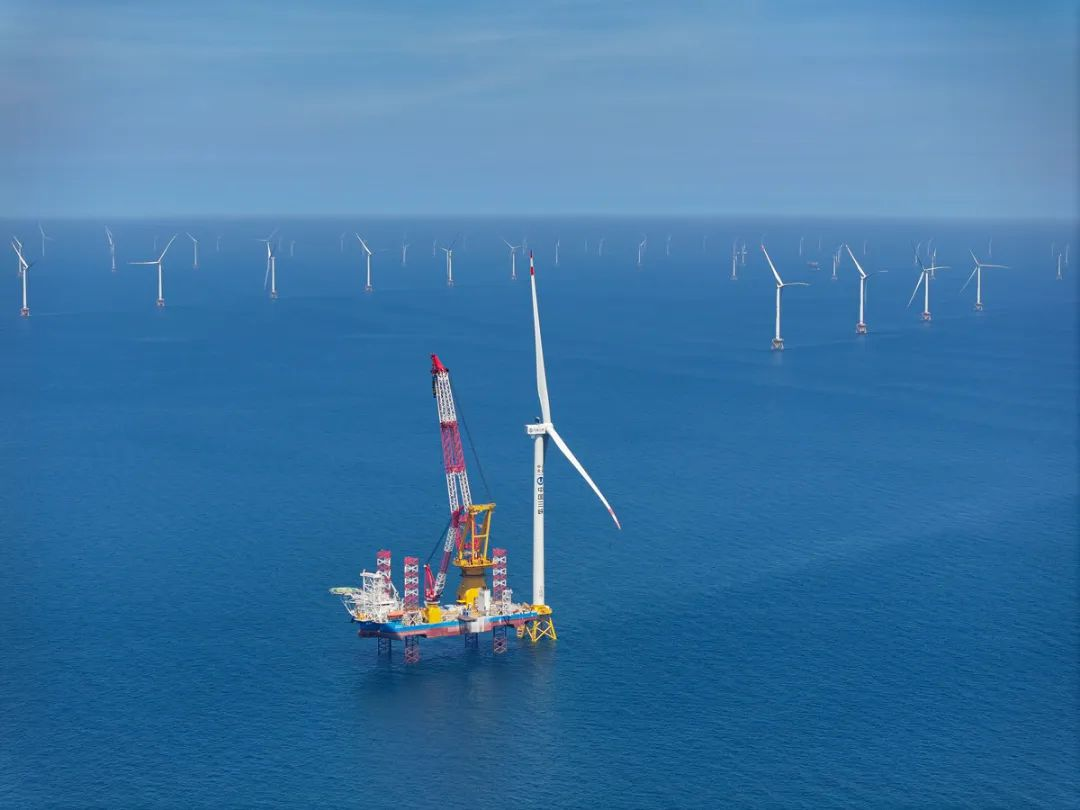
我国海上风电累计装机达4351万千瓦,连续四年居全球首位!
Zhong Guo Dian Li Bao· 2025-05-27 06:50
Core Insights - As of the end of April, China's offshore wind power installed capacity reached 43.51 million kilowatts, maintaining the world's largest share at over 50% of the global total [1][2] - Guangdong Province's offshore wind power capacity has surpassed 12.5 million kilowatts, with Yangjiang City contributing 6 million kilowatts, ranking second nationally [2] Industry Developments - Significant breakthroughs in offshore wind power technology have been achieved, including the launch of a domestic 26-megawatt offshore wind turbine model and advancements in subsea flexible direct current transmission and deep-sea booster station technologies [2] - A number of floating offshore wind turbine units have been constructed and are now operational [2] Future Projections - By 2030, Yangjiang is projected to reach an offshore wind power capacity of 40 million kilowatts, generating over 100 billion kilowatt-hours of electricity, which would account for approximately one-ninth of Guangdong's estimated electricity consumption in 2024 [2] - This development is expected to reduce carbon dioxide emissions by 80 million tons annually, highlighting significant environmental benefits [2] Market Trends - The offshore wind power sector in China is entering a phase of market competition, characterized by accelerated deep-sea development, continuous technological upgrades, and multi-industry integration [2] - The industry faces challenges such as complex construction conditions and increased technical difficulties, necessitating a focus on innovative floating foundation research and development, as well as improved policy incentives and collaborative mechanisms [2]