技术升级

Search documents
全球稀土,在库存彻底耗尽之前
汽车商业评论· 2026-03-23 23:06
Core Insights - The article discusses the increasing tensions between Japan and the U.S. against China regarding rare earth minerals, emphasizing the need for diversification in supply chains [3][4] - China's stringent export controls on rare earths, particularly since 2025, have raised concerns about the global automotive industry's reliance on these materials [4][18] - The article highlights the challenges faced by countries seeking alternatives to Chinese rare earths, including performance, cost, and time constraints [20][21] Group 1: Japan-U.S. Cooperation - Japan and the U.S. have agreed to strengthen cooperation to diversify the supply chain of critical minerals, including rare earths [3] - The meeting in Tokyo marks a significant step in addressing the risks associated with over-reliance on specific regions for critical minerals [3][4] - The urgency for alternative sources is underscored by the fact that China controls approximately 90% of global rare earth processing capacity [4][18] Group 2: Impact of China's Export Controls - China's export controls on rare earths have been described as the most stringent in history, establishing a comprehensive control system over the entire industry chain [4][18] - The automotive industry is particularly vulnerable, with estimates suggesting that a complete halt in Chinese supplies could lead to significant production disruptions within two months [4][7] - The article compares the rare earth supply crisis to the semiconductor crisis, indicating its potential to severely impact production lines [13] Group 3: Challenges in Finding Alternatives - The performance of rare earth magnets is difficult to replicate, as they provide significant advantages in size and efficiency for electric motors [19][20] - The cost of rare earth permanent magnets produced in China is approximately 60% lower than that of foreign competitors, making it challenging for others to compete [20] - Developing new rare earth mines and refining facilities is a lengthy process, often taking 5 to 10 years, which complicates the search for alternatives [21] Group 4: Global Supply Chain Restructuring - Countries are increasingly collaborating to mitigate reliance on Chinese rare earths, with Japan and the U.S. planning joint development of rare earth resources [28][29] - The U.S. has signed multiple bilateral agreements to enhance its critical mineral supply chain, indicating a shift towards multilateral cooperation [33][34] - European countries are also exploring collaborative models to secure critical raw materials, similar to Japan's approach [35] Group 5: China's Strategic Shift - China is shifting its focus from resource control to technology control in the rare earth sector, aiming to enhance the value-added aspects of its industry [43][44] - The article notes that China's advancements in rare earth technology could solidify its dominance in the global market, even as other countries seek alternatives [51] - The establishment of a comprehensive compliance framework for rare earth exports indicates China's intent to maintain influence over global supply chains [49][51]


战略看多中游制造系列三:如何具象化和跟踪中游制造的价格?
Huachuang Securities· 2026-03-15 05:50
Group 1: Macro Overview - The midstream manufacturing sector is a key driver of economic stability, with 8 out of 10 tracked prices rising this year, indicating a positive trend[1] - The PPI weight of midstream manufacturing has increased by approximately 6 percentage points over the past decade to 41%[1] - Midstream manufacturing is expected to benefit from technological upgrades and global supply chain restructuring, marking a strategic era for the sector[1] Group 2: Price Tracking Indicators - In the computer and communication electronics sector, the PPI weight is projected to be around 12.5% in 2025, with DDR5 prices rising by approximately 33% this year[1] - The electrical machinery sector, with a PPI weight of about 8.5%, has seen a 7% increase in photovoltaic component prices this year[2] - The automotive manufacturing sector, accounting for 8.1% of PPI, is experiencing a marginal improvement in vehicle prices, with some companies indicating potential price increases due to rising costs[5] Group 3: Material Costs - The metal products industry, with a PPI weight of 3.4%, has seen steel prices decrease by about 2% this year, while copper prices have increased by 2%[6] - The new shipbuilding price index in the railway, shipbuilding, and aerospace sector, which has a PPI weight of 1.3%, has risen by 1% this year[7] - The price of battery-grade lithium carbonate, crucial for battery manufacturing, has surged by approximately 34% this year, reflecting its significant cost share in lithium batteries[3]
——战略看多中游制造系列三:如何具象化和跟踪中游制造的价格?
Huachuang Securities· 2026-03-15 04:42
Group 1: Macro Overview - The midstream manufacturing sector is a key driver of economic stability, with 8 out of 10 tracked price indicators showing an upward trend this year[1] - The PPI weight of midstream manufacturing has increased by approximately 6 percentage points over the past decade to 41%[15] - Midstream manufacturing is expected to benefit from technological upgrades and global supply chain restructuring, marking a strategic era for the sector[10] Group 2: Price Tracking Indicators - In the computer and communication electronics sector, the price of DDR5 memory chips has risen by about 33% this year, while NAND Flash prices have also increased by 33%[1] - The price of battery-grade lithium carbonate has surged by approximately 34% this year, reflecting its significant cost share in lithium batteries[3] - The average price of air conditioners has increased by around 13% this year, with some manufacturers planning price hikes of 2% to 12% due to rising copper costs[3] Group 3: Industry-Specific Insights - The automotive manufacturing sector, which has a PPI weight of about 8.1%, is experiencing marginal improvements in pricing due to rising costs of chips and raw materials[5] - The steel price index has decreased by approximately 2% this year, while copper prices have risen by 2%[6] - The new shipbuilding price index has increased by 1% this year, indicating a slight recovery in the maritime sector[7]
张瑜:进击的“中游”,来自供给力量的呐喊——战略看多中游制造系列一
一瑜中的· 2026-03-03 14:14
Core Viewpoint - The report emphasizes that midstream manufacturing is a strategic and significant direction for China's manufacturing industry in the coming years, driven by technological advancements and global supply concerns [2]. Group 1: Three Stages of Chinese Manufacturing - From 2000 to 2015, the focus was on upstream manufacturing, benefiting from urbanization and industrialization, with urbanization rates increasing from 34.7% in 1999 to 57.33% in 2015, averaging an annual increase of 1.4% [4][23]. - From 2015 to 2021, the focus shifted to downstream manufacturing, driven by consumer upgrades, with the ratio of household wealth to GDP rising to 4.39 by 2021, comparable to the U.S. in the early 1990s [4][27]. - Starting from 2025, the focus is expected to be on midstream manufacturing, addressing global supply concerns amid demographic changes and technological revolutions [5][31]. Group 2: Capital Market Mapping - The capital market has shifted focus from upstream to downstream and now to midstream, with midstream companies expected to present diverse investment opportunities and long-term competitive advantages [14]. Group 3: Global Supply Concerns - The report identifies three types of anxieties contributing to global supply concerns: the "power" anxiety of superpowers like the U.S., the "security" anxiety of middle powers, and the "development" anxiety of emerging countries [8][39][50]. - These anxieties create a demand for resources and capital goods, enhancing China's bargaining power as a comprehensive supply country [9]. Group 4: Advantages of Midstream Manufacturing - China's midstream manufacturing benefits from a continuously improving industrial chain, with the Competitive Industrial Performance Index (CIP) score narrowing the gap with leading countries [10][57]. - The complexity of China's manufacturing is increasing, with a higher share of intermediate goods in exports, rising from 38.7% in 2000 to 47.5% by 2025 [10][63]. - The capacity of China's manufacturing is both large and flexible, with significant growth in sectors like new energy vehicles, which saw production increase from 1.46 million units in 2020 to 16.52 million units by 2025 [10][67]. Group 5: Export Space Analysis - Despite reaching a trade surplus of $1.18 trillion in 2025, concerns about export limits are addressed by highlighting that broader export opportunities remain, including brand development and technological advancements [6][75]. - The report suggests that China's broad export share is still lower than that of the U.S., indicating potential for growth in overseas investments and exports [6][76].
未知机构:东吴电子陈海进芯碁微装业绩超预期先进封装PCB双轮驱动逻辑完美验证-20260227
未知机构· 2026-02-27 02:45
Summary of Conference Call Records Company Overview - **Company**: 芯碁微装 (Chipbond Technology Corporation) - **Industry**: Advanced Packaging and PCB (Printed Circuit Board) Key Points Financial Performance - **2025 Annual Revenue**: 14.08 billion CNY, representing a year-on-year growth of 47.61% [1] - **Net Profit**: 2.90 billion CNY, with a year-on-year increase of 80.42% [1] - **Q4 2025 Net Profit**: Approximately 0.91 billion CNY, showing a quarter-on-quarter growth of about 60% [1] Growth Drivers - **Dual-Engine Growth**: The high growth is attributed to dual drivers: advanced packaging and PCB, alongside global expansion [2] - **High Demand for PCB Equipment**: Strong orders for high-end PCB equipment and successful mass delivery of WLP series in the semiconductor sector [2] - **Profit Margin Improvement**: Continuous optimization of product structure has led to an increase in gross margin [2] Global Expansion - **International Operations**: The Thailand subsidiary has played a crucial role in regional operations and service, significantly increasing overseas business scale [2] - **Product Exports**: Products are being exported to multiple countries, including Japan and Vietnam [2] Production Capacity - **New Production Base**: The successful launch of the second-phase production base ensures timely delivery of high-end equipment, effectively reducing unit costs and enhancing profitability [2] Competitive Positioning - **Core Competitive Advantage**: Advanced packaging and high-end PCB capabilities create a strong competitive moat [3] - **Market Position**: The company is well-positioned to capitalize on the expansion opportunities in the domestic CoWoS-L market and has received high recognition for its LDI technology from leading domestic packaging and testing firms [3] - **AI Server Demand**: The demand for high-layer and high-density PCBs is experiencing exponential growth driven by AI servers, with the company being a leader in LDI technology [3] Future Outlook - **Continued Benefits**: The company is expected to benefit from both domestic substitution and technological upgrades as the AI computing infrastructure continues to expand [3] Risk Factors - **Supply Chain Risks**: Potential fluctuations in the supply chain could impact operations [4] - **Downstream Demand**: There is a risk that downstream demand may not meet expectations [4] - **Increased Competition**: The industry is facing heightened competition, which could affect market dynamics [4]

【跑好“第一棒” 力促“开门红”】肃北工业发展势头劲
Xin Lang Cai Jing· 2026-02-24 00:50
Group 1 - The core viewpoint emphasizes the strong industrial development momentum in Su Bei County, particularly in the non-ferrous and ferrous metal sectors, as well as coal mining, which are all advancing together to achieve production goals in the first quarter [1][2] - The North East Mining Company is highlighted as a leader in the non-ferrous metal industry in Su Bei County, ensuring continuous production during the Spring Festival by pre-scheduling shifts and securing materials [1] - Technological upgrades are identified as a key driver for capacity increases in the ferrous metal sector, with the investment of 313 million yuan in the Jiaoji Iron Mine's technical improvement project, which is currently in the critical trial operation phase [1] Group 2 - The coal industry is also showing strong performance, with efficient operations observed at the Tulu East Open-pit Coal Mine, where large excavators and heavy transport vehicles are actively engaged in mining activities [1] - The county is set to anchor its industrial development direction in 2026, focusing on core industries such as non-ferrous metals, ferrous metals, and coal, aiming for a coordinated advancement [2]
日照港裕廊治理调整与技术升级,中期净利下滑
Xin Lang Cai Jing· 2026-02-21 03:33
Corporate Governance Changes - The company has revised its articles of association and officially abolished the supervisory board, transferring its functions to the audit committee, with the termination of supervisory board members' positions [1] - Mr. Jin Feng has been appointed as a non-executive director and a member of the remuneration committee, while Mr. Chen Zhou has been elected as an employee representative director, completing the board structure adjustment [1] - These changes may impact the company's governance efficiency and supervisory mechanisms, warranting investor attention on subsequent execution [1] Business and Technological Development - In 2025, the company launched a fully automated grain continuous unloading machine with an operational efficiency of 1,500 tons per hour and a fully automated bulk grain loading system [1] - The company has enhanced unloading efficiency by 30% through the use of laser radar technology, aimed at strengthening its competitive edge in bulk cargo handling [1] - The actual impact of these technological upgrades on the company's throughput and costs in 2026 remains to be observed [1] Financial Performance - The company's net profit for the first half of 2025 was 82.79 million yuan, representing a year-on-year decline of 31.3%, primarily due to a contraction in business volume caused by adjustments in customer demand [2] - In October 2025, shareholders transferred their holdings from Standard Chartered Bank to Bank of China International Securities, with the transfer representing 5.46% of market value, indicating a potential change in shareholder structure [2] - Future financial reports, such as the 2025 annual report, may provide further insights into the progress of business recovery [2]

春运不再“难”
Xin Lang Cai Jing· 2026-02-16 00:28
Core Insights - The Spring Festival travel rush has transformed from a challenging experience to a more efficient and pleasant journey for travelers, reflecting advancements in railway operations and technology [1][2] Group 1: Changes in Passenger Experience - Daily passenger flow at Guangzhou South Station has exceeded 530,000 since the 2026 Spring Festival, a 14% increase compared to three years ago, yet the average stay time has decreased by 17% [1] - The railway system's refined operations and technological upgrades have contributed to a more comfortable travel experience, with improved train dispatch intervals and streamlined passenger flow [1] Group 2: Service Innovations - The "Light Travel" service, which allows passengers to have their luggage picked up at home and delivered to their destination, has been fully implemented across multiple stations in Guangdong, enhancing convenience for families and travelers [2] - The evolution of the Spring Festival travel experience signifies not only improved infrastructure and service concepts but also a broader enhancement in societal operational efficiency [2]
“东北轮胎大王”再出重拳!6.58亿收购后又有大动作
Xin Lang Cai Jing· 2026-02-14 14:36
Core Viewpoint - The acquisition and subsequent technological upgrade of the tire manufacturing facility by Liaoning Hengdasheng Investment Co., Ltd. marks a significant shift in the operational strategy and ownership structure of the company, transitioning from Japanese to Chinese control, with a focus on enhancing production capabilities and market responsiveness [3][4][12]. Group 1: Acquisition Details - In August 2025, Toyo Tire divested its loss-making operations in China, selling 86% of the shares of Tongyio Tire Zhangjiagang Co., Ltd. to Liaoning Hengdasheng for approximately $91.59 million (6.58 billion RMB) [4][12]. - The factory has been renamed Hengdasheng Toyo Tire (Zhangjiagang) Co., Ltd., indicating a new era under Chinese capital after over a decade of Japanese management [4][12]. Group 2: Technological Upgrade - The technological renovation project for the radial tire production line has been officially registered with the Zhangjiagang Free Trade Zone Management Committee, marking the beginning of substantial operational integration and technological enhancement [3][11]. - The project aims to upgrade existing production processes and equipment, focusing on increasing automation levels and optimizing production capacity to better respond to market demands [3][11][12]. Group 3: Financial Context and Market Position - The previous operations under Toyo Tire faced declining sales, with revenue dropping from 348 million RMB in 2022 to 203 million RMB in 2024, resulting in a loss of 5 million RMB in 2024 [6][14]. - Liaoning Hengdasheng, as a leading tire distributor in Northeast China, possesses a robust sales network across over 20 provinces, which is expected to enhance the manufacturing capabilities through vertical integration [6][14]. Group 4: Strategic Implications - Analysts suggest that the combination of technological upgrades and strong distribution channels will address the production and sales disconnect experienced by the factory, potentially leading to a turnaround in profitability [9][16]. - The success of this integration and upgrade will serve as a critical case study for the effects of mergers and acquisitions within the Chinese tire industry [9][16].
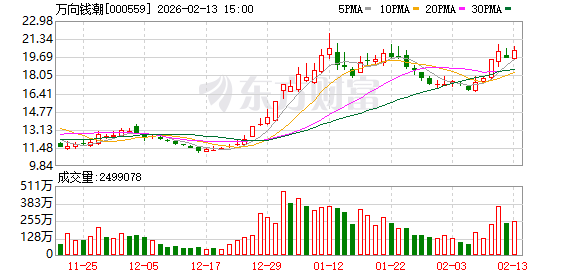
万向钱潮:公司战略规划将围绕主营业务展开,持续推进技术升级、市场拓展和产业协同
Zheng Quan Ri Bao· 2026-02-13 09:13
Core Viewpoint - Wanxiang Qianchao's strategic planning will focus on its main business, emphasizing continuous technological upgrades, market expansion, and industrial synergy [2] Group 1 - The company will provide specific annual operational plans in future periodic reports and related announcements [2]