海贝

Search documents
一枚硬币有两面 爱恨交织“孔方兄”
Xin Lang Cai Jing· 2026-01-09 17:40
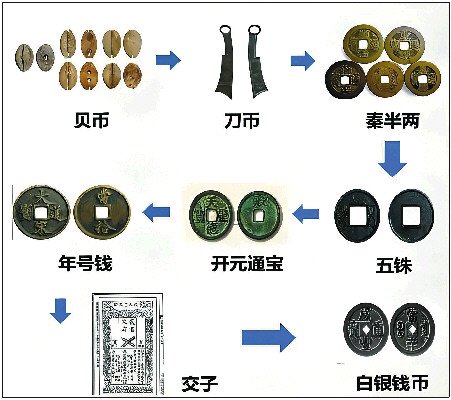
Core Perspective - The evolution of currency in China reflects a complex interplay of political power, economic life, technological breakthroughs, and philosophical ideas, illustrating how the nation built its intricate exchange system and credit world over time [2]. Group 1: Historical Development of Currency - The concept of currency began with primitive barter systems, which were inefficient, leading to the emergence of primitive money, such as shells, as a medium of exchange [3]. - The first significant currency in China was sea shells, which became a recognized measure of wealth and facilitated large transactions during the Xia and Shang dynasties [4]. - The transition from natural objects to metal coins began with the introduction of bronze shells during the Shang dynasty, marking the start of artificial currency manufacturing [4]. Group 2: Currency in the Warring States Period - The Spring and Autumn and Warring States periods saw diverse currency forms reflecting regional cultures, such as cloth coins in the agricultural core and knife coins in martial regions [6]. - The use of gold emerged as a high-value international currency, providing a stable anchor in a fragmented monetary system [6]. Group 3: Standardization under the Qin Dynasty - The unification of China under Qin Shi Huang led to the standardization of currency, with the introduction of the "half tael" coin and the iconic round coin with a square hole [7]. - This design change not only served practical purposes but also carried cultural significance, symbolizing the connection between heaven and earth [7]. Group 4: The Han and Tang Dynasties - The Han dynasty improved upon the Qin currency system with the introduction of the "Wuzhu" coin, which became the most successful and longest-used currency in Chinese history [8]. - The Tang dynasty introduced the "Kaiyuan Tongbao," marking a shift in currency philosophy and establishing a model for future coinage that influenced East Asia [8][9]. Group 5: The Rise of Paper Currency - The Song dynasty initiated a revolutionary experiment with credit currency through the invention of "Jiaozi," a paper currency that emerged from the need for a more efficient payment system [10]. - The Yuan dynasty expanded the use of paper currency, achieving a pure paper economy, although it later faced issues of hyperinflation due to excessive issuance [10]. Group 6: The Silver Era - The Ming dynasty saw the rise of silver as a dominant currency, facilitated by global trade, particularly through the maritime Silk Road, which integrated China into the early global economy [11]. - The Qing dynasty continued the dual currency system of silver and copper coins, while also introducing official paper currency to address market challenges [12]. Group 7: The Evolution of Currency and Credit - The history of currency in China illustrates a transition from tangible objects to abstract symbols, reflecting the increasing complexity of economic exchanges and the state's role in controlling monetary systems [13]. - The evolution of currency highlights the enduring human pursuit of reliable and efficient value exchange systems, from ancient shells to modern digital payments [13].

东西问|樊海涛:两千多年前的云南,何以出现类似希腊风格头盔?
Zhong Guo Xin Wen Wang· 2025-12-24 09:24
Core Viewpoint - The bronze helmet discovered in Yunnan, which exhibits characteristics similar to Greek styles, suggests potential cultural exchanges between ancient Yunnan and the Mediterranean world, highlighting the significance of the ancient Dian culture as a center of bronze civilization in Asia [3][4][5]. Group 1: Cultural Significance - The bronze helmet, dating back to the Western Han period, was unearthed from the Yangfutou tomb site in Kunming, which has been recognized as one of the "Top Ten Archaeological Discoveries" in 1999, revealing a rich array of artifacts that reflect the cultural interactions of the time [4][10]. - The helmet's design, featuring a unique shape reminiscent of the Greek "petasos," indicates that while it was locally manufactured, it also embodies foreign cultural influences, suggesting a complex web of cultural exchange [5][9]. Group 2: Archaeological Findings - The Yangfutou tomb site spans over 40,000 square meters and has yielded more than 7,000 valuable burial artifacts, including bronze items, tools, and daily utensils, showcasing the advanced craftsmanship and cultural richness of the ancient Dian civilization [4][10]. - The helmet features intricate designs, including two roosters, which symbolize agility and bravery, reflecting the local customs and the significance of poultry in ancient Yunnan culture [7][10]. Group 3: Cultural Exchange Mechanisms - Ancient Yunnan's position as a cultural melting pot is attributed to its location at the intersection of three major cultural transmission routes, facilitating indirect cultural exchanges with various regions, including the Mediterranean [9][10]. - The presence of artifacts such as the "sea shells" from the Gengma Shifo Cave site indicates early cultural interactions between Yunnan and the South Asian subcontinent, further emphasizing the region's historical significance in global trade and cultural exchange [10][12].