
深海材料

Search documents
【宁夏日报】代表委员议政录 | 王东新委员:强集群育未来推动宁夏新型材料产业加速跑
Xin Lang Cai Jing· 2026-02-06 11:19
Core Viewpoint - The new materials industry is a key economic pillar for Ningxia and requires accelerated development through cluster-based growth led by leading enterprises to seize future development opportunities [2][4]. Group 1: Industry Development - There is a strong need to enhance support for the cluster development of Ningxia's new materials industry and to cultivate future-oriented new materials sectors, aiming for high-quality development [2][4]. - The proposal includes establishing a special fund to support future industries, particularly in superconducting materials, new energy storage, quantum technology, aerospace, deep-sea, and biomedical materials, to strengthen and expand Ningxia's new materials industry [5]. Group 2: Organizational and Policy Recommendations - Recommendations include strengthening organizational leadership and improving work mechanisms, using policies to guide the industry, and leveraging leading enterprises to support local small and medium-sized enterprises [5]. - Regular high-level forums, such as the "Ningxia Helan Mountain New Materials High-end Forum and Industry Development Exchange Conference," are suggested to enhance the influence of Ningxia's new materials sector nationally [5]. - The establishment of innovation coalitions in the new materials field, driven by approved key laboratories in Ningxia, is proposed to enhance technological innovation capabilities and talent development among small enterprises [5].


2025年中国深海科技行业原材料现状 深海材料决定着科技能力的边界【组图】
Xin Lang Cai Jing· 2026-01-21 08:13
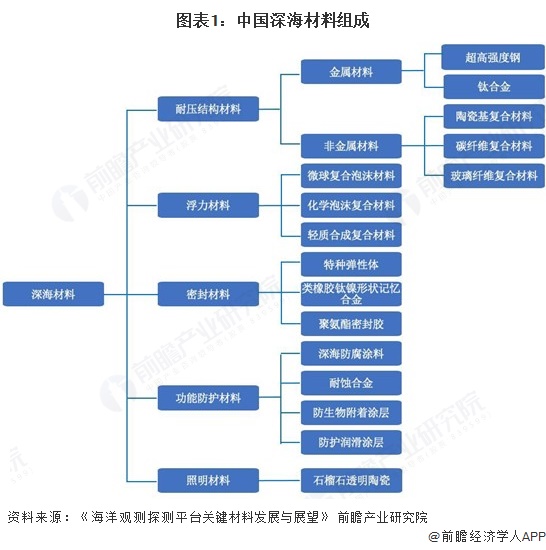
Core Viewpoint - The development of deep-sea materials is crucial for advancing deep-sea technology and unlocking the potential of the trillion-dollar deep-sea mineral resources market, supporting the entire industry chain from equipment manufacturing to resource utilization [1][3]. Group 1: Deep-Sea Materials Overview - Deep-sea materials are essential for operations in extreme environments characterized by high pressure, low temperature, and strong corrosion, directly influencing development capabilities [1]. - These materials can be categorized by function into pressure-resistant structural materials, buoyancy materials, sealing materials, protective materials, and lighting materials, and by properties into high-strength metal materials, polymer composites, and ceramic-based composites [1][3]. Group 2: Pressure-Resistant Structural Materials - Pressure-resistant structural materials are divided into metal and non-metal categories, with metal systems being more mature, including high-strength alloy steel, titanium alloys, and aluminum alloys [3]. - Non-metal materials are also making progress, with composite materials showing significant potential due to their lightweight and corrosion-resistant properties [3][4]. Group 3: Titanium Alloys - Titanium alloys, known as "marine metals," are favored for their high strength, excellent corrosion resistance, and low density (60% of steel), making them ideal for marine engineering and deep-sea pressure vessels [5]. - Companies like BaoTi Co., Ltd. and Western Materials are leading in titanium alloy production, with BaoTi being the largest global producer and achieving mass production of deep-sea titanium alloy components [7]. Group 4: Sealing Materials - Deep-sea sealing materials include rubber sealing materials, metal sealing materials, and special engineering plastics, with rubber materials currently dominating the market [9]. - Metal seals, particularly titanium and nickel-based alloys, are gaining attention for their superior durability and temperature adaptability in deep-sea applications [9]. Group 5: Corrosion-Resistant Materials - Corrosion-resistant materials are critical in deep-sea environments, with methods to reduce corrosion including the development of new materials and the application of protective coatings [11]. - Common anti-corrosion coatings used in marine applications include rubber-based, epoxy-based, fluorocarbon, and organic silicone coatings, each with specific advantages and limitations [11].






深海科技-海洋强国战略的关键支柱
2025-07-16 06:13
Summary of Conference Call on Deep Sea Technology and Marine Economy Industry Overview - The focus of the conference call is on the **deep sea technology** and **marine economy** sectors, which are gaining significant attention in the market [1][2]. - The marine economy is projected to contribute **10 trillion yuan** to the national GDP by 2024, accounting for **7.8%** of the total GDP, indicating a substantial growth potential [2]. Key Points and Arguments - The government has recognized deep sea technology as a crucial component of the marine economy, emphasizing its role in driving economic growth [2][5]. - The marine economy's GDP contribution is noted to be **11.5%**, positioning it as a new engine for economic growth [2]. - Recent government reports have highlighted the importance of developing new technologies and products in deep sea technology, aiming for large-scale application and demonstration [2]. - The strategic importance of deep sea technology is underscored by historical remarks from national leaders, advocating for the establishment of deep sea research bases and the modernization of marine industries [3][5]. Development Plans and Trends - Coastal provinces are actively releasing development plans for high-quality marine economic growth, such as Shanghai's and Guangdong's recent initiatives [3]. - The marine economy encompasses various sectors, including deep sea technology, marine tourism, and marine fisheries, with a strong emphasis on marine equipment manufacturing and emerging industries [4]. - The deep sea technology sector is identified as a key pillar of the marine economy, with a focus on deep sea materials, equipment manufacturing, and application [5][6]. Equipment and Technological Needs - The development of deep sea technology requires advanced underwater equipment to address the complex challenges of deep sea exploration [7]. - The shipbuilding industry is experiencing a resurgence, with a **13.8%** increase in ship completion volume and a **58.8%** rise in new orders in 2024 [8]. - There is a growing demand for underwater robots and other specialized equipment for deep sea exploration and resource development [8]. Future Opportunities - The integration of digitalization and artificial intelligence in marine industries is anticipated to drive further advancements in deep sea technology [10]. - The establishment of underwater data centers is highlighted as a critical factor for enhancing data security and compliance for domestic and international enterprises [11][12]. - The marine communication sector is expected to grow alongside the expansion into deeper waters, necessitating improved communication technologies [12]. Conclusion - The deep sea technology and marine economy sectors present significant investment opportunities, driven by government support, technological advancements, and increasing market demand [1][2][5].