淳厚瑞明

Search documents
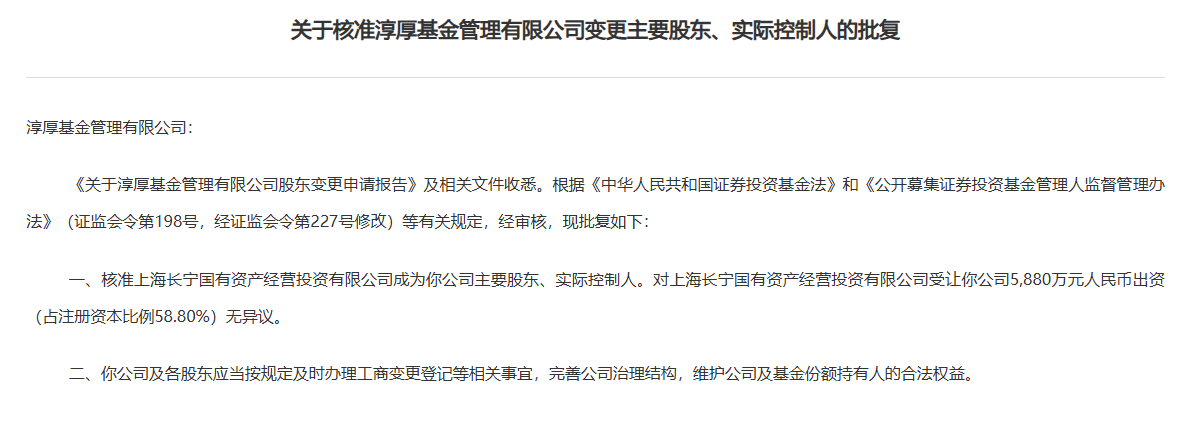
淳厚基金股权乱局落幕:长宁国投入主掌舵,柳志伟等4股东退出
Di Yi Cai Jing· 2026-01-11 12:05
Core Viewpoint - The control dispute over Chunhou Fund has concluded with state-owned enterprise Shanghai Changning State-owned Assets Management Investment Co., Ltd. becoming the major shareholder and actual controller, marking a transition from a privately held public fund to a state-controlled entity [1][3]. Group 1: Shareholder Changes - The China Securities Regulatory Commission approved Changning State-owned Assets to acquire 58.80% of Chunhou Fund's shares, ending a four-year shareholder dispute [3]. - Original shareholders, including Liu Zhiwei and others, transferred their shares to Changning State-owned Assets, resulting in a new ownership structure [3][5]. - The new management team has been established, with significant changes in key positions, including the departure of the original chairman and general manager [5]. Group 2: Management Restructuring - The new management team is characterized by strong financial and state-owned enterprise backgrounds, with the new chairman Chen Hong and general manager Zuo Jiqing bringing extensive experience in asset management [5][6]. - The primary mission of the new management is to enhance the fiduciary responsibility and protect investor interests [6]. Group 3: Governance Crisis and Regulatory Actions - The governance crisis began in 2022, leading to regulatory scrutiny, including multiple fines and investigations due to violations in information disclosure and governance failures [7][8]. - The Shanghai Securities Regulatory Bureau issued several penalties and corrective measures against Chunhou Fund and its shareholders for failing to manage shareholder affairs properly [8]. Group 4: Impact on Business Operations - The prolonged internal conflict and regulatory penalties have severely impacted Chunhou Fund's operations and market reputation, resulting in a significant reduction in assets under management [9]. - As of the third quarter of 2025, Chunhou Fund's total asset value was approximately 19.91 billion, down over 40% from its peak of 35.46 billion in mid-2022, with many funds below the 50 million threshold [9].