淳厚稳荣一年定开

Search documents
前总经理邢媛发公开信讨要说法,淳厚基金“内斗”何时休?
Huan Qiu Lao Hu Cai Jing· 2026-02-04 12:04
Core Viewpoint - The internal conflict within Chunhou Fund has resurfaced due to a public letter from former General Manager Xing Yuan, highlighting ongoing issues related to management and governance, stemming from a four-year-long equity struggle [1][2][4]. Group 1: Internal Conflict and Management Issues - Xing Yuan, holding 31.2% of the shares, criticized the new management for irregularities in bonus and performance distribution in her public letter [2]. - The internal strife has been exacerbated by the entry of state-owned capital, which has led to a significant management overhaul [7]. - The fund's management scale has drastically decreased from 324.2 billion to 198.5 billion since the onset of the internal conflict, with no new products launched since 2023 [6][7]. Group 2: Historical Context of Equity Struggles - The equity conflict began in 2022 when second-largest shareholder Liu Zhiwei acquired shares without notifying other shareholders, increasing his stake from 26% to 57% [4]. - Liu Zhiwei's actions led to a power struggle, resulting in the resignation of key figures and attempts to consolidate control [5][6]. - Regulatory intervention occurred in 2024, with Liu Zhiwei being ordered to transfer his shares due to violations, but the conflict continued with ongoing legal disputes [5][6]. Group 3: Fund Performance and Structure - Chunhou Fund's management scale as of Q4 2025 was 198.5 billion, ranking 114th among 167 public funds, with a significant concentration in bond funds [2][3]. - The fund has faced issues with "mini funds," with 10 out of 20 products having scales below 50 million, and five funds have been liquidated since 2025 due to falling below the liquidation threshold [3]. - The two main funds, Chunhou Anyu and Chunhou Anxin, account for 161.73 billion, representing nearly 80% of the total management scale, indicating a lack of diversification [3].
淳厚基金股权乱局落幕:长宁国投入主掌舵,柳志伟等4股东退出
Di Yi Cai Jing· 2026-01-11 12:05
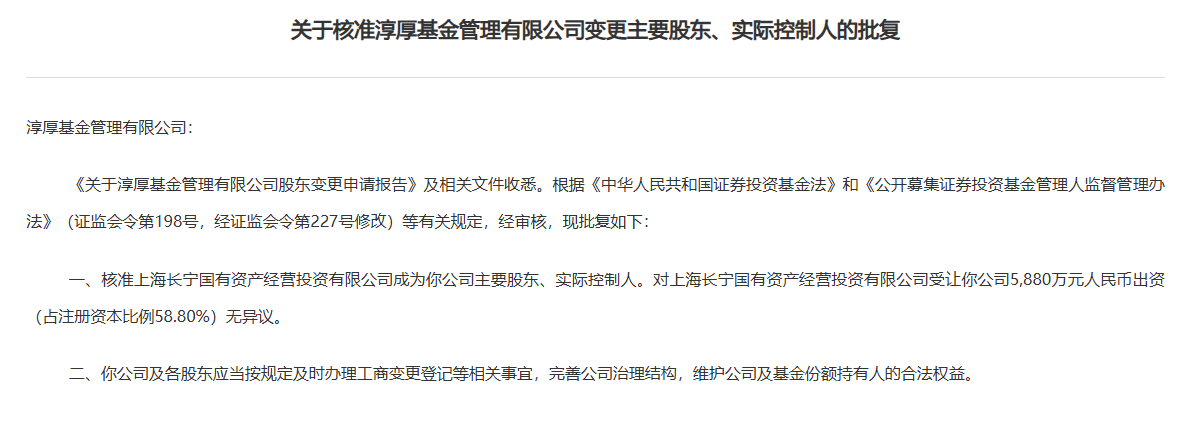
Core Viewpoint - The control dispute over Chunhou Fund has concluded with state-owned enterprise Shanghai Changning State-owned Assets Management Investment Co., Ltd. becoming the major shareholder and actual controller, marking a transition from a privately held public fund to a state-controlled entity [1][3]. Group 1: Shareholder Changes - The China Securities Regulatory Commission approved Changning State-owned Assets to acquire 58.80% of Chunhou Fund's shares, ending a four-year shareholder dispute [3]. - Original shareholders, including Liu Zhiwei and others, transferred their shares to Changning State-owned Assets, resulting in a new ownership structure [3][5]. - The new management team has been established, with significant changes in key positions, including the departure of the original chairman and general manager [5]. Group 2: Management Restructuring - The new management team is characterized by strong financial and state-owned enterprise backgrounds, with the new chairman Chen Hong and general manager Zuo Jiqing bringing extensive experience in asset management [5][6]. - The primary mission of the new management is to enhance the fiduciary responsibility and protect investor interests [6]. Group 3: Governance Crisis and Regulatory Actions - The governance crisis began in 2022, leading to regulatory scrutiny, including multiple fines and investigations due to violations in information disclosure and governance failures [7][8]. - The Shanghai Securities Regulatory Bureau issued several penalties and corrective measures against Chunhou Fund and its shareholders for failing to manage shareholder affairs properly [8]. Group 4: Impact on Business Operations - The prolonged internal conflict and regulatory penalties have severely impacted Chunhou Fund's operations and market reputation, resulting in a significant reduction in assets under management [9]. - As of the third quarter of 2025, Chunhou Fund's total asset value was approximately 19.91 billion, down over 40% from its peak of 35.46 billion in mid-2022, with many funds below the 50 million threshold [9].