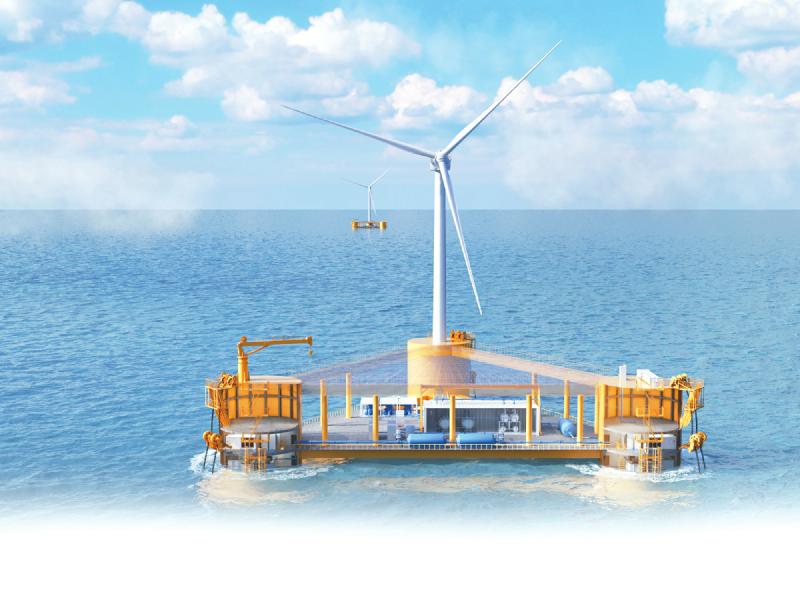
漂浮式风电耦合海水无淡化原位制氢综合平台

Search documents
海上有座“岛” 用风制“黄金”
Si Chuan Ri Bao· 2025-12-29 22:39
Core Viewpoint - The successful development of a floating wind power hydrogen production platform by Dongfu Research Institute marks a significant technological breakthrough in China's deep-sea renewable energy equipment sector, paving the way for commercial applications of floating wind power hydrogen production [4][12]. Group 1: Technological Advancements - The platform has received the Approval in Principle (AIP) certificate from the China Classification Society, making it the world's first floating wind power hydrogen production platform to achieve this certification [4]. - The platform utilizes a novel method for direct electrolysis of seawater to produce hydrogen, overcoming long-standing challenges related to corrosion and impurities in seawater [6][12]. - The technology involves a membrane that separates seawater from the electrolyte, allowing pure water molecules to enter the electrolyte without additional energy consumption [6]. Group 2: Market Potential - China's offshore wind power capacity has ranked first globally for four consecutive years, with significant potential in deep-sea wind energy resources estimated to exceed 1.2 billion kilowatts [5]. - The shift from nearshore to deep-sea wind energy presents both opportunities and challenges, including increased technical difficulties and costs [5][12]. Group 3: Strategic Collaborations - A strategic partnership was formed between the team led by Academician Xie Heping and Dongfang Electric Group shortly after the publication of their research, facilitating knowledge sharing and collaborative problem-solving [9][11]. - This collaboration has accelerated the transition from laboratory research to practical applications in offshore environments [11]. Group 4: Future Developments - The project team plans to develop scaled-down prototypes and conduct further testing to enhance the platform's reliability and cost-effectiveness [13]. - Ongoing research will focus on large-scale offshore wind power, new wave energy generation equipment, and integrated energy utilization for islands [13].

技术进步推动海上风电“深远化”发展
Zheng Quan Ri Bao Zhi Sheng· 2025-12-16 16:35
Group 1 - The Jiangsu Dafeng offshore wind power project has achieved full-capacity grid connection, marking a significant breakthrough in China's offshore wind power development towards deep waters [1] - The project is located 85.5 kilometers offshore, making it the farthest offshore wind power project in China to date [1] - The successful grid connection demonstrates the technical feasibility of stable power transmission from deep sea areas, providing valuable experience and data for future wind power development [1] Group 2 - Several high-quality offshore wind power projects are progressing, including a 2GW deep-sea project by Zhejiang Energy Group and a 1GW project by China Energy Construction Group [2] - These projects serve as "technology verifiers" and "industry pioneers," validating key technology routes and providing replicable engineering experiences for future large-scale development [2] - Offshore wind power installations are expected to reach 24GW by 2027, with a compound annual growth rate of 56% from 2025 to 2027 [2] Group 3 - Multiple listed companies are accelerating their entry into the deep-sea wind power sector, with Ningbo Oriental Cable Co., Ltd. breaking foreign monopolies in high-end marine transmission equipment [3] - Mingyang Smart Energy Group has launched the world's first 50MW floating offshore wind turbine, designed for water depths exceeding 40 meters, enhancing market opportunities in deep-sea wind power [3] - Companies are also investing in industrial base construction, such as the establishment of the Zhejiang Ningbo Offshore Wind Mother Port Equipment Development Co., Ltd. for the development of a deep-sea wind power base [3]


东方电气漂浮式风电制氢平台通过权威认证
Si Chuan Ri Bao· 2025-12-08 21:56
Core Insights - The floating wind power hydrogen production platform developed by Dongfu Research Institute has received the Approval in Principle (AIP) certificate from China Classification Society, marking it as the world's first floating wind power hydrogen production platform to achieve this certification [1][2] - This achievement signifies a key technological breakthrough for China in the deep-sea renewable energy equipment sector and advances the commercialization of floating wind power hydrogen production platforms [1] Group 1 - The floating wind power hydrogen production platform utilizes wind energy in deep-sea areas to produce hydrogen, which is then transported back to shore for comprehensive utilization [1] - The development of offshore wind resources has become saturated in nearshore areas, making deep-sea wind energy a more promising direction due to its broader development range and more stable wind conditions [1] - The platform integrates original principles and technologies from the team of academician Xie Heping, overcoming critical challenges in offshore power management, system control, and high-pressure hydrogen storage [2] Group 2 - The floating wind power hydrogen production platform has become a research hotspot in both domestic and international offshore wind power and marine engineering equipment sectors [1] - The successful certification of the platform represents a significant breakthrough for Dongfang Electric Group in the competitive new market of "floating offshore wind power + seawater hydrogen production" [2]
海上风电加速挺进深远海
Zheng Quan Ri Bao· 2025-12-08 17:11
Core Insights - The floating wind power hydrogen production platform developed by Dongfang Electric has received the Approval in Principle (AIP) from China Classification Society (CCS), marking it as the world's first certified floating wind power hydrogen production platform [1] Group 1: Industry Development - As of September 2025, China's offshore wind power cumulative installed capacity is expected to reach 44.61 million kilowatts, with an additional 3.5 million kilowatts added, maintaining the global leading position for five consecutive years [2] - The development of deep-sea wind power is seen as having significant potential due to more stable wind speeds and higher wind energy density compared to nearshore resources [2] - Recent technological advancements include the integration of the world's largest 26 MW offshore wind turbine and the demonstration of the first 16 MW floating offshore wind power system [2] Group 2: Policy Support - The Ministry of Natural Resources has issued guidelines encouraging the construction of offshore wind power in already developed marine areas, such as oil and gas development zones [3] - The "Wind Energy Beijing Declaration 2.0" aims for an annual increase of no less than 12 million kilowatts in wind power installations during the 14th Five-Year Plan, with offshore wind power accounting for at least 1.5 million kilowatts [3] - Local governments are establishing specialized offshore wind power industrial parks, covering the entire industry chain from turbine manufacturing to supporting equipment [3] Group 3: Corporate Strategies - Companies in the offshore wind power sector are actively positioning themselves to capitalize on the opportunities presented by deep-sea wind power, with investments in various segments such as floating wind equipment and dynamic cables [4] - Longyuan Power has launched an offshore wind power comprehensive detection platform, which has been successfully applied in several offshore projects [4] - Yunda Energy has established offshore wind power assembly bases in Dalian and Wenzhou, focusing on both nearshore and deep-sea projects [4] Group 4: Equipment and Technology - Jiangsu Runbang Heavy Industry is constructing a manufacturing base to expand its business in marine engineering and related equipment [5] - Companies are encouraged to focus on key areas such as 20 MW turbine components and dynamic cables, while also exploring the integration of offshore wind power with hydrogen production and energy storage [6] - The shift towards deep-sea wind power is expected to lower the cost of electricity generation, enhancing competitiveness with traditional energy sources [6]