
新能源装备

Search documents
临平区以“中国绿港”为主引擎,驱动高质量发展新征程
Hang Zhou Ri Bao· 2026-02-27 02:03
Core Viewpoint - Linping District is focusing on high-quality development and common prosperity by upgrading industries and improving people's livelihoods, aiming to transform development results into tangible happiness for the community [1] Group 1: Industry Upgrades - The district will prioritize the new energy equipment industry as a breakthrough for transformation and upgrading, targeting an industrial output value exceeding 40 billion yuan this year [1] - Key sectors include wind power equipment, turbine and auxiliary machinery, and electrochemical energy storage, with major enterprises like Yunda Energy and Hangzhou Turbine leading the way [1] Group 2: Emerging Industries - The artificial intelligence industry is expected to bring significant changes, with a focus on computing power and terminal applications, leveraging leading companies such as Alibaba Cloud and China Unicom [1] - Linping aims to establish a computing power town to support this growth [1] Group 3: Sector-Specific Goals - The district plans to achieve industrial output values of over 20 billion yuan for intelligent connected vehicles, 22 billion yuan for high-end general equipment, and 13 billion yuan for biomedicine and medical devices [2] - The traditional clothing industry will also undergo a transformation towards specialization and digitization, aiming for an output value exceeding 19 billion yuan [2] Group 4: Enterprise Support Initiatives - Linping is implementing initiatives like the "Eagle Action" for top enterprises and a dual-driven plan for specialized and innovative enterprises, targeting the addition of 60 new industrial enterprises this year [2] - The district will also introduce new industrial policies to support enterprises, focusing on land use, labor, energy, and financing challenges [2]
全力推动高质量发展实现新跃升
Xin Lang Cai Jing· 2026-02-25 18:56
Group 1: High-Quality Development Focus - The core focus is on achieving high-quality development through advanced manufacturing as a support, aiming to build a modern industrial system that reflects Inner Mongolia's unique advantages [1] - Emphasis on developing advanced manufacturing, enhancing traditional industries like coal, chemicals, and metallurgy, and promoting strategic emerging industries such as new energy and green computing [1][2] - The initiative includes the implementation of "Artificial Intelligence +" actions and enhancing service industry capabilities to accelerate the digital transformation of manufacturing [1] Group 2: Innovation and Business Environment - Innovation is highlighted as a key driver for development, with a focus on enhancing self-reliance in technology and increasing product value to respond to market fluctuations [2] - The creation of a first-class business environment is prioritized, with actions aimed at improving the quality of the business environment to ensure ease of operations for enterprises [2] - Policies to attract talent and encourage entrepreneurship in Inner Mongolia are being strengthened to foster a vibrant economic atmosphere [2] Group 3: Collaborative and Green Development - Collaborative development is emphasized to enhance overall and coordinated growth, with a focus on green development and expanding open opportunities [2] - The construction of a new energy system and increasing the local consumption of green electricity are key objectives, alongside efforts to protect the environment [2] - The development of ecological industries and carbon sink economies is being promoted to create new spaces for green growth [2] Group 4: People-Centric Approach and Safety - The ultimate goal of high-quality development is to enhance the well-being of the people, ensuring that development benefits all communities [3] - Safety is underscored as a prerequisite for development, with measures in place for risk management and emergency response to safeguard public safety [3] - The call to action emphasizes the need for proactive engagement in seizing opportunities and addressing challenges in the development process [3]
百利科技子公司又陷合计1亿元金融借款纠纷 近期频繁涉诉
Mei Ri Jing Ji Xin Wen· 2026-02-25 12:12
Core Viewpoint - Baili Technology is facing significant financial and legal challenges, including ongoing losses and multiple lawsuits related to financial borrowing contracts, which may impact its operational and financing capabilities. Group 1: Financial Performance - Baili Technology has reported a net loss of 118 million yuan in 2023 and an increased loss of 401 million yuan in 2024, with projections indicating a continued loss of 140 million to 200 million yuan in 2025 [3] - The company has experienced three consecutive years of losses, attributed to long revenue recognition cycles and reduced gross margins due to delayed project deliveries and increased credit impairment losses [3] Group 2: Legal Issues - The company is involved in two financial borrowing contract disputes, with a total claim amount of 104 million yuan, including 84.85 million yuan from Jiangsu Bank and 18.8 million yuan from Industrial and Commercial Bank [1][2] - Baili Technology has a history of frequent litigation, with total claims from various lawsuits and arbitration cases amounting to 291 million yuan as of February 10 [3] Group 3: Operational Impact - Baili Lithium Battery, a key subsidiary of Baili Technology, is primarily engaged in the production of lithium battery materials and has clients such as CATL and Hunan Shanshan, making the ongoing lawsuits potentially detrimental to its daily operations and financing capabilities [2] - The company is actively collecting evidence and preparing to respond to the lawsuits to protect its legal rights, while also indicating that the final impact will depend on court rulings [1][4]

天合光能、双良节能、英集芯等9位董秘被警示,6家长三角公司在列,上交所严控互动蹭热点 | 长三角资本局
Xin Lang Cai Jing· 2026-02-25 11:37
Core Viewpoint - In early 2026, approximately 9 listed company secretaries have been warned by regulators due to issues related to information disclosure on interactive platforms and public accounts, with some facing investigations [1][9][10] Group 1: Regulatory Actions - The regulatory stance is clear: interactive platforms, WeChat public accounts, and investor relations activity records are considered extensions of information disclosure [1][10] - All cases occurred within the Shanghai Stock Exchange system, covering both the main board and the Sci-Tech Innovation Board [1][9] - Six out of the nine companies involved are from the Yangtze River Delta region, indicating a concentration of manufacturing and tech firms in this area [1][10] Group 2: Company Profiles and Issues - Tianhe Solar's secretary, Wu Qun, misrepresented a partnership with SpaceX, leading to regulatory scrutiny [3][11] - Shuangliang Energy's Yang Likang failed to adequately disclose the scale and uncertainty of an overseas order related to SpaceX, which constituted about 0.11% of revenue [3][12] - Yingjixin's Wu Renchao did not sufficiently clarify the sales scale of a brain-machine interface chip, which was still in the market cultivation phase [4][12] - Hangxiao Steel's Yao Jianfeng exaggerated the impact of a project related to commercial space, which accounted for less than 1% of annual revenue [4][12] - Electric Science Digital's Hou Zhiping did not provide adequate details on the development stage and sales scale of satellite and AI products, which were less than 0.1% of total orders [4][13] - Woge Optoelectronics' Gong Qingyu failed to reflect the development stage and uncertainty of products mentioned in disclosures [5][13] - Guokai Military's Deng Weiyong did not sufficiently disclose the uncertainty of R&D partnerships, which were still in the development phase [5][13] - Yahui Long's Wang Mingyang provided inconsistent information regarding a strategic cooperation agreement, leading to regulatory concerns [6][14] - Tianpu's Kang Xiao faced scrutiny for not adequately warning about risks related to new AI business plans amid stock price fluctuations [6][14] Group 3: Common Themes and Implications - The secretaries share a common background of familiarity with capital markets and internal operations, indicating a shift in their roles from mere information transmitters to key participants in capital narratives [4][14] - The concentration of companies in the Yangtze River Delta reflects the region's industrial structure, with a high density of firms in solar energy, new energy equipment, semiconductors, and military technology [7][14] - The recent regulatory tightening emphasizes the importance of complete and accurate information disclosure, particularly in sensitive market contexts [8][15]

博雷顿2026年股份解禁与治理结构变更引关注
Xin Lang Cai Jing· 2026-02-23 09:54
Group 1 - The core event for the company is the unlocking of H-share shareholder shares on May 6, 2026, which represents a significant proportion of the total share capital, potentially impacting stock liquidity [1] - The company will no longer have a supervisory board and will delegate related powers to the audit committee of the board of directors starting from February 5, 2026, indicating a change in corporate governance structure [1] - The company is making ongoing progress in its business operations, including advancements in overseas solar storage projects and the commercialization of autonomous driving technology, although these developments are part of long-term operational dynamics rather than specific time-bound events [1]
突发利空!百利科技,债务逾期!昨日股价跌停
Zhong Guo Ji Jin Bao· 2026-02-12 23:22
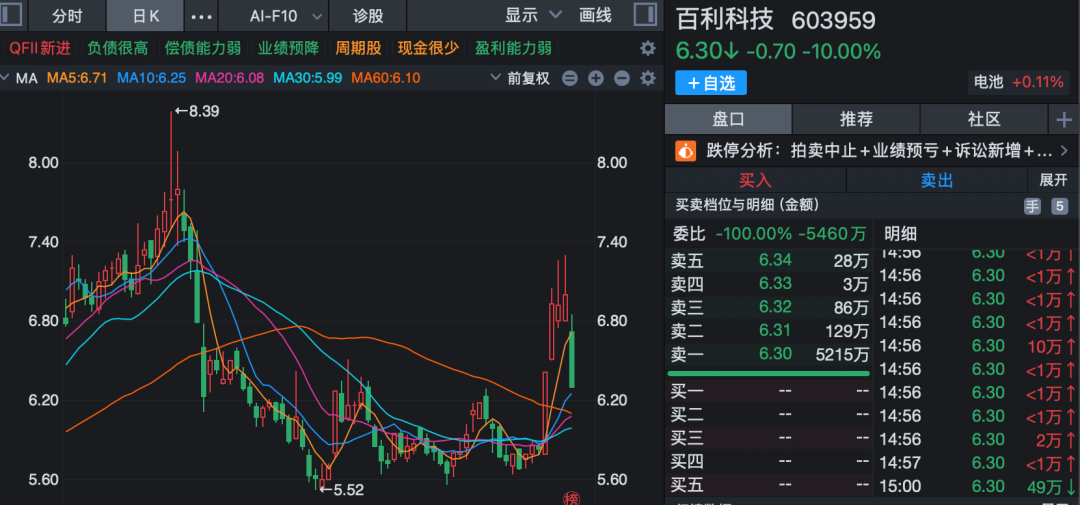
Core Viewpoint - Baili Technology (603959) experienced a significant stock price drop, hitting the limit down after a major negative announcement regarding loan defaults and financial difficulties [1][3]. Financial Performance - Baili Technology and its subsidiary, Baili Lithium Battery, have accumulated a total of 4 loans with a principal amount of 258 million yuan, which are now subject to early repayment demands from banks due to missed interest payments [3]. - The company reported losses of 118 million yuan in 2023 and 401 million yuan in 2024, with a projected net loss of between 140 million yuan and 200 million yuan for 2025 [4]. Debt Situation - The company is in communication with creditors to reach a debt resolution plan to address overdue debts [4]. - The overdue loans may lead to a decline in financing capabilities and potential legal actions against the company [3]. Shareholder Changes - Hunan Pailer Technology Co., Ltd. has become the largest shareholder of Baili Technology, acquiring a total of 58.08 million shares, representing an 11.85% stake [5]. - The new chairman, Lei Limeng, has been appointed and is expected to steer the company towards recovery [5]. Business Operations - Baili Technology primarily engages in engineering consulting, design, and general contracting, having expanded into the new energy equipment sector through the acquisition of Baili Lithium Battery in 2017 [4]. - The company faces challenges in revenue recognition due to lengthy project execution and delivery timelines, which have negatively impacted profit margins [4]. Strategic Developments - The new major shareholder has previously contributed to the growth of a leading machine tool company, indicating potential for strategic improvements in Baili Technology's operations [5][6]. - The donation of shares from Pailer Technology Group to Baili Technology's subsidiary indicates a strengthening of ties within the industry [6].

突发利空!603959,债务逾期!昨日股价跌停
Zhong Guo Ji Jin Bao· 2026-02-12 16:25
Core Viewpoint - Baili Technology (603959) experienced a significant stock price drop, reaching the daily limit down after receiving a major negative announcement regarding loan repayment issues [2][3]. Group 1: Loan Issues - Baili Technology and its subsidiary, Changzhou Baili Lithium Battery Smart Factory Co., Ltd., received early repayment notices from banks due to failure to pay interest on time, totaling 4 loans with a principal amount of 258 million yuan [3]. - The notices were received between January 26 and February 11, indicating potential liquidity issues for the company and its subsidiary [3]. - The company acknowledged that unresolved loan issues could lead to decreased financing capabilities and potential legal actions, including forced execution or claims for joint guarantee responsibilities [3]. Group 2: Financial Performance - Baili Technology has reported losses of 118 million yuan in 2023 and 401 million yuan in 2024, with a projected net loss of between 140 million yuan and 200 million yuan for 2025 [4]. - The company attributes its financial struggles to long project execution cycles and reduced gross margins from delayed project deliveries and increased credit impairment losses [4]. Group 3: New Shareholder and Management Changes - Hunan Pailer Technology Co., Ltd. became the largest shareholder of Baili Technology, acquiring 11.85% of the shares, which is seen as a potential turning point for the company [5]. - Lei Limo, the actual controller of Hunan Pailer, was appointed as the chairman and co-president of Baili Technology, with previous experience in leading a successful machine tool and new energy equipment company [5]. - Under Lei Limo's leadership, the company's losses have reportedly decreased year-on-year [5]. Group 4: Strategic Developments - In December, Pailer Technology Group donated 10% of its shares in Pailer Intelligent Nano Technology to Baili Technology's wholly-owned subsidiary, which aligns with the company's focus on new materials and energy solutions [6]. - The strategic relationship with Pailer Intelligent Nano Technology is expected to enhance Baili Technology's position in the supply chain of new energy materials and equipment [6].
生产场 生活场 创新场
Xin Lang Cai Jing· 2026-02-11 18:46
Core Insights - Industrial tourism is gaining popularity as a new frontier in cultural and tourism consumption, driven by technological advancements and policy support for the integration of industrial culture and tourism [1][2] Group 1: Industrial Tourism Trends - The rise of industrial tourism reflects the public's increasing interest in scientific knowledge and emerging technologies, shifting from superficial entertainment to deeper engagement with knowledge [2] - Over a hundred national-level industrial tourism demonstration benchmarks have been established across various industries, supported by local initiatives to promote the "industrial + cultural tourism" innovation practice [1][2] Group 2: Case Study - Dongjiao Memory - Dongjiao Memory, a 282-acre park formerly known as the state-owned Hongguang Electronic Tube Factory, has seen daily visitor numbers exceed 50,000 since its reopening in June 2021, with projected annual visitors reaching 17.94 million by 2025 [3] - The park features over 70 domestic brands and 90 flagship stores, making it a popular cultural and creative destination for young people [3] Group 3: Value Creation in Industrial Tourism - Four core pathways are suggested for transforming industrial spaces into integrated environments for production, consumption, experience, and knowledge [4][6] - The boundaries between production and visitor experience are increasingly blurred, with interactive elements embedded in production processes [4] - User participation in production processes enhances brand trust and recognition [5] - The integration of local culture and community activities into old industrial spaces activates their multiple values and attracts stable visitor flows [6] - Industrial tourism is encouraged to take on a greater role in public science education, transforming high-tech knowledge into engaging learning experiences [6] Group 4: Technological Integration - The acceleration of technologies such as AI, virtual reality, big data, and IoT is creating new opportunities for industrial tourism [6] - AI-guided systems can provide personalized tours based on visitor demographics, while data analytics enhances tourism planning and exhibition design [6]

766亿港元!无锡传奇父子今日再敲钟,人手一个IPO
Xin Lang Cai Jing· 2026-02-11 10:33
Core Insights - Wuxi Xian Dao Intelligent Equipment Co., Ltd. successfully listed on the Hong Kong Stock Exchange on February 11, raising a net amount of HKD 4.8 billion with a market capitalization of approximately HKD 76.6 billion [2][43] - The company forecasts a net profit of between RMB 1.5 billion and RMB 1.8 billion for 2025, representing a year-on-year growth of 424.29% to 529.15% [2][43] - The founders, Wang Yanqing and his son Wang Lei, each have their own IPO, with a combined market value exceeding RMB 120 billion [3][44] Company Overview - Xian Dao Intelligent was founded by Wang Yanqing, who started his career in a small warehouse and later transformed the company into a leading player in the global new energy equipment market [12][53] - The company has become the largest supplier of lithium battery, photovoltaic, and hydrogen energy equipment, maintaining a leading market share in the new energy equipment sector [12][53] - As of 2022, the company employed nearly 20,000 people, with over 5,000 in R&D, and holds more than 2,400 authorized patents [12][53] Historical Background - Wang Yanqing was born in 1966 in Wuxi and began his career as an assistant engineer before starting his own business in 1999 [6][48] - The company was officially established in 2002 and began scaling operations, eventually becoming a key supplier for major international brands like Panasonic and Tesla [10][51] - In 2015, the company went public on the Shenzhen Stock Exchange, achieving a peak market value of RMB 130 billion [12][51] Wang Lei's Journey - Wang Lei, the son of Wang Yanqing, took a different path by establishing Jiangsu Weidao Nano Technology Co., Ltd., which went public in 2022 [14][56] - Under Wang Lei's leadership, the company has seen significant growth, particularly in the semiconductor and photovoltaic sectors, with a 2.96-fold increase in new orders in 2023 [19][60] - The company has achieved a market value of RMB 36.25 billion as of February 10, 2026 [21][62] Economic Impact - The success of Wang Yanqing and Wang Lei reflects the evolution of Wuxi's private economy, showcasing resilience and innovation in high-end manufacturing [3][44] - Their entrepreneurial journeys illustrate the transition from grassroots enterprises to global leaders in the new energy sector, embodying the spirit of Wuxi's business community [24][65]
未知机构:天风机械新能源装备调研要点02091BEST真空室-20260210
未知机构· 2026-02-10 02:15
Key Points Summary Industry Overview - The focus is on the new energy equipment sector, particularly related to companies like Tianfeng Machinery and its collaborations with leading enterprises such as Guoguang, Antai, Parker, and Longda [1][3]. Core Insights and Arguments - **Installation of BEST Vacuum Chamber**: The BEST vacuum chamber is expected to be installed relatively quickly, indicating progress in production capabilities [1][3]. - **Strategic Collaborations**: Ongoing strategic cooperation with Guoguang includes weekly communications, with five projects currently in progress, particularly focusing on the implementation of a shrinkage device [1][3]. - **Chuan Factory Collaboration**: The Chuan factory is also in collaboration, with expected rapid implementation [2][4]. - **Satellite Teams Collaboration**: Two satellite teams are collaborating, with a desktop version expected to launch in June, followed by high-temperature superconducting orders [4]. - **PCB Laminating Machine Delays**: Progress on PCB laminating machines is pending final confirmation from German partners, with prototype delays until May [4]. - **Semiconductor Orders**: In the semiconductor sector, a significant order from a major client is anticipated for 2025, with expectations of several units being delivered this year [4]. - **Silicon Carbide Equipment Demand**: There are clear signs of increased market demand for silicon carbide processing equipment, covering sizes from 6 inches to 12 inches [4]. - **Lithium Battery Orders**: For 2025, lithium battery orders are projected to exceed 100 million, including various components such as blue film removal and laser baking [4]. - **Refinancing for Expansion**: The company plans to push forward with refinancing to support the headquarters and production base, aiming for completion by mid-year to enhance new energy capacity [4]. - **Offshore Engineering Orders**: The order structure for offshore engineering has improved significantly, with good demand for oil and gas-related equipment in the U.S. [4]. - **Acquisition of Two Targets**: The acquisition of two targets is expected to yield optimistic orders, potentially exceeding 100 million, focusing on water treatment equipment and semiconductor cooling components [4]. - **SAF Field Development**: In the SAF field, a pilot line with a capacity of 1,000 tons is expected to be built in Ningxia, with an investment scale reaching billions, and potential orders between several million to 100 million [4]. Additional Important Insights - **Production Capacity Growth**: The leading companies are expected to increase production capacity by 50%, aiming for 450 GWh by the end of 2025 based on a target of 900 GWh [5]. - **Structural Components Growth**: The internal target for structural components is a 40% growth this year, benefiting from expansion and CCS component volume, although mergers and acquisitions face temporary obstacles [5]. - **Overseas Orders**: New overseas orders are expected to ramp up in 2024, with confirmations starting in Q4 2025, indicating a potential for exceeding expectations [5]. - **Continuous Progress in Solid-State Equipment**: Ongoing advancements in solid-state compression and roller pressing equipment are being pursued [5].