火星计划

Search documents
马斯克回应SpaceX将重心转移至月球:仍会推进火星计划
Sou Hu Cai Jing· 2026-02-15 08:38
Core Viewpoint - SpaceX is shifting its focus to building a self-sustaining city on the Moon while still pursuing its Mars plans, with the adjustment potentially accelerating Mars development timelines by up to five years [1][2]. Group 1: Strategic Shift - Elon Musk announced that SpaceX has redirected its efforts towards constructing a self-sustaining city on the Moon, aiming to achieve this within a decade [2]. - The company maintains its commitment to developing a Mars city, with plans to initiate this project in approximately 5 to 7 years [2]. - Musk emphasized that ensuring the future of civilization is the top priority, and the Moon offers a faster path to this goal [2]. Group 2: Timeline and Priorities - SpaceX has postponed its original Mars mission planned for this year to focus on the long-awaited NASA lunar missions [2]. - The current target for an unmanned lunar landing is set for March 2027 [2]. - Musk indicated that the impact of the Moon focus on Mars city development would not exceed five years and could potentially expedite the Mars timeline [1].

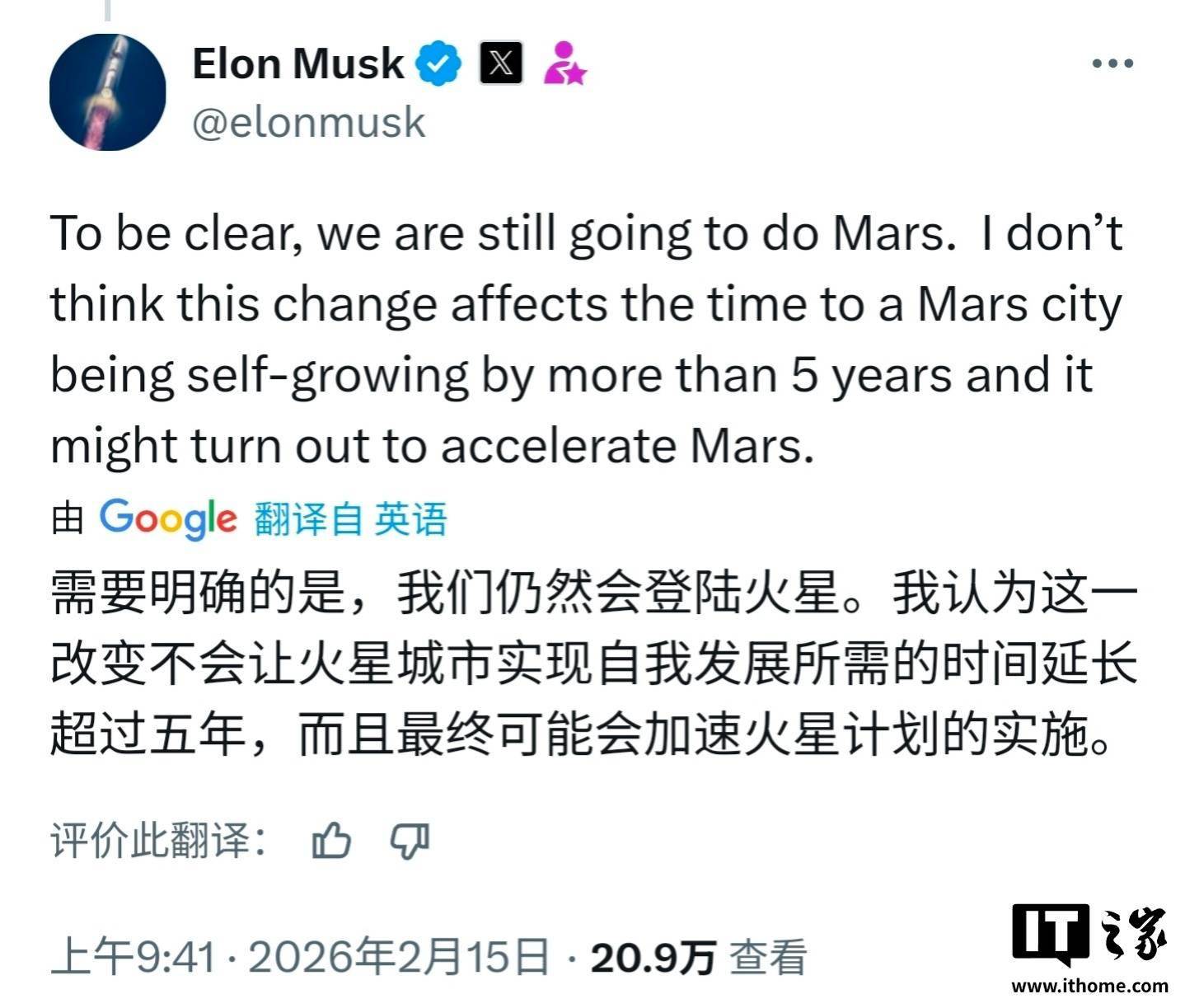
马斯克:仍将推进火星计划
Jin Rong Jie· 2026-02-15 03:08
Core Viewpoint - SpaceX is shifting its focus from Mars to the Moon, planning to establish a self-sustaining city on the Moon within ten years, while still advancing its Mars plans [1] Group 1 - The adjustment in focus to the Moon is not expected to delay the timeline for Mars city development by more than five years [1] - The shift may even accelerate the development process for Mars [1]
马斯克:仍将推进火星计划
财联社· 2026-02-15 02:58
Group 1 - The core viewpoint of the article is that SpaceX is shifting its focus from Mars to the Moon, planning to establish a self-sustaining city on the Moon within ten years, while still maintaining its Mars ambitions [1] - Elon Musk clarified that the adjustment in focus will not significantly delay the timeline for developing a self-sustaining city on Mars, estimating that the impact will be no more than five years and could potentially accelerate Mars development [1]