
月球城市建设

Search documents
国泰海通|机械:SpaceX计划在月球电磁弹射卫星,推动国内火箭技术加速迭代——商业航天事件点评
国泰海通证券研究· 2026-03-01 14:30
Core Viewpoint - SpaceX plans to launch satellites from the Moon using a giant electromagnetic catapult to establish a constellation of 1 million satellites for a space AI data center, which is expected to accelerate the iteration of domestic rocket technology and benefit the satellite manufacturing and rocket launch industries [1][2]. Group 1: SpaceX's Moon Launch Plans - SpaceX aims to build a factory on the Moon to assemble satellites equipped with high-performance AI processors, utilizing the Moon's low gravity, lack of atmosphere, and abundant solar energy for satellite launches via a multi-kilometer electromagnetic catapult [1][2]. - The U.S. Federal Communications Commission has accepted SpaceX's plan to launch up to 1 million satellites for a data center network in Earth orbit, which will operate at altitudes between 500-2,000 km and provide an additional 100 GW of space computing power annually, powered by solar energy [2]. Group 2: Integration with xAI and Future IPO - SpaceX has acquired xAI, a company owned by Elon Musk, to integrate technologies such as the Grok model, rocket launches, and satellite internet for its space data center strategy, with plans for an IPO in 2026 to fund Starship flight tests, data center networking, and lunar base construction [2]. Group 3: Lunar City and Global Space Competition - Elon Musk's lunar city construction plan may intensify global space competition, with a permanent lunar base providing advantageous conditions for SpaceX's satellite network [3]. - SpaceX's lunar missions align with the U.S. Artemis program and policies to ensure American space dominance, increasing competition in spacecraft, satellite internet, and space robotics, while expanding commercial space applications and industry scale [3]. Group 4: Investment Recommendations - Investors are advised to focus on satellite manufacturing companies capable of large-scale, low-cost production, as well as suppliers of key components like phased array antennas, onboard laser communication terminals, and Hall thrusters [4]. - The Starship flight tests are expected to boost confidence in reusable rocket manufacturing and launch, benefiting leading commercial rocket companies with "high payload + reusable" technology and related core component firms [4]. - Space photovoltaic technology is highlighted as a crucial energy supply method for the operation of space data center satellites and lunar base construction, with potential for increased application opportunities [4].


马斯克:仍将推进火星计划;此前宣布优先十年内建月球城市,五至七年启动火星计划
Sou Hu Cai Jing· 2026-02-15 04:05
Core Viewpoint - SpaceX is shifting its focus from Mars to the Moon, planning to establish a self-sustaining city on the Moon within ten years, while still pursuing its Mars ambitions, which may be accelerated by this shift [1][3][5]. Group 1: Strategic Shift - Elon Musk announced that the recent focus has shifted to building a self-expanding city on the Moon, which could be achieved in less than ten years, compared to over 20 years for Mars [3][5]. - The company will still work on the Mars city, with plans to initiate related work in 5 to 7 years [5][8]. Group 2: Technical Considerations - Musk highlighted that the launch window for Mars occurs every 26 months, requiring a 6-month journey, while lunar missions can be launched every 10 days with a 2-day travel time [5]. - This indicates that the iterative development speed for the lunar city will be significantly faster than for the Martian city [5]. Group 3: Business Developments - SpaceX has postponed its planned Mars mission to prioritize the long-awaited NASA lunar flight, aiming for an unmanned lunar landing in March 2027 [8]. - The company is also expanding its efforts in deploying AI data centers in space and has recently acquired Musk's startup xAI, raising the combined company's valuation to $1.25 trillion [8]. - SpaceX is considering an initial public offering (IPO) as early as this summer [8]. Group 4: NASA Collaboration - NASA has commissioned SpaceX to prepare a modified Starship vehicle for docking with its spacecraft near the Moon, which is a key part of NASA's Artemis program to land astronauts on the Moon [9]. - SpaceX has utilized billions in funding from NASA to assist in the development of the Starship, which is over 400 feet tall and fully reusable [9].
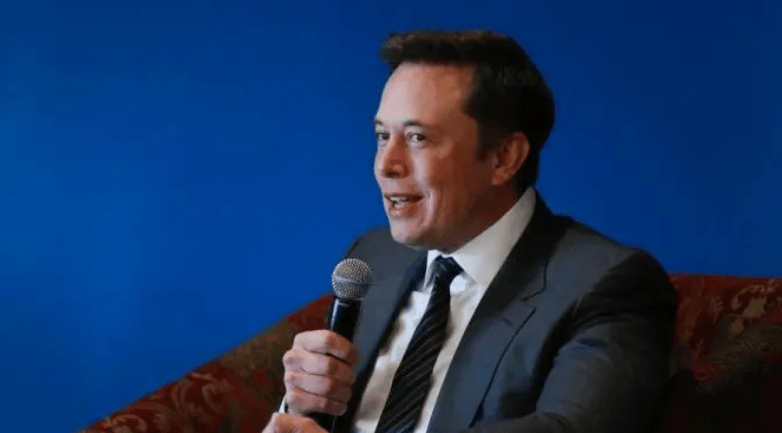
马斯克:仍将推进火星计划
Jin Rong Jie· 2026-02-15 03:08
Core Viewpoint - SpaceX is shifting its focus from Mars to the Moon, planning to establish a self-sustaining city on the Moon within ten years, while still advancing its Mars plans [1] Group 1 - The adjustment in focus to the Moon is not expected to delay the timeline for Mars city development by more than five years [1] - The shift may even accelerate the development process for Mars [1]
马斯克酝酿在月球造AI卫星工厂,此前称要10年内建成月球城市
Sou Hu Cai Jing· 2026-02-11 08:43
Group 1 - Elon Musk outlined plans for a lunar satellite factory during an all-hands meeting at his AI company xAI, emphasizing the need to build AI satellites on the Moon to enhance computational capabilities for AI development [1] - SpaceX has shifted its focus to constructing a "self-expanding city" on the Moon, with expectations to achieve this within a decade, while still pursuing the long-term vision of Mars colonization [1][3] - Musk stated that the construction of a lunar city can progress much faster than a Martian city due to the shorter travel times and more frequent launch opportunities, with lunar missions possible every 10 days compared to Mars missions every 26 months [3]
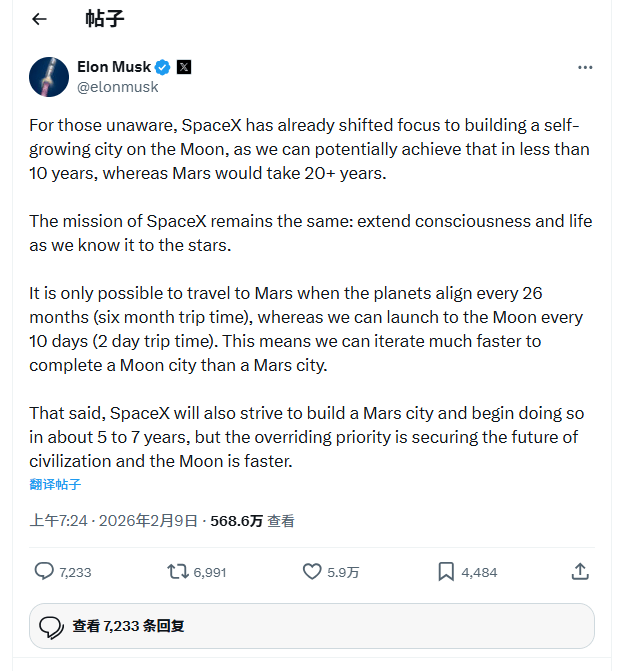
马斯克暂缓火星梦
Sou Hu Cai Jing· 2026-02-11 00:38
Core Perspective - The shift in focus from Mars to lunar city construction by Musk signifies a significant change in the narrative of human space exploration, indicating a recalibration of the path towards interstellar civilization [1][3][4] Group 1: Technical and Engineering Aspects - The decision to prioritize lunar exploration is driven by practical considerations, as the Moon is only 380,000 kilometers away, allowing for more frequent supply and personnel rotations compared to Mars, which is tens of millions of kilometers away and has a launch window every 26 months [3][4] - Establishing a "self-sustaining city" on the Moon requires a high level of logistics and emergency capabilities, making it a more controllable testing ground for deep space survival technologies [3][6] Group 2: Political and Strategic Context - The shift aligns with the U.S. space policy's return to a "near-Earth to Moon" approach, with the Artemis program receiving clear timelines and symbolic significance, reflecting national capability and great power competition [4][6] - SpaceX, as a core contractor, must align more closely with national strategies, making lunar exploration a more immediate and resource-backed goal compared to the long-term vision of Mars colonization [4][6] Group 3: Long-term Implications - The lunar city concept introduces a model of continuous construction, failure, and correction, contrasting with the historical narrative of space exploration that oscillates between monumental achievements and stagnation [9] - This approach emphasizes sustainability in the path of exploration rather than a rapid arrival at a destination, suggesting a more reliable and patient method for extending civilization [9]

新华读报|马斯克宣告或十年内建成月球城市
Xin Hua She· 2026-02-10 03:40
Core Viewpoint - SpaceX has shifted its focus from Mars exploration to building a self-sustaining city on the Moon, with a potential completion timeline of less than 10 years, while the Mars plan is projected to take over 20 years [2]. Group 1 - Elon Musk announced the strategic pivot of SpaceX towards lunar city development on social media [2]. - The company believes it can achieve the lunar city goal in under a decade, significantly faster than the Mars mission timeline [2].
马斯克宣布战略调整:优先十年内建月球城市 五至七年启动火星计划
Zhong Guo Xin Wen Wang· 2026-02-09 14:25
Core Insights - Elon Musk, founder of SpaceX, has shifted the company's focus towards building a self-sustaining city on the Moon, aiming to achieve this goal in less than 10 years, compared to over 20 years for Mars exploration [1] - Musk highlighted that the launch window for Mars occurs every 26 months, requiring a 6-month journey, while lunar missions can be launched every 10 days with a 2-day travel time [1] - The rapid iteration potential for lunar city construction is significantly higher than that for Mars, although SpaceX remains committed to its Mars city plans, with work expected to start in 5 to 7 years [1]
马斯克宣布战略调整:优先十年内建月球城市,五至七年启动火星计划
Zhong Guo Xin Wen Wang· 2026-02-09 13:31
Group 1 - The core focus of SpaceX has shifted towards building a self-sustaining city on the Moon within the next ten years, as stated by Elon Musk [3] - Musk highlighted that the timeline for initiating the Mars project is set for 5 to 7 years, despite the longer overall timeline for Mars colonization, which could exceed 20 years [3] - The launch window for Mars missions occurs every 26 months, requiring a 6-month journey, while lunar missions can be launched every 10 days with a 2-day travel time, indicating a faster iteration for lunar city development [3] Group 2 - SpaceX remains committed to the Mars city project, even as it prioritizes lunar city construction [3] - Musk's announcement emphasizes the strategic importance of lunar exploration for rapid development compared to Mars [3]
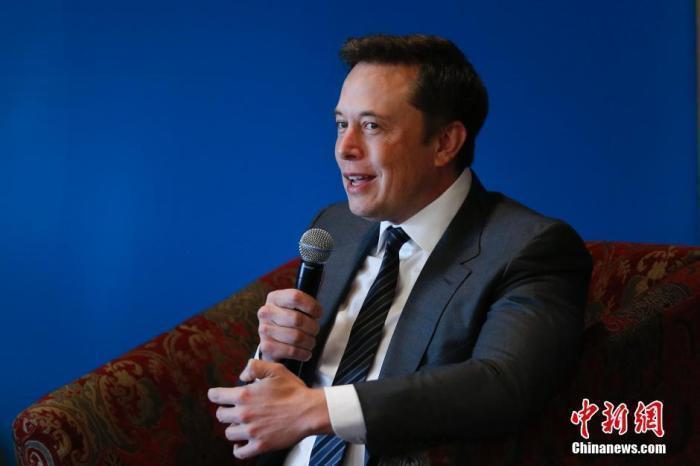
马斯克宣布:重返月球!
国芯网· 2026-02-09 12:43
Group 1 - The core viewpoint is that SpaceX is shifting its focus from Mars colonization to building a self-sustaining city on the Moon, aiming to achieve this within a decade, while Mars colonization is projected to take over 20 years [2][7]. - The time cost for Mars missions is significant, with launch windows occurring every 26 months and a travel time of 6 months, whereas lunar missions can be launched every 10 days with a travel time of 2 days [7][8]. - Policy pressure from the U.S. government, specifically the Trump administration's goal for astronauts to return to the Moon by 2028, necessitates that SpaceX, as a key contractor for NASA, prioritize lunar missions [8]. - The commercial reality indicates that lunar missions can generate revenue more quickly than Mars missions, as they can secure contracts from NASA, mine helium-3 for future nuclear fusion, and lease lunar land for commercial ventures [8].

马斯克又改口:先造月球城市 再登陆火星
Xin Lang Cai Jing· 2026-02-09 08:56
Core Viewpoint - SpaceX is shifting its focus towards building a "self-sustaining city" on the Moon, which could be realized in less than a decade, while still planning to initiate its long-term Mars colonization project within the next 5 to 7 years [1] Group 1: Lunar Focus - SpaceX aims to prioritize lunar landings, with a target for an unmanned lunar mission by March 2027 [1] - The company believes that constructing a city on the Moon can be achieved more rapidly than on Mars due to more frequent launch opportunities, with a launch window to the Moon every 10 days compared to every 26 months for Mars [1] Group 2: Mars Plans - Despite the shift in focus to the Moon, SpaceX still intends to pursue its Mars colonization plans, with an initial goal of launching an unmanned spacecraft to Mars by the end of 2026 [1] - Elon Musk previously expressed confidence in achieving a manned landing on Mars by the end of 2026, contingent on favorable conditions [1]