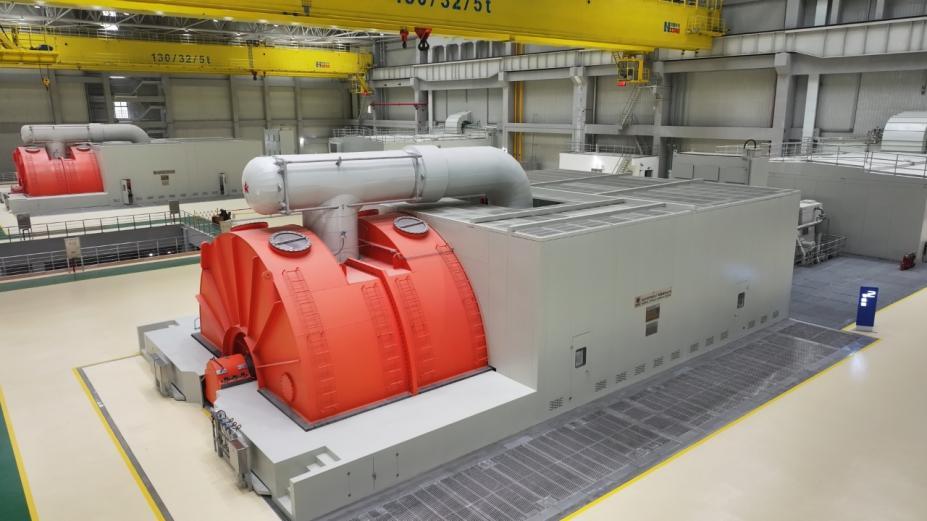
燃气—蒸汽联合循环机组

Search documents
济南,重塑城市的“绿色DNA”
Feng Huang Wang Cai Jing· 2026-01-27 00:16
其实只要留心观察不难发现,如今"绿色低碳发展"的力量已经悄然融入到我们的日常生活中。从顶层设 计到基层实践,从工业转型到市民生活,一场关于绿色发展的深刻变革,正在悄然发生。 能源"绿色含量"稳步提升 清晨6点,济南西站南广场,一辆纯电动公交车缓缓驶入站台。司机按下按钮,车顶的充电弓自动升 起,与站台顶棚的充电装置精准对接。"现在充电10分钟能跑一圈,比燃油车安静多了,也干净。" 这是济南公交系统电动化改造的一个日常场景。截至2025年底,济南已投运新能源公交车超过4000辆, 建成充电站200余座,公交电动化率超过90%。 变化始于2020年。那一年,济南在全国率先提出建设"无废城市"试点,随后又成为国家首批碳达峰试点 城市,再到今年济南两会上,低碳发展被写入"十五五"规划纲要和政府工作报告,成为城市发展的核心 战略之一。 在章丘区,华电章丘发电有限公司的厂区内,一座崭新的燃气—蒸汽联合循环机组正在稳定运行。与传 统燃煤机组不同,这座机组几乎看不到烟囱冒烟,厂区绿化率超过40%,更像一座公园。 "我们去年完成了两台66万千瓦超超临界燃煤机组的超低排放改造,现在正在推进燃气机组建设。"公司 环保负责人指着远处的 ...
国内单机容量最大效率最高燃气电厂全面投产
Ke Ji Ri Bao· 2026-01-20 11:38
Core Viewpoint - The Zhejiang Anji Power Plant has officially commenced operation, featuring the largest single-unit capacity and highest efficiency gas power plant in China, marking a significant milestone in the country's energy sector [1][3]. Group 1: Plant Specifications and Capacity - The total installed capacity of the Zhejiang Anji Power Plant is 1.686 million kilowatts, equipped with two 843,000-kilowatt gas-steam combined cycle units [3]. - The plant utilizes advanced 9H gas turbine technology, achieving a combined cycle efficiency of 64.15% [3]. - The annual electricity generation capacity is projected to reach 7 billion kilowatt-hours, sufficient to meet the annual electricity needs of approximately 6 million residents [3]. Group 2: Environmental and Efficiency Benefits - The plant is expected to reduce carbon dioxide emissions by approximately 1.86 million tons annually and save about 680,000 tons of standard coal [3]. - The combustion temperature reaches 1,600°C, resulting in a 60% reduction in carbon dioxide emissions per kilowatt-hour compared to a million-kilowatt coal-fired power plant [3]. - The average concentration of oxides emitted is 22.2 milligrams per standard cubic meter, which is over 50% lower than national emission standards [3]. Group 3: Technological Advancements - The plant has achieved a rapid startup time of 90 minutes from a hot state to full load operation, enhancing its flexibility to integrate with renewable energy sources like wind and solar [3]. - A national-level hydrogen blending test platform has been established to promote the compatibility of various fuels, including hydrogen, ammonia, and methanol [4]. - The project aims to overcome technical barriers in hydrogen co-firing technology, which is crucial for the power industry’s transition to low-carbon and zero-carbon solutions [4].