
甲骨文云基础设施(OCI)

Search documents
美股异动 | 计划再融资500亿美元扩建云基础设施 甲骨文(ORCL.US)盘前涨近4%
Zhi Tong Cai Jing· 2026-02-02 14:05
Core Viewpoint - Oracle plans to raise $45 billion to $50 billion by 2026 through a combination of debt and equity issuance to expand its cloud infrastructure capacity [1] Group 1: Financing Plans - Oracle aims to raise approximately half of the funds through equity-linked securities and common stock, including mandatory convertible preferred stock [1] - The company will utilize an "at-the-market" (ATM) stock program with a maximum size of $20 billion for financing [1] - The remaining funds will be raised through a one-time bond issuance in early 2026 [1] Group 2: Customer Demand - The financing is intended to meet the signed demand from Oracle's largest cloud infrastructure (OCI) customers, which include AMD, Meta, NVIDIA, OpenAI, TikTok, and xAI [1]

豪赌AI再加码!甲骨文拟筹500亿美元扩建云基础设施
美股IPO· 2026-02-02 07:37
Core Viewpoint - Oracle plans to raise $45 billion to $50 billion by 2026 through a combination of debt and equity issuance to expand its cloud infrastructure capacity, aiming to meet the signed demand from major clients like AMD, Meta, NVIDIA, OpenAI, TikTok, and xAI [1] Group 1 - Oracle intends to raise about half of the funds through equity-linked securities and common stock, including mandatory convertible preferred stock, and plans to utilize an "at-the-market" stock program of up to $20 billion [3] - The remaining funds will be raised through a one-time bond issuance in early 2026, following a significant $18 billion debt issuance in 2025 [3] - A key component of Oracle's cloud investment is a contract with OpenAI, which has committed to spending approximately $300 billion to rent servers from Oracle [3][4] Group 2 - Concerns are growing among investors regarding the return on large AI-related investments made by tech companies, including Oracle, as the company's stock has dropped over 50% since reaching an all-time high on September 10, resulting in a market cap loss of over $460 billion [4] - The rapid decline in Oracle's stock price has been exacerbated by worries about the AI outlook, with major tech firms investing billions in data centers without clear paths to investment returns [4] - TD Cowen reports that Oracle is facing severe funding challenges for its AI data center expansion and is considering significant layoffs of 20,000 to 30,000 employees, which could release $8 billion to $10 billion in cash flow [4][5] Group 3 - Oracle's capital expenditure burden from the agreement with OpenAI is estimated at $156 billion, leading to an increase in expected capital expenditures for 2026 by $15 billion to $50 billion [5] - In addition to the OpenAI project, Oracle has agreements with Meta and NVIDIA, with total investments in data centers reaching $523 billion, requiring the procurement of approximately 3 million GPUs [5] - Several U.S. banks have ceased lending for Oracle's data center projects, raising doubts about the company's ability to secure funding from other major banks, while Asian banks appear more optimistic [5]


豪赌AI再加码!甲骨文(ORCL.US)拟筹500亿美元扩建云基础设施
智通财经网· 2026-02-02 02:01
Core Viewpoint - Oracle plans to raise $45 billion to $50 billion by 2026 through a combination of debt and equity issuance to expand its cloud infrastructure capacity, driven by demand from major clients like AMD, Meta, NVIDIA, OpenAI, TikTok, and xAI [1] Group 1: Financing Plans - Oracle intends to raise approximately half of the funds through equity-linked securities and common stock, including mandatory convertible preferred stock, and a $20 billion At-the-Market (ATM) stock program [1] - The remaining funds will be raised through a one-time bond issuance in early 2026, following a $18 billion debt issuance in 2025, which was one of the largest corporate bond issues that year [1] Group 2: Client Contracts and Financial Pressure - A significant part of Oracle's cloud investment is tied to a contract with OpenAI, which has committed to spending around $300 billion on server rentals [1] - Concerns are rising regarding the financial pressure from substantial capital expenditures without a clear return timeline, especially since OpenAI is currently unprofitable [1][2] Group 3: Market Reactions and Stock Performance - Oracle's stock has dropped over 50% since reaching an all-time high on September 10, resulting in a market capitalization loss of more than $460 billion [2] - Investor skepticism about the returns on AI-related investments has intensified, particularly as major tech companies continue to invest heavily in data centers without clear paths to profitability [2] Group 4: Operational Challenges - TD Cowen reports that Oracle is facing severe funding challenges for its AI data center expansion, leading to considerations of significant layoffs and potential divestitures, including the sale of its healthcare software division Cerner, acquired for $28.3 billion in 2022 [2] - Oracle's capital expenditure related to the OpenAI agreement is estimated at $156 billion, raising its expected capital expenditure for 2026 to $50 billion [3] Group 5: Banking Support and Credit Concerns - Several U.S. banks have ceased lending for Oracle's data center projects, raising doubts about the company's ability to secure funding from other major banks [3] - Concerns regarding Oracle's capacity to finance its expansion have led to widening credit default swap (CDS) spreads and pressure on its stock and bond prices [3]
甲骨文(ORCL.US)雄心目标获分析师正面评价,但客户集中风险仍受关注
Zhi Tong Cai Jing· 2025-10-20 11:39
Core Insights - Oracle Corporation (ORCL.US) recently held an "Analyst Day" event, unveiling ambitious long-term financial goals driven by the rising demand for AI applications and infrastructure, which received positive evaluations from analysts [1][2] - The company set a target for fiscal year 2030 (FY30) total revenue of $225 billion, corresponding to a five-year compound annual growth rate (CAGR) of 31%, and a diluted earnings per share (EPS) target of $21, with a five-year CAGR of 28% [1][2] - The Oracle Cloud Infrastructure (OCI) business is expected to be the core growth engine, with revenue targets raised from $144 billion to $166 billion, accounting for nearly 75% of total revenue [1][2] Financial Projections - Piper Sandler analysts noted that the updated long-term targets include a revenue goal of $225 billion for FY30, indicating a CAGR of 31%, higher than the previous estimate of around 20% [2] - OCI's expected five-year operating cash flow CAGR is projected to reach 75%, driving its FY30 revenue to $166 billion, an increase from the previous estimate of $144 billion [2] - Goldman Sachs raised its 12-month target price for Oracle from $310 to $320, maintaining a "neutral" rating, citing attractive long-term growth targets but highlighting execution uncertainties and financial risks [5] Cost Structure and Profitability - Oracle's joint CEO Clay Magouyrk provided details on the gross margin for AI data center GPU sales, indicating that costs are divided into two parts: site, data center, and power costs (35% of total costs) and compute, network, and storage costs (65% of total costs) [1][6] - The overall gross margin for these services is approximately 35%, which includes initial startup costs [1][6] Customer Base and Growth Drivers - Oracle achieved a breakthrough in Q2 FY25 by adding four non-OpenAI customers, including Meta, with a total contract value (TCV) of $65 billion, reducing reliance on a single customer [6] - OCI's four segments showed high growth: AI Infrastructure (117% YoY growth, 30-40% gross margin), Distributed Cloud (77% YoY growth, 40-60% gross margin), Cloud Natives (49% YoY growth, 40-60% gross margin), and Enterprise (33% YoY growth, 65-80% gross margin) [6] Strategic Initiatives - Oracle has deployed over 600 AI Agents, with 2,400 customers utilizing industry AI Agents within 18 months, indicating rapid deployment and minimal need for professional services [7] - The company plans to extend its Universal Credits model from OCI to the application layer, further lowering barriers for AI application adoption [7] Risks and Challenges - Analyst Kevin Anthony D. Arroyo highlighted risks associated with Oracle's heavy reliance on OpenAI, with approximately two-thirds of its nearly $500 billion in unfulfilled orders linked to the startup [3][4] - The five-year $300 billion infrastructure leasing agreement with OpenAI raises concerns about payment capabilities and sustainability, as OpenAI has yet to achieve profitability [4][8] - Goldman Sachs identified four core risks: execution risk, customer concentration risk, financial pressure from high capital expenditures, and market competition risk [8]
甲骨文(ORCL.US)涨逾4% 云基础设施营收将迎来快速增长
Zhi Tong Cai Jing· 2025-09-15 14:15
Core Viewpoint - Oracle's cloud infrastructure (OCI) revenue is projected to experience significant growth, with expectations of reaching $10.2 billion in FY2025, $32 billion in FY2026, and exceeding $144 billion by FY2030, reflecting a compound annual growth rate of nearly 70% [1] Group 1: Financial Performance - Oracle's remaining performance obligations (RPO), a key metric for measuring "contracted but not yet delivered revenue," surged 359% year-over-year to $455 billion, surpassing market expectations [1] - Management forecasts that RPO will exceed $500 billion within a few months [1] Group 2: Market Impact - The rise of AI is not only transforming Oracle but also reshaping the growth dynamics of the entire technology industry [1] - UBS believes that Oracle's recent stock increase is not coincidental, as several key data points in the earnings report validate the explosive potential of its AI business [1]
美股异动 | 甲骨文(ORCL.US)涨逾4% 云基础设施营收将迎来快速增长
智通财经网· 2025-09-15 14:13
Core Insights - Oracle's stock rose over 4% to $304.40, driven by strong growth projections for its cloud infrastructure (OCI) revenue [1] - OCI revenue is expected to reach $10.2 billion in FY2025, $32 billion in FY2026, and exceed $144 billion by FY2030, indicating a compound annual growth rate of nearly 70% [1] - The remaining performance obligations (RPO), a key metric for "contracted but not yet delivered revenue," surged 359% year-over-year to $455 billion, significantly surpassing market expectations [1] Financial Performance - The projected OCI revenue growth reflects a pivotal shift in Oracle's business model, primarily fueled by advancements in AI technology [1] - Management anticipates RPO will exceed $500 billion within months, highlighting the robust demand for Oracle's services [1] Industry Impact - AI is not only transforming Oracle but also reshaping the growth dynamics of the entire technology sector [1] - UBS suggests that Oracle's recent stock performance is not coincidental, as key financial metrics in the earnings report validate the explosive potential of its AI business [1]
瑞银电话会议解读甲骨文(ORCL.US)财报:藏不住的AI算力真相,大涨绝非偶然
智通财经网· 2025-09-15 13:13
Core Viewpoint - Oracle's stock surged 36% following its Q1 FY2026 earnings report, driven by significant growth in its cloud infrastructure business and the transformative impact of AI on the tech industry [1] Group 1: Financial Highlights - Cloud business is on a clear growth trajectory, projected to increase from $10.2 billion in FY2025 to $32 billion in FY2026, and expected to exceed $144 billion by FY2030, with a compound annual growth rate of nearly 70% [2] - Oracle signed four multi-billion dollar contracts with three clients, including OpenAI, indicating strong demand and a concentration of high-value contracts [3] - Remaining performance obligations (RPO) surged 359% year-over-year to $455 billion, significantly exceeding market expectations, with projections to surpass $500 billion in the coming months [4] Group 2: Competitive Advantages - Oracle's growth is attributed to three core competitive strengths: 1. Timing the industry transformation, with a focus on the larger potential of inference applications over training [5] 2. Unique product barriers, including modular design and rapid data center deployment capabilities, enhancing responsiveness during AI compute shortages [6] 3. Control over core data, leveraging autonomous database security and proprietary data integration into public models, establishing a "data entry" advantage in enterprise AI [7] Group 3: Industry Insights - The earnings report reveals broader trends in the AI industry, with three key insights for investors: 1. AI transformation is in its early stages, with future growth driven by the scaling of inference applications, enterprise and sovereign AI adoption, and breakthroughs in intelligent agent AI [8][9] 2. A persistent compute gap exists, with Oracle planning to invest $35 billion in capital expenditures for FY2026, indicating strong demand for compute resources and related chip growth [10] 3. Investment strategies should encompass a "full-stack" approach across three layers: enabling layer (hardware and infrastructure), intelligent layer (models and cloud services), and application layer (AI services and applications) [11]
全球首富短暂易主 背后是AI技术的红利兑现
Zhong Guo Xin Wen Wang· 2025-09-11 07:46
Group 1 - Larry Ellison briefly surpassed Elon Musk to become the world's richest person, with a net worth of $393 billion due to a surge in Oracle's stock price [1][2] - Oracle's stock price increased by 36% on October 10, marking its largest single-day percentage gain since 1992, resulting in a market capitalization increase of $244 billion [2] - Ellison's wealth rose by $89 billion in a single day, setting a record for the largest one-day increase in personal wealth [2] Group 2 - The surge in Ellison's wealth is attributed to the AI technology boom and significant contracts, including a five-year deal with OpenAI worth $300 billion for computing power [4] - Oracle's revenue from partnerships with major companies like Amazon, Alphabet, and Microsoft has increased over 16 times in the first quarter of this year [4] - Oracle's stock has risen by 45% this year, while Tesla's stock has declined by approximately 14%, contributing to the shift in wealth rankings [4]

全球首富短暂易主,背后是AI技术的红利兑现
Zhong Guo Xin Wen Wang· 2025-09-11 03:11
Group 1 - Larry Ellison briefly surpassed Elon Musk to become the world's richest person, with a net worth of $393 billion due to a significant rise in Oracle's stock price [2][3] - Oracle's stock surged by 36% on September 10, marking its largest single-day percentage increase since 1992, resulting in a market value increase of $244 billion [3] - Ellison's wealth increased by $89 billion in a single day, setting a record for the largest daily wealth increase [3] Group 2 - The surge in Ellison's wealth is attributed to the growing demand for AI technology and substantial contracts, including a five-year deal with OpenAI worth $300 billion for computing power [4][6] - Oracle's revenue from partnerships with major companies like Amazon, Alphabet, and Microsoft has increased over 16 times in the first quarter of this year [6] - Oracle's stock has risen by 45% this year, while Tesla's stock has declined by approximately 14%, contributing to the shift in wealth rankings [6]
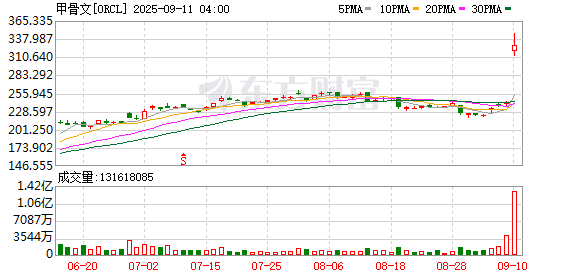
高达4550亿美元合同储备引爆股价 甲骨文(ORCL.US)暴涨超34%
Zhi Tong Cai Jing· 2025-09-10 13:53
Core Viewpoint - Oracle's stock surged over 34%, marking its largest single-day increase since 1999, with a market value increase of approximately $200 billion, driven by a significant rise in its Remaining Performance Obligations (RPO) [1] Group 1: Financial Performance - Oracle's RPO experienced a remarkable year-over-year increase of 359%, reaching $455 billion, indicating strong future revenue potential [1] - Jefferies analyst Brent Thill's team noted that the RPO performance in Q1 exceeded market expectations, reinforcing the trend of accelerating business growth for Oracle [1] Group 2: Analyst Insights - Kirk Materne's analyst team highlighted that while Oracle's overall Q1 performance met expectations, the accelerated growth in Oracle Cloud Infrastructure (OCI) backlog was the key highlight of the earnings report [1] - The report supports Oracle's previous assertions regarding accelerated growth in future revenue and earnings per share [1] Group 3: Target Price Adjustment - Jefferies maintained a "Buy" rating on Oracle and raised its target price from $270 to $360, reflecting confidence in the company's growth trajectory [1]