
电机驱动产品

Search documents
涨!涨!涨!半导体行业掀涨价风暴
Xin Lang Cai Jing· 2026-02-11 10:16
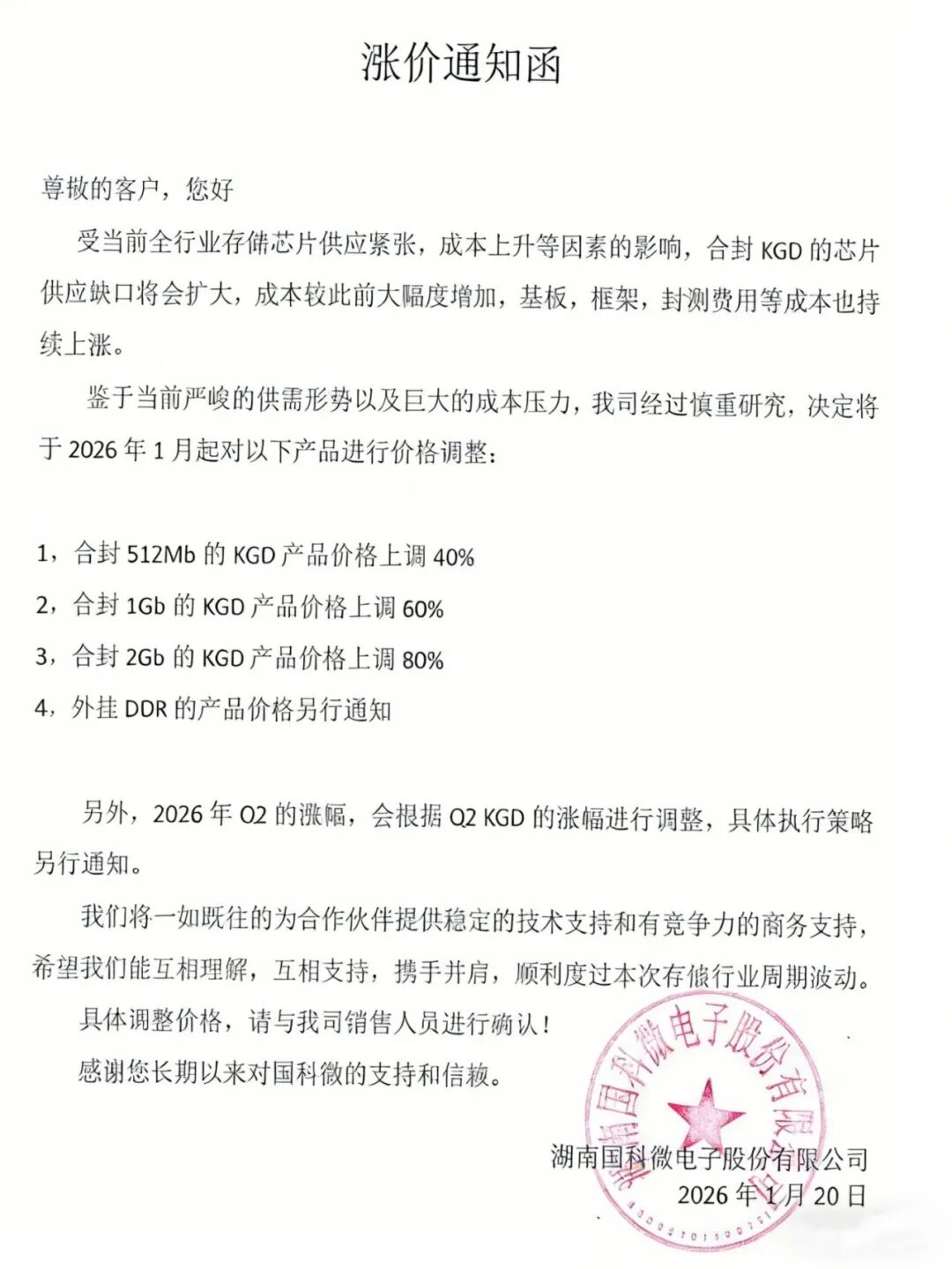
Core Viewpoint - The global semiconductor industry is experiencing a new wave of price increases across the entire supply chain, driven by surging AI demand and rising raw material costs [1][3][61]. Group 1: Price Increases in Domestic Semiconductor Companies - Over 20 semiconductor companies have officially announced price increases [2][62]. - Domestic chip manufacturers are significantly raising prices, with increases as high as 80% for certain products [4][63]. - Guokewai announced price hikes for its KGD storage products, with increases of 40% to 80% [6][66]. - Zhongwei Semiconductor is raising prices for MCU and NOR Flash products by 15% to 50% due to supply chain pressures [9][73]. - Biyiwei has also announced price increases across its entire product line, citing rising raw material costs [17][76]. Group 2: Price Increases in International Semiconductor Companies - International semiconductor giants are also raising prices, with ADI increasing prices by 15% to 30% starting February 1, 2026 [21][81]. - Infineon plans to raise prices for power switches and IC products due to increased demand from AI data centers [24][83]. - Texas Instruments is expected to raise prices by over 30% across nearly all categories due to rising costs [21][81]. Group 3: Price Increases in Wafer Foundry and Packaging - Wafer foundries are increasing prices, with TSMC raising advanced process prices by 3% to 10% [25][85]. - Packaging and testing services are seeing price increases of up to 30%, driven by high demand and capacity constraints [27][86]. Group 4: Impact of Raw Material Costs - The prices of precious metals like gold, silver, and copper are rising, significantly impacting chip manufacturing costs [57][116]. - The increase in raw material costs is leading to a ripple effect across the semiconductor supply chain, prompting many companies to raise their product prices [57][116]. Group 5: Effects on End Markets - The price increases in storage chips are affecting end markets, with PC manufacturers like Dell and Lenovo planning price hikes of 10% to 30% [59][118]. - In the smartphone sector, rising storage costs are pressuring new product pricing, particularly for low-end models [59][118]. - The automotive electronics sector is also feeling the impact, with companies like Xiaomi and NIO reporting cost pressures due to rising semiconductor prices [59][119].


600877 3分钟封板
Shang Hai Zheng Quan Bao· 2025-11-27 05:05
Market Overview - On November 27, A-shares saw a collective rise in the three major indices, with the Shanghai Composite Index up by 0.49%, the Shenzhen Component Index up by 0.38%, and the ChiNext Index up by 0.56%. The total trading volume in the Shanghai and Shenzhen markets reached 1.097 trillion yuan, a decrease of 46.9 billion yuan compared to the previous trading day, with over 3,300 stocks rising across the market [2]. Consumer Electronics Sector - The consumer electronics sector showed strong performance, with several stocks such as Spring Autumn Electronics hitting the daily limit [5]. - Spring Autumn Electronics announced plans to acquire all shares of Asetek A/S for a total consideration of up to 547 million Danish kroner (approximately 598 million yuan), aiming to acquire at least 90% of the shares [7]. Semiconductor Sector - The semiconductor sector continued to rise, with Electric Science Chip (600877) hitting the daily limit within three minutes. Other stocks like Lixin Micro and Xidi Micro rose over 10% [4]. - Electric Science Chip reported increased market pressure in the consumer electronics and security electronics markets, leading to delayed customer payments and significant price reductions in the industry, which impacted revenue and net profit. The company is actively expanding into key markets such as satellite communication, industrial control, and smart connected vehicles to drive stable business development [4]. Retail Sector - The retail sector remained active, with Maoye Commercial achieving three consecutive daily limits, and other stocks like Guangbai Co. and Dongbai Group also seeing gains [9]. - A recent government initiative aims to enhance the adaptability of consumer goods supply and demand, targeting a significant optimization of the supply structure by 2027, with the goal of creating three trillion-level consumption fields and ten hundred-billion-level consumption hotspots [10].


电科芯片三季度业绩大幅下滑拓展重点市场寻求增量
Xin Lang Cai Jing· 2025-10-30 21:06
Core Viewpoint - The company reported a significant decline in both revenue and net profit for Q3 2025, attributing the downturn to intensified competition in the consumer electronics market and aggressive price reductions to maintain market share [1]. Financial Performance - For Q3 2025, the company achieved a revenue of 196 million yuan, a year-on-year decrease of 17.02% [1]. - The net profit attributable to shareholders was 1.51 million yuan, reflecting a substantial year-on-year decline of 92.67% [1]. - The net profit after deducting non-recurring items was -4.1 million yuan [1]. - Cumulatively, from January to September 2025, the company reported a total revenue of 644 million yuan, down 11.30% year-on-year [1]. - The net profit attributable to shareholders for the first nine months was 9.93 million yuan, a decrease of 83.15% year-on-year [1]. - The net profit after deducting non-recurring items was -9.60 million yuan, indicating a shift from profit to loss [1]. Market Strategy - In response to the challenging market conditions, the company has actively sought to expand into key markets to drive growth [1]. - The company has introduced its Beidou short message SoC chips to the top five domestic smartphone manufacturers [1]. - The broadband/narrowband satellite communication SoC chips have been successfully integrated into products for a major smartphone client [1].